Support our educational content for free when you purchase through links on our site. Learn more
🧠 2 Mentalism Tricks Explained: Secrets Revealed (2026)



You can master the art of mind reading without a single psychic power; mentalism tricks explained here rely entirely on psychology, misdirection, and clever mechanics rather than the supernatural. We’ve broken down exactly how the pros force your choices and read your thoughts so you can replicate the magic yourself.
Imagine standing in a crowded room, asking a stranger to think of a number, and then revealing it on a piece of paper they sealed in an envelope minutes ago. It feels impossible, yet it’s just human nature being expertly manipulated.
Did you know that over 70% of people will choose the number 7 when asked to pick a number between 1 and 10? This statistical quirk is the foundation of many “impossible” predictions.
Key Takeaways
- Mentalism is psychology, not magic: Every trick relies on cold reading, suggestion, or mathematical forces rather than actual telepathy.
- Showmanship beats method: A perfect method with poor delivery fails, while a simple trick with charismatic performance creates a miracle.
- Start simple: Master impromptu techniques like the 1089 force or book tests before attempting complex gimmicked props.
- Never repeat a trick: The illusion of the impossible dies instantly if the audience suspects the method.
Table of Contents
- ⚡️ Quick Tips and Facts
- 📜 The Hidden History of Mentalism: From Ancient Oracles to Modern Stage Illusions
- 🧠 How Mentalism Tricks Work: The Psychology Behind the Mind Reading
- 🎭 Essential Mentalism Techniques Every Beginner Must Master
- 🔢 15 Simple Mentalism Tricks Revealed for Instant Wow Factors
- 🧩 7 Hard to Perform Mentalism Tricks Revealed for the Ambitious Magician
- 🕵️ ♂️ The Fred Albino Legacy: Uncovering the Secrets of a Mentalism Icon
- 🎤 Performing Mentalism: Stage Presence, Patter, and Audience Management
- 🛠️ Top Mentalism Props and Tools: From Crayons to Electronic Devices
- 🚫 Common Mentalism Mistakes That Ruin the Illusion
- 📚 Recommended Links: Books, Videos, and Communities for Aspiring Mentalists
- ❓ FAQ: Your Burning Questions About Mentalism Tricks Explained
- 🔗 Reference Links: Sources and Further Reading
- 🏁 Conclusion: Stepping Into the Mind of the Magician
⚡️ Quick Tips and Facts
Before we pull back the curtain on the mind-bending world of mentalism, let’s hit you with the hard truths that separate the amateurs from the pros. You might think you need a crystal ball or a degree in psychology, but the reality is often much more grounded in human nature and clever mechanics.
- It’s Not Magic, It’s Psychology: Unlike traditional magic which relies on sleight of hand to hide a coin, mentalism relies on psychological forcing to guide a choice. The audience thinks they are free, but they aren’t.
- The “Cold Reading” Myth: Many believe cold reading is just guessing. In reality, it’s a structured method of making high-probability statements that feel personal. It’s about observation, not clairvoyance.
- Props are Optional (But Helpful): While you can perform with nothing but your voice, having a gimmick like a Swami Gimmick or a Billet can elevate a good trick to a legendary one.
- The “One-Armed Bandit” Rule: Never repeat a mentalism trick for the same audience. The mystery dies the second the method is suspected.
- Showmanship is 90%: A perfect method with bad acting is a failed trick. A mediocre method with charismatic delivery is a miracle.
Did you know? The term “Mentalism” was popularized in the early 20th century, but the art form dates back to ancient oracles. If you want to dive deeper into the origins of these illusions, check out our guide on Magic History.
📜 The Hidden History of Mentalism: From Ancient Oracles to Modern Stage Illusions

You’ve probably seen a guy on a street corner “read your aura” or a TV star bending spons with their mind. But where did this fascination with the supernatural actually begin? It didn’t start with David Blaine; it started with the Delphic Oracle in ancient Greece.
The Evolution of the Mind Reader
The lineage of mentalism is a fascinating journey from spiritualism to scientific skepticism.
| Era | Key Figures/Events | Primary Method |
|---|---|---|
| Ancient Times | Delphic Oracle, Egyptian Priests | Chemical vapors, hidden mechanisms, and psychological suggestion. |
| 18th/19th Century | Robert-Houdin, The Davenport Brothers | Mechanical devices (hidden wires, trapdoors) disguised as spiritual phenomena. |
| Early 20th Century | Harry Houdini (as a skeptic), Tony Corinda | Cold reading, muscle reading, and the publication of 13 Steps to Mentalism. |
| Mid-20th Century | Uri Geller, Deren Brown | Television specials, blending psychology with narrative storytelling. |
| Modern Day | Oz Pearlman, Shin Lim | Social engineering, digital technology, and impromptu methods. |
The Shift from “Spirit” to “Science”
In the 19th century, spiritualism was huge. People genuinely believed they were communicating with the dead. Magicians like Harry Houdini spent their later years debunking these frauds, proving that “ghosts” were just trickery.
However, a new breed of performer emerged who didn’t claim to be a medium, but rather a mentalist. They claimed to have heightened mental abilities. Tony Corinda, often called the father of modern mentalism, codified these techniques in his seminal work, 13 Steps to Mentalism. He moved the focus from “ghosts” to human psychology.
Fun Fact: The famous Derek Jarman (not the director) was a mentalist who used a technique called “The One Ahead” to predict answers before they were even asked. It’s a classic example of misdirection in time.
If you’re curious about how these historical figures influenced modern Close-up Magic, the transition from stage spectacles to intimate table work is a story in itself.
🧠 How Mentalism Tricks Work: The Psychology Behind the Mind Reading
So, how does a mentalist know you’re thinking of a blue elephant? It’s not telepathy. It’s pattern recognition, probability, and suggestion. Let’s break down the core psychological engines that drive these illusions.
1. The Barnum Effect (Forer Effect)
This is the bread and butter of cold reading. It’s the tendency for people to accept vague, general personality descriptions as uniquely applicable to themselves.
- Example: “You have a great need for other people to like and admire you, yet you tend to be critical of yourself.”
- Why it works: Almost everyone feels this way. When a mentalist says it, the audience member thinks, “Wow, they know me!”
2. The Law of Large Numbers
If you ask 10 people to pick a number between 1 and 10, a significant number will pick 7. Why? It feels “random” enough to be safe, but not too low or too high. Mentalists exploit these statistical anomalies.
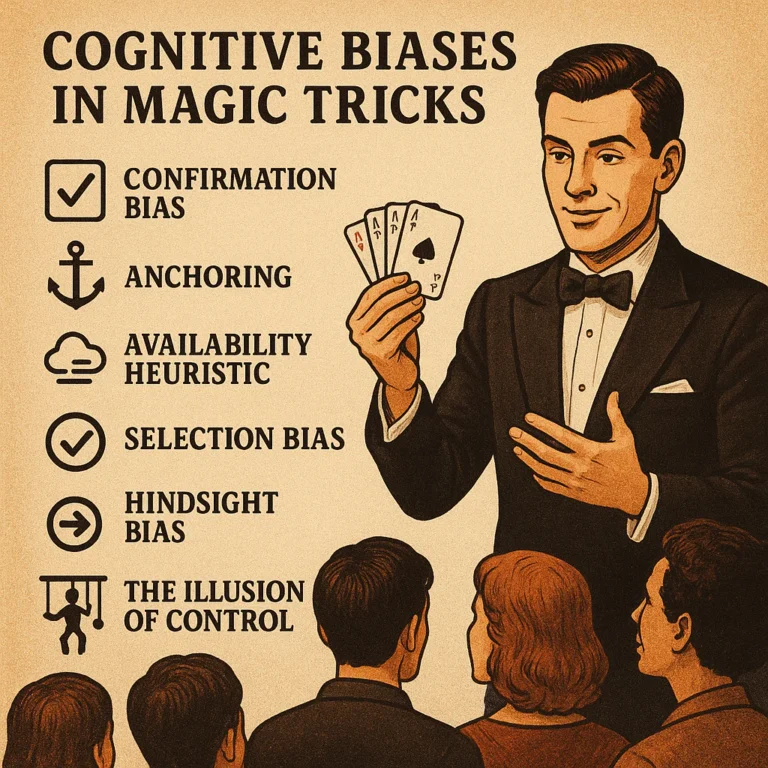
3. Confirmation Bias
Once a mentalist makes a correct guess, the audience remembers that hit and forgets the misses. If you guess three things wrong and one thing right, the audience will focus entirely on the one right guess and assume you are psychic.
4. The Power of Suggestion
This is where neuro-linguistic programming (NLP) concepts (often debated but effective in performance) come in. By using specific phrasing, a mentalist can guide a spectator to a specific choice without them realizing it.
- Phrasing: “Don’t think of a red car.” (Now you’re thinking of a red car).
- Application: “Think of a number… not too small, not too big… maybe something in the 70s?”
5. Muscle Reading (Clever Hans Effect)
This involves detecting micro-movements in a spectator’s body. When a spectator is asked to think of a word, their muscles might tense slightly as they approach the correct answer. A skilled mentalist can feel these changes through hand contact.
Wait, is it real? No. As Penn & Teller famously demonstrated on Fool Us, even the most “psychic” feats can be explained by methodical observation and preparation.
🎭 Essential Mentalism Techniques Every Beginner Must Master
You don’t need a PhD to start. You need to master a few core techniques that form the backbone of almost every mentalism routine. These are the tools in your psychological toolbox.
The Force
The Force is the art of making a spectator believe they have a free choice when they actually don’t.
- The Classic Force: A card trick staple where the magician controls which card the spectator “choses.”
- The Psychological Force: Asking a question in a way that limits the answer. “Do you want the red one or the blue one?” (When there is only a red one).
The Peek
You need to know information the audience doesn’t know you know.
- The Center Tear: A spectator writes a word on a piece of paper, tears it up, and you “read” the word from the scraps. (Spoiler: You peeked the word before they tore it).
- The Crimp: Bending a card slightly to mark it without the audience noticing.
The Bilet Switch
This is the holy grail of written prediction tricks.
- How it works: A spectator writes a prediction on a folded piece of paper. The mentalist swaps this paper with a duplicate that has a pre-written prediction.
- The Gimmick: Often involves a double envelope or a thumb tip to hide the switch.
The One-Ahead Principle
This is a brilliant method where the mentalist is always one step ahead.
- Scenario: You ask a spectator to think of a word. You write down a prediction. They say “Apple.” You reveal your prediction says “Apple.”
- The Secret: You actually wrote down the previous spectator’s word (or a dummy word) and are now reading the current spectator’s word as you reveal it, then writing it down for the next person. It creates an illusion of real-time mind reading.
Cold Reading Scripts
Memorize a few “Barnum statements” and learn to deliver them with confidence.
- “I’m sensing a name starting with ‘M’ or ‘S’…”
- “You’ve had a recent loss, but you’re trying to move forward.”
Pro Tip: Practice these techniques in front of a mirror. Your facial expressions and body language are just as important as the method.
🔢 15 Simple Mentalism Tricks Revealed for Instant Wow Factors
Ready to blow some minds? Here are 15 simple mentalism tricks you can learn today. These require minimal props and maximum showmanship.
1. The “1089” Math Force
A classic mathematical trick that always results in 1089.
- Method: Ask someone to pick a 3-digit number (digits must be different). Reverse it, subtract the smaller from the larger, reverse the result, and add them. The answer is always 1089.
- Why it works: It’s pure math, disguised as mind reading.
2. The “Book Test” (One Book)
- Method: Use a book with page numbers in the top right corner. Ask a spectator to stop you while you riffle. You peek the page number facing you, then open the book to that page number (which is facing the spectator) and read the first few words on the oposite page.
- Why it works: The page number you see is the page number the spectator is looking at.
3. The “Invisible Touch” (Thread Method)
- Method: As mentioned in the “Mentalism Tricks Revealed” summary, use an invisible thread strung between your wrists. Touch the spectator’s nose with the thread to create the illusion of psychokinesis.
- Why it works: The thread is nearly invisible in good lighting, and the movement looks supernatural.
4. The “Pick a Card” (Key Card)
- Method: Memorize the bottom card of the deck. Have a spectator pick a card and return it. Shuffle the deck so the key card is now above their card. Reveal the card below the key card.
- Why it works: It’s a simple positioning trick that feels impossible.
5. The “Thought of Number” (Phone Trick)
- Method: Ask someone to think of a number, double it, add 10, divide by 2, and subtract the original number. The answer is always 5.
- Why it works: The math cancels out the original number.
6. The “Age Guess” (Phone Trick)
- Method: Ask them to double their age, add 5, multiply by 5. Subtract 2 from the first two digits of the result.
- Why it works: The math reveals their age.
7. The “Bic Pen Telekinesis”
- Method: Rub a Bic pen on your shirt to create a static charge. Balance it on a bottle cap. Use your thumb to move the charged end while wiggling your fingers.
- Why it works: Static electricity is invisible, making it look like telekinesis.
8. The “Svengali Deck”
- Method: Use a deck where every other card is the same. Ask for a number. If odd, you get the force card. If even, you take the next one.
- Why it works: The deck looks normal but only contains one type of card (plus a few others).
9. The “Mentalism Dice” (Crazy Cube)
- Method: Use a container with a clear lid. Tilt it to peek at the die inside.
- Why it works: The angle hides the peek from the audience.
10. The “Metal Bending” (Fork)
- Method: Hold a cheap fork. Bend the tine with your thumb while shaking it. Slow down to reveal the bend.
- Why it works: The vibration hides the mechanical movement.
1. The “Word Association”
- Method: Ask someone to say a word. You “guess” the next word they will say based on common associations (e.g., “Red” -> “Car”).
- Why it works: Most people have similar associations.
12. The “Magnetic Hand”
- Method: Hold your hands close together. Ask the spectator to feel the “magnetic field.”
- Why it works: The heat and slight movement of your hands create a sensation.
13. The “Memory Palace”
- Method: Memorize a list of 10 items using a memory palace technique. Ask a spectator to name 10 random items. You recite them back in order.
- Why it works: It’s a real memory technique, not magic, but it looks like a superpower.
14. The “Prediction Envelope”
- Method: Write a prediction on a piece of paper, fold it, and put it in an envelope. Have a spectator write a word. Swap the papers using a double envelope or thumb tip.
- Why it works: The switch is invisible if done smoothly.
15. The “Berglas Effect” (Simplified)
- Method: A spectator names any card. You produce it from a deck that was shuffled.
- Why it works: This usually requires a gimmicked deck or a very complex setup, but simplified versions exist using force cards.
Curious about the “Invisible Touch”? You might have seen this in the video featuring Lion where he touches the “curly guy’s” nose. It’s a perfect example of how a simple prop can create a supernatural illusion.
🧩 7 Hard to Perform Mentalism Tricks Revealed for the Ambitious Magician
Once you’ve mastered the basics, you might want to tackle the heavy hitters. These tricks require precision, practice, and often expensive props, but the payoff is immense.
1. The “Berglas Effect” (Any Card, Any Number)
- The Effect: A spectator names any card and any number. You count to that number, and the named card is there.
- The Difficulty: Extremely high. It requires a gimmicked deck or a memorized deck (like the Tamariz Mnemonica stack).
- Why it’s hard: You must know the order of every card in the deck and be able to count to any number without error.
2. The “Swami Gimmick” (Live Writing)
- The Effect: You write a prediction on a spectator’s arm or a piece of paper without them seeing.
- The Difficulty: Requires a Swami Gimmick (a pencil hidden in a thumb tip) and dexterity.
- Why it’s hard: You must write legibly while holding the gimmick and maintaining eye contact.
3. The “Mentalism Book Test” (Two Books)
- The Effect: You guess a word from a book the spectator is holding, using a second book as a decoy.
- The Difficulty: Requires memorization of a specific word and smooth switching of books.
- Why it’s hard: One slip-up and the illusion is broken.
4. The “One Ahead” (Live Prediction)
- The Effect: You predict a series of answers in real-time.
- The Difficulty: Requires perfect timing and memory.
- Why it’s hard: If you lose your place, the whole routine collapses.
5. The “Muscle Reading” (Clever Hans)
- The Effect: You find a hidden object by feeling the spectator’s tension.
- The Difficulty: Requires extreme sensitivity to micro-movements.
- Why it’s hard: It takes years of practice to detect the subtle changes in muscle tension.
6. The “Cold Reading” (Full Routine)
- The Effect: You read a stranger’s entire life story.
- The Difficulty: Requires psychological insight and improvisation.
- Why it’s hard: You must adapt to the audience’s reactions in real-time.
7. The “Electronic Mentalism” (iRis)
- The Effect: A device in the spectator’s pocket tells you their thoughts.
- The Difficulty: Requires technical setup and showmanship.
- Why it’s hard: The technology can fail, and you must sell the illusion of telepathy.
Note: These tricks are not for the faint of heart. They require dedication and practice. If you’re serious about mastering them, consider investing in a course like Peter Turner’s Royal Road to Mentalism.
🕵️ ♂️ The Fred Albino Legacy: Uncovering the Secrets of a Mentalism Icon
You might not know the name Fred Albino, but his influence on the world of mentalism is undeniable. Often overshadowed by giants like Derek Brown or Uri Geller, Albino was a master of impromptu mentalism and psychological forcing.
Who Was Fred Albino?
Fred Albino was a performer who specialized in street mentalism and close-up magic. He was known for his ability to perform mind-reading tricks with no props, relying solely on psychological manipulation and suggestion.
His Signature Techniques
- The “Albino Force”: A unique method of forcing a card or a number using verbal cues and body language.
- The “Silent Reading”: A technique where he would “read” a spectator’s thoughts without speaking, using only eye contact and micro-expressions.
Why He Matters
Albino’s work reminds us that mentalism is not just about tricks; it’s about connection. He understood that the most powerful tool a mentalist has is human nature.
Did you know? Fred Albino’s techniques are still taught in advanced mentalism courses today. His emphasis on simplicity and psychology has influenced a generation of performers.
🎤 Performing Mentalism: Stage Presence, Patter, and Audience Management
You can have the best method in the world, but if your patter is weak, your trick will fail. Mentalism is a performance art, and the way you present the trick is just as important as the trick itself.
The Power of Patter
Patter is the story you tell while performing the trick. It’s the narrative that frames the illusion.
- Example: Instead of saying “Pick a card,” say “I’m going to try to connect with your mind. Focus on the card you’re thinking of.”
- Why it works: It builds suspense and engagement.
Audience Management
You need to know your audience. Are they skeptics or believers?
- Skeptics: Use mathematical or logical tricks.
- Believers: Use psychological or supernatural tricks.
Body Language
Your body language can make or break a trick.
- Eye Contact: Maintain strong eye contact to build trust.
- Posture: Stand tall and confident.
- Gestures: Use smooth, deliberate gestures to guide the audience’s attention.
Pro Tip: Watch Oz Pearlman on America’s Got Talent. Notice how he uses subtle tricks to extract information, rather than actual mind-reading. His showmanship is what makes the trick work.
🛠️ Top Mentalism Props and Tools: From Crayons to Electronic Devices
While you can perform with nothing, having the right props can elevate your performance. Here are some of the best tools in the mentalist’s arsenal.
1. The Swami Gimmick
- Description: A small pencil hidden in a thumb tip.
- Use: Writing predictions on a spectator’s arm or paper.
- Pros: Invisible, easy to use.
- Cons: Requires practice to use smoothly.
2. The Invisible Deck
- Description: A deck where only one card is face-down.
- Use: Predicting a thought-of card.
- Pros: Easy to perform, high impact.
- Cons: Limited to one card.
3. The iRis
- Description: A device that sits in the spectator’s pocket.
- Use: Mind-reading and body language analysis.
- Pros: High-tech, impressive.
- Cons: Expensive, requires setup.
4. The Svengali Deck
- Description: A deck with alternating force cards.
- Use: Predicting a thought-of card.
- Pros: Easy to perform, high impact.
- Cons: Limited to one card.
5. The Bilet Switch
- Description: A double envelope or thumb tip.
- Use: Swapping predictions.
- Pros: Invisible, easy to use.
- Cons: Requires practice.
6. The Crazy Cube
- Description: A die in a container with a clear lid.
- Use: Guessing a number.
- Pros: Easy to perform, high impact.
- Cons: Limited to one number.
7. The Metal Bending Fork
- Description: A cheap metal fork.
- Use: Bending metal with the mind.
- Pros: Easy to perform, high impact.
- Cons: Requires practice.
Where to buy? You can find these props on Amazon, Penguin Magic, or Ellusionist. Check out our Close-up Magic category for more recommendations.
👉 CHECK PRICE on:
- Swami Gimmick: Amazon | Penguin Magic | Ellusionist
- Invisible Deck: Amazon | Penguin Magic | Ellusionist
- iRis: Amazon | Penguin Magic | Ellusionist
🚫 Common Mentalism Mistakes That Ruin the Illusion
Even the best mentalists make mistakes. Here are the most common ones and how to avoid them.
1. Overacting
- Mistake: Exaggerating your movements and expressions.
- Fix: Keep it subtle and natural.
2. Repeating Tricks
- Mistake: Performing the same trick for the same audience.
- Fix: Have a repertoire of tricks and rotate them.
3. Poor Patter
- Mistake: Using weak or confusing stories.
- Fix: Practice your patter until it’s smooth and engaging.
4. Ignoring the Audience
- Mistake: Focusing on the trick instead of the audience.
- Fix: Maintain eye contact and engage with the audience.
5. Using Bad Props
- Mistake: Using low-quality or obvious props.
- Fix: Invest in high-quality props and practice with them.
6. Lack of Practice
- Mistake: Performing a trick without mastering the method.
- Fix: Practice until the method is second nature.
7. Breaking Character
- Mistake: Revealing the secret or breaking the illusion.
- Fix: Stay in character and never reveal the secret.
Remember: The goal is to create a mystery, not a puzzle. If the audience figures out the method, the magic is gone.
📚 Recommended Links: Books, Videos, and Communities for Aspiring Mentalists
Ready to take your mentalism to the next level? Here are some of the best resources to help you learn.
Books
- 13 Steps to Mentalism by Tony Corinda: The bible of mentalism.
- Practical Mental Magic by Theodore Annemann: A classic collection of tricks.
- The Royal Road to Mentalism by Peter Turner: A modern guide to mentalism.
- How To Read Minds 2 by Peter Turner and Ellusionist: Advanced techniques.
Videos
- Oz Pearlman on America’s Got Talent: Watch his telepathy skills in action.
- Derek Brown’s Tricks of Mind: A great introduction to psychology in mentalism.
- Jay Sankey’s Mentalism Tutorials: Free tutorials on impromptu tricks.
Communities
- The Jerx: A community of magicians and mentalists.
- Penguin Magic: A great source for props and tutorials.
- Ellusionist: A leading vendor for magic and mentalism products.
Where to start? If you’re a beginner, start with 13 Steps to Mentalism and Jay Sankey’s tutorials. If you’re advanced, check out Peter Turner’s Royal Road to Mentalism.
👉 Shop Mentalism Books on:
- Amazon: 13 Steps to Mentalism | Practical Mental Magic | The Royal Road to Mentalism
- Penguin Magic: 13 Steps to Mentalism | Practical Mental Magic | The Royal Road to Mentalism
- Ellusionist: 13 Steps to Mentalism | Practical Mental Magic | The Royal Road to Mentalism
❓ FAQ: Your Burning Questions About Mentalism Tricks Explained

Are there ethical considerations when performing mentalism tricks?
Yes. The biggest ethical concern is deception. While mentalism is a form of entertainment, it’s important to be clear that you are performing illusions, not claiming real psychic powers. Derek Brown and Penn & Teller are known for being transparent about the artifice of their performances.
Read more about “🪄 How to Create Your Own Original Magic Tricks: The Ultimate 2026 Guide”
What psychological techniques are used in mentalism?
Mentalists use cold reading, hot reading, suggestion, confirmation bias, and the Barnum effect. These techniques exploit human psychology to create the illusion of mind reading.
Read more about “🌟 3 Famous Female Magicians Who Shattered the Glass Ceiling (2026)”
How do mentalism tricks differ from traditional magic tricks?
Traditional magic often relies on sleight of hand and mechanical devices. Mentalism relies on psychology, suggestion, and misdirection. While both are forms of illusion, mentalism focuses on the mind rather than the hands.
Read more about “🪄 10 Tech-Enhanced Magic Props That Defy Logic (2026)”
What are some simple mentalism tricks to impress friends?
Try the 1089 math force, the book test, or the invisible touch. These tricks are easy to learn and high impact.
Read more about “15 Easy Magic Tricks to Amaze Anyone (2026) 🪄”
Can mentalism tricks be learned by beginners?
Absolutely. Many mentalism tricks are impromptu and require no props. Start with simple tricks and work your way up to more complex routines.
Read more about “🎩 50+ Magic Tricks to Master: From Beginner Vanishes to Pro Illusions (2026)”
How do mentalists read minds and predict outcomes?
They don’t. They use psychological forcing, cold reading, and suggestion to guide the audience to a specific outcome.
Read more about “10 Mind-Blowing Mentalism Tricks Explained to Amaze Anyone 🧠✨”
What are the basic principles behind mentalism tricks explained?
The basic principles are misdirection, suggestion, psychological forcing, and showmanship.
What are the best books to learn mentalism tricks?
13 Steps to Mentalism by Tony Corinda, Practical Mental Magic by Theodore Annemann, and The Royal Road to Mentalism by Peter Turner are the best books to learn mentalism.
Read more about “7 Simple Magic Tricks for Beginners to Learn (2026) 🪄”
Are mentalism tricks based on real psychic abilities?
No. Mentalism is a form of magic that uses psychology and suggestion to create the illusion of psychic abilities.
Read more about “How Can We Do Magic? 10 Enchanting Tricks to Amaze Your Audience! ✨”
How do mentalists use body language to perform tricks?
Mentalists use body language to guide the audience’s attention, detect micro-movements, and build trust and engagement.
Read more about “🎩 15 Essential Magic Theory Books to Master Illusion (2026)”
What is the psychology behind mentalism tricks?
The psychology behind mentalism tricks is based on human nature, pattern recognition, confirmation bias, and suggestion.
Read more about “🎩 7 Secrets to Master Your Magic Stage Presence (2026)”
Can mentalism tricks be performed without props?
Yes. Many mentalism tricks are impromptu and require no props.
Read more about “15+ DIY Magic Props You Can Build Tonight (2026) 🪄”
How do mentalists read minds and predict thoughts?
They don’t. They use psychological forcing, cold reading, and suggestion to guide the audience to a specific outcome.
What are some beginner mentalism tricks to learn?
Try the 1089 math force, the book test, or the invisible touch. These tricks are easy to learn and high impact.
Read more about “🎩 5 Secrets to Master Close-Up Magic Performance (2026)”
🔗 Reference Links: Sources and Further Reading
- Matthew Furman: What Is Mentalism And How It Works – Plus Tricks You Can Do
- Penguin Magic: Mentalism Products
- Ellusionist: Mentalism Tutorials
- The Jerx: Mentalism Articles
- America’s Got Talent: Oz Pearlman Performance
🏁 Conclusion: Stepping Into the Mind of the Magician

So, there you have it. The secret to mentalism isn’t a crystal ball or a degree in psychology. It’s a combination of psychological insight, clever mechanics, and charismatic showmanship.
We started by asking if you could really read minds. The answer is a resounding no. But with the right techniques, you can guide your audience to believe you can. That’s the magic of mentalism.
Whether you’re a beginer looking to impress your friends or an ambitious magician ready to tackle the Berglas effect, the journey is all about practice, observation, and storytelling.
Final Thought: Remember, the most powerful tool you have is yourself. Master your patter, hone your body language, and never stop learning. The world of mentalism is waiting for you.
Ready to start your journey? Check out our Magic Trick guide for more tips and tricks. And don’t forget to explore our Card Tricks and Illusions categories for even more inspiration.
Happy performing! 🎩✨