Support our educational content for free when you purchase through links on our site. Learn more
15 Cognitive Biases in Magic Tricks 🎩

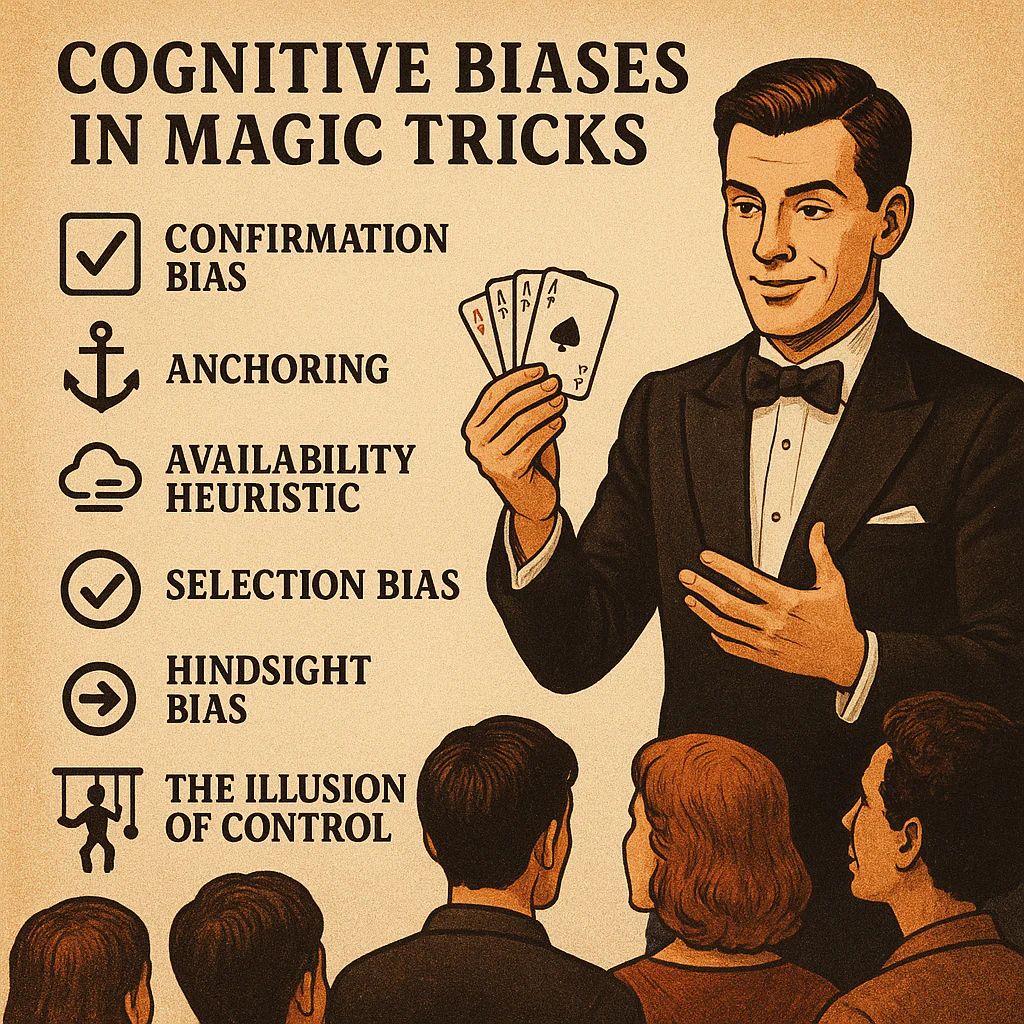

Cognitive biases in magic tricks are the hidden engines behind many impossible-looking effects: magicians guide your attention, shape your expectations, and let your memory quietly fill in the gaps. The strongest performances do not overpower your eyes; they persuade your brain to accept the wrong explanation.
We learned this firsthand during a close-up coin routine. A spectator watched both hands from only a few feet away, then confidently pointed to the hand that never held the coin. The secret was not speed. It was a natural gesture, a convincing assumption, and a perfectly timed question.
Research on inattentional blindness shows that people can miss an unexpected event while concentrating on another task. That same mental shortcut helps explain why a card can change in plain sight, a coin can vanish under your nose, and a “free” choice can land exactly where the magician wants it.
Key Takeaways
- Magic exploits attention, not just eyesight: Misdirection guides what you process as important.
- Inattentional blindness and change blindness help conceal secret movements and switches.
- Confirmation bias encourages spectators to favor explanations that support the miracle.
- Anchoring and framing influence choices, numbers, and interpretations before the trick begins.
- Memory is reconstructive: People often remember a cleaner, fairer version of the effect afterward.
- The feeling of free choice can be engineered through forces, equivoque, language, and timing.
- The Forer effect supports cold reading and mentalism by making broad statements feel personally precise.
- Ethical magic creates wonder without exploiting fear, grief, money, or personal vulnerability.
- Understanding cognitive biases can improve your magic by helping you design stronger scripts, timing, and audience management.
Table of Contents
- ⚡ Quick Tips and Facts About Cognitive Biases in Magic Tricks
- 🧠 Why Magic Works Even When You Know It Is an Illusion
- 🎩 Cognitive Biases vs. Sleight of Hand
- 📚 The Psychology and History of Cognitive Biases in Magic
- From Ancient Conjuring to Modern Psychological Illusions
- How Magicians Borrow from Cognitive Science
- The Role of Misdirection, Attention, and Perception
- 🔍 What Are Cognitive Biases in Magic Tricks?
- Cognitive Biases, Mental Shortcuts, and Everyday Decisions
- How Expectations Shape What Spectators See
- Why Magic Relies on Assumptions Rather Than Deception Alone
- 🎯 15 Cognitive Biases Magicians Use to Create Powerful Illusions
- 1. Confirmation Bias: Seeing Evidence for the Effect
- 2. Attentional Bias: Directing the Spectator’s Focus
- 3. Change Blindness: Missing Secret Transformations
- 4. Inattentional Blindness: Failing to Notice the Obvious
- 5. Choice-Supportive Bias: Remembering a Free Choice
- 6. Anchoring Bias: Establishing a False Point of Reference
- 7. Framing Effect: Changing Meaning with Presentation
- 8. Priming: Planting Invisible Psychological Cues
- 9. Recency and Primacy Effects: Controlling Memory
- 10. Availability Heuristic: Making Impossible Explanations Feel Likely
- 11. Representativeness Heuristic: Predicting Patterns That Feel Right
- 12. Base-Rate Neglect: Ignoring the Method’s Probability
- 13. Hindsight Bias: Believing the Outcome Was Obvious
- 14. Fundamental Attribution Error: Blaming Skill Instead of Context
- 15. Illusory Truth Effect: Believing Repeated Claims
- 🪄 How Misdirection Exploits Human Attention
- Visual Misdirection and the Spotlight of Attention
- Verbal Misdirection, Patter, and Suggestion
- Timing, Gestures, Eye Contact, and Body Language
- Why Looking Away Can Make You Miss the Secret Move
- 👁️ Perception, Memory, and the Construction of Magical Experiences
- Selective Attention and Divided Attention
- Gestalt Principles in Card, Coin, and Stage Magic
- False Memories and the Malleability of Eyewitness Recall
- Why Spectators Remember a Stronger Miracle Than They Saw
- 🎴 How Cognitive Biases Power Popular Magic Tricks
- Card Forces and the Illusion of Free Choice
- Coin Vanishes and Attentional Misdirection
- The Cups and Balls: Tracking Errors and Magical Timing
- Predictions, Mentalism, and Confirmation Bias
- Ruber Pencil and Visual Persistence
- The French Drop and Assumption-Based Seeing
- Cold Reading and the Barnum Effect
- Optical Illusions, Levitation, and Perceptual Ambiguity
- 🧩 The Psychology of Choice in Mentalism and Close-Up Magic
- Forcing a Card, Number, Object, or Thought
- Equivoque and the Magician’s Choice
- Free Will, Control, and the Feeling of Agency
- Why Multiple Outs Make Predictions Sem Impossible
- 🎭 How Magicians Build Convincing Magical Experiences
- Creating Expectations Before the Trick Begins
- Managing Spectator Assumptions
- The Importance of Conviction, Confidence, and Showmanship
- Using Humor and Emotion to Strengthen Misdirection
- The Peak-End Rule and the Final Magical Moment
- 🧪 Cognitive Psychology Experiments That Explain Magic
- Inattentional Blindness and the Invisible Gorilla
- Change Blindness Demonstrations
- The Strop Effect and Attention Conflicts
- The McGurk Effect and Auditory-Visual Illusions
- The Misinformation Effect and False Recall
- ✅ Ethical Use of Psychological Principles in Magic
- Entertainment, Consent, and Respect for Spectators
- Psychological Magic vs. Manipulation
- Avoiding Fear, Embarrassment, and High-Pressure Participation
- Responsible Mentalism and Claims of Real Powers
- 🛠️ How to Use Cognitive Biases When Learning Magic
- Practice Attention Management Before Secret Techniques
- Study Spectator Psychology and Natural Movement
- Build Misdirection into Your Script
- Record, Review, and Improve Your Performance
- Common Beginner Mistakes That Reveal the Method
- 🔬 How to Analyze a Magic Trick Like a Cognitive Scientist
- Identify the Effect, Method, and Psychological Conviction
- Map Attention Before, During, and After the Secret Move
- Separate What Happened from What the Audience Rembers
- Test Whether the Trick Works Without Psychological Misdirection
- 📱 Cognitive Biases in Street Magic, Social Media, and Video
- How Camera Angles Create Digital Misdirection
- Editing, Cuts, Reactions, and Online Deception
- Why Viral Magic Videos Feel More Impossible
- Live Performance vs. Recorded Magic
- 🧠 Can You Outsmart a Magician’s Cognitive Biases?
- Questions to Ask Yourself During a Trick
- Why Method-Hunting Can Make You Miss the Real Secret
- How to Watch Without Becoming a Difficult Spectator
- The Limits of Rational Thinking During Astonishment
- 🌍 Magic, Cognitive Biases, and Everyday Decision-Making
- What Magic Teaches Us About Advertising and Persuasion
- Misdirection in Politics, Media, and Social Platforms
- Recognizing Biases in Scams and Deceptive Claims
- Using Magical Thinking More Safely
- ❓ Frequently Asked Questions About Cognitive Biases in Magic Tricks
- What cognitive bias is most commonly used in magic?
- Is misdirection a cognitive bias?
- Do magicians manipulate the brain or the eyes?
- Why do people fail to see obvious magic methods?
- Can knowing about cognitive biases ruin magic?
- What is the difference between mentalism and psychological magic?
- How can beginners practice psychological misdirection?
- Are cognitive biases in magic ethically acceptable?
- 🏁 Conclusion: Why the Mind Is Every Magician’s Best Prop
- 🔗 Recommended Links for Magic Psychology and Cognitive Science
- ❔ FAQ
- 📖 Reference Links
⚡ Quick Tips and Facts About Cognitive Biases in Magic Tricks
The best magic trick experiences do not usually defeat your eyes. They guide your attention, expectations, memory, and assumptions toward a perfectly reasonable—but wrong—explanation. That is the little psychological trapdoor beneath the top hat 🎩
- Misdirection is attention management, not simply “look over there.”
- Inattentional blindness can make people miss an obvious event when concentrating on another task, as demonstrated in the famous Invisible Gorilla study.
- Confirmation bias encourages spectators to favor explanations that match what they already believe.
- Anchoring makes the first detail, instruction, or interpretation disproportionately influential.
- Change blindness means people can miss substantial alterations when visual continuity is interrupted.
- Memory reconstructs experiences rather than replaying them like a video file, according to research summarized by the American Psychological Association.
- The Forer effect makes vague personality statements feel personally accurate, a favorite tool in fortune-telling and some forms of mentalism.
- A force creates the feeling of choice while quietly steering the outcome.
- Timing matters as much as technique: a secret move performed during a natural gesture is far safer than one performed under a spotlight of suspicion.
- Magic is entertainment; scams are exploitation. The same cognitive weaknesses that make a card vanish delightful can make false medical or financial claims dangerous.
| Cognitive principle | What the spectator experiences | How a magician may use it |
|---|---|---|
| Selective attention | “I watched the hands the whole time.” | Places the secret action outside the audience’s chosen focus |
| Confirmation bias | “That explanation must be right.” | Encourages an attractive but incomplete theory |
| Anchoring | “The first choice mattered.” | Establishes an early instruction or number |
| Change blindness | “Nothing changed.” | Hides a switch during a visual interruption |
| Forer effect | “That reading describes me exactly.” | Uses broad statements that feel personal |
| Memory reconstruction | “I remember it happening differently.” | Lets the audience strengthen the miracle afterward |
🧠 Why Magic Works Even When You Know It Is an Illusion
Knowing that a trick has a method does not automatically reveal the method. You may understand that a coin did not truly disappear, yet still fail to see when it left the hand.
Research on visual attention, including work by Christopher Chabris and Daniel Simons, shows that confidence in seeing is not the same as complete observation. As the Multnomah County cognitive-bias guide puts it, “seeing is believing” is unreliable because sight and hearing can be misled.
At Magic Trick™, we have seen this repeatedly during close-up performances. A spectator can stare at a magician’s hands from less than a metre away, describe every finger movement with absolute confidence, and still miss the crucial transfer. The hands were visible. The meaning assigned to the hands was not accurate.
🎩 Cognitive Biases vs. Sleight of Hand
Sleight of hand is the physical method. Cognitive bias is the psychological weather around it.
A classic coin trick may require:
- A concealed coin.
- A natural-looking hand position.
- A reason for the audience to look at the other hand.
- A believable story that explains the movement.
- A delay before the reveal.
The secret technique handles step one. Biases and attention management handle steps two through five.
| Method component | Physical skill | Psychological support |
|---|---|---|
| False transfer | Finger dexterity | Spectators assume the receiving hand holds the coin |
| Card force | Timing and control | The participant remembers a free choice |
| Switch | Coordination | Change blindness masks the moment of replacement |
| Vanish | Concealment | Attention shifts toward the supposed destination |
| Mentalism reading | Observation and language | Forer effect and self-validation create perceived accuracy |
A technically brilliant move can fail if it looks suspicious. A modest move can astonish if it looks ordinary.
📚 The Psychology and History of Cognitive Biases in Magic

Magic has always been part theatre, part technology, and part amateur psychology. Before researchers gave names to attentional bias or memory distortion, performers discovered practical versions through trial, error, and thousands of puzzled faces.
From Ancient Conjuring to Modern Psychological Illusions
The history of magic includes cups-and-balls performances documented in ancient Egypt, spiritualist demonstrations in the nineteenth century, and modern close-up magic shaped by performers such as Dai Vernon, Juan Tamariz, David Copperfield, Derren Brown, and Penn & Teller.
The apparatus changed. The human brain did not suddenly install anti-misdirection update.
Early performers learned that audiences:
- Assume an object remains where they last saw it.
- Treat a confident gesture as meaningful.
- Follow the performer’s gaze.
- Remember the dramatic ending more clearly than the quiet setup.
- Prefer one coherent explanation over several uncertain possibilities.
Those observations align with modern cognitive science. Amos Tversky and Daniel Kahneman helped establish the study of judgment heuristics and systematic errors, while later researchers examined attention, perception, memory, and decision-making in more specialized ways.
How Magicians Borrow from Cognitive Science
Most magicians do not begin by reading a laboratory paper and then inventing a trick. More often, the craft develops practically:
- A performer notices that spectators look where the performer looks.
- The performer repeats the action.
- The timing is refined.
- A script is added.
- The method becomes a routine.
- Researchers later describe the underlying process with terms such as inattentional blindness or change blindness.
That does not mean every magical technique is scientifically validated in every setting. A laboratory result may involve a controlled screen, a timed task, and hundreds of participants. A live performance includes personality, noise, social pressure, lighting, and audience expectation.
The principle may transfer, but the conditions matter.
The Role of Misdirection, Attention, and Perception
Alan Hudson’s discussion of the psychology of illusion describes magic as the craft of creating a false reality through perception, attention, memory, and expectation. That wording is useful, but we would sharpen it slightly:
Magicians rarely create a complete false reality. They create a plausible interpretation and give the brain enough support to maintain it.
A spectator may see:
- A hand apparently empty.
- A card apparently freely selected.
- A prediction apparently written before the choice.
- A ball apparently travelling through a solid cup.
The eyes receive data. The brain supplies a story. Magic lives in the gap between those two operations.
🔍 What Are Cognitive Biases in Magic Tricks?
A cognitive bias is commonly described as a systematic error in thinking that affects judgment, decisions, and behavior. The American Psychological Association and educational resources from Britannica describe biases as patterns in processing information that can lead people away from purely rational evaluation.
In magic, the word “bias” should not imply stupidity. Every human being uses shortcuts. Without them, ordinary life would become impossibly slow.
Cognitive Biases, Mental Shortcuts, and Everyday Decisions
Your brain constantly estimates:
- Where an object is likely to be.
- Which sound deserves attention.
- Whether a person appears trustworthy.
- What a familiar action means.
- What should happen next.
- Which details can safely be ignored.
These shortcuts are efficient. If you reached for a cup and had to consciously calculate every muscle movement, breakfast would take until dinner.
Magic exploits the same efficiency. When a magician reaches toward a pocket, you do not inspect every millimetre of the movement. You recognize the action as familiar. That automatic interpretation is useful in daily life—and wonderfully vulnerable in a theatre.
The Multnomah County guide notes that biases are influenced by emotions, motivations, upbringing, identity, and social pressure. A magic audience adds another powerful influence: the social agreement to be entertained.
How Expectations Shape What Spectators See
Expectation acts like an invisible stagehand.
If a performer says, “Watch the coin carefully,” you may assume the coin is the important object. If the performer asks you to hold a card tightly, you may assume the card cannot be switched. If the performer announces that a prediction was written before the show, you may inspect the prediction rather than question the timing of the announcement.
A spectator does not merely observe an event. They observe it through a prediction about what the event means.
| Expectation | Likely interpretation |
|---|---|
| “The coin is in the left hand.” | The left hand becomes the assumed location |
| “You can change your mind.” | The choice feels more autonomous |
| “Nothing has been added or removed.” | The audience may stop checking object count |
| “This is an ordinary deck.” | The deck receives less suspicion |
| “Think of any number.” | The participant may overlook subtle constraints |
Why Magic Relies on Assumptions Rather Than Deception Alone
A magician does not need to fool every sense at every moment. They only need to make the audience’s assumptions do some of the work.
Consider a false transfer:
- The coin begins in the right hand.
- Both hands approach each other.
- The right hand apparently places the coin into the left.
- The right hand closes naturally.
- The left hand becomes the presumed location.
- The right hand secretly retains the coin.
- Attention shifts to the left hand.
- The left hand opens empty.
The crucial step is not the finger position. It is step five: the audience accepts the transfer as complete.
🎯 15 Cognitive Biases Magicians Use to Create Powerful Illusions
No single trick requires all fifteen. Strong routines often combine three or four, like a magician’s version of a carefully engineered cocktail—minus the tiny umbrella.
1. Confirmation Bias: Seeing Evidence for the Effect
Confirmation bias is the tendency to seek, interpret, and remember information that supports existing beliefs. The Yale Program on Climate Change Communication has documented how prior worldviews can influence interpretation even when people possess substantial knowledge.
In magic, a spectator who believes the card was fairly selected may reinterpret ambiguous moments in its favor:
- “I definitely could have chosen another card.”
- “The magician never touched the deck.”
- “The prediction was already there.”
- “The card was lost fairly.”
The audience is not necessarily inventing memories dishonestly. They are organizing uncertain details around the strongest interpretation.
Performance use: Make the desired explanation attractive, simple, and emotionally satisfying.
2. Attentional Bias: Directing the Spectator’s Focus
Attentional bias describes the tendency to prioritize some stimuli over others. Magicians direct attention through:
- Eye contact.
- Head turns.
- Hand gestures.
- Verbal emphasis.
- Sound.
- Movement.
- Social questions.
- A sudden pause.
A magician might ask, “Did you see the coin go?” The question itself can direct attention toward the coin’s supposed journey, not the hand that secretly retained it.
The National Academies explains that attention is selective and limited. You can see more than you consciously process, but you cannot reliably analyze every visible event at once.
3. Change Blindness: Missing Secret Transformations
Change blindness occurs when observers fail to notice a change, especially when the transition is interrupted by:
- A blink.
- A gesture.
- A camera cut.
- A body turn.
- A momentary obstruction.
- A shift in attention.
In a card switch, the audience may see the deck before and after the change yet fail to detect the replacement. They are not blind in a literal sense. They are missing the transition, which is often the least memorable part of the routine.
Research from the University of Illinois attention resources demonstrates why continuity can be surprisingly fragile.
4. Inattentional Blindness: Failing to Notice the Obvious
Inattentional blindness is the failure to notice an unexpected object or event while focusing attention elsewhere.
The Invisible Gorilla experiment became famous because many viewers counting basketball passes failed to notice a person in a gorilla suit crossing the scene.
A magician uses a smaller, more elegant version:
- Give the audience a task.
- Make the task feel important.
- Perform a secret action outside the task’s focus.
- Reveal the result.
- Let astonishment erase the method.
This is why a secret move may happen in plain sight. Visibility is not the same as awareness.
5. Choice-Supportive Bias: Remembering a Free Choice
Choice-supportive bias can make people remember their own decisions as more independent, confident, or favorable than they were.
That is useful for a card force. A participant may genuinely feel:
- “I could have chosen any card.”
- “I changed my mind.”
- “The magician never influenced me.”
- “I freely settled on that one.”
A well-designed force does not feel like a struggle against the performer. It feels like an ordinary decision.
The strongest force is often the one nobody remembers as a force.
6. Anchoring Bias: Establishing a False Point of Reference
Anchoring causes an initial number, idea, or impression to influence later judgments. The Nobel Prize overview of Kahneman’s work explains how initial information can shape estimates even when it is irrelevant.
Magic applications include:
- Saying “a small number” before asking for a number.
- Demonstrating a particular object before offering a choice.
- Introducing a card as “the important one.”
- Establishing that the deck is shuffled before a controlled sequence.
- Presenting one explanation before the real method is considered.
An anchor need not be forceful. A casual first impression can be enough.
7. Framing Effect: Changing Meaning with Presentation
The framing effect occurs when the wording or context of identical information changes judgment.
Compare:
- “You may keep the card.”
- “You may eliminate the card.”
- “Point to one.”
- “Tell me which one you want to save.”
The physical options may be identical. The psychological experience is not.
Magicians frame actions to make methods feel natural:
- A cut becomes “mixing.”
- A glimpse becomes “checking the condition.”
- A controlled card becomes “your card returning.”
- A verbal restriction becomes “fairness.”
8. Priming: Planting Invisible Psychological Cues
Priming occurs when earlier exposure influences later responses. The effects are often subtle and depend heavily on context, so performers should avoid treating priming as mind control.
A magician may prime:
- A color by mentioning a red object.
- A number by using repeated counts.
- A location by gesturing toward it.
- An emotional tone through music or storytelling.
- An interpretation by naming the effect before it happens.
The Association for Psychological Science discusses the complexity and limitations of priming research. In performance, priming works best as supporting texture, not as a guaranteed prediction engine.
9. Recency and Primacy Effects: Controlling Memory
People may give disproportionate weight to the first or last elements in a sequence. Magicians use this by:
- Making the opening fair and disarming.
- Placing the secret action in the middle.
- Ending with a strong visual transformation.
- Repeating the clean display after the method has passed.
If the final image is a signed card inside an impossible location, spectators may remember the entire routine as cleaner than it was.
10. Availability Heuristic: Making Impossible Explanations Feel Likely
The availability heuristic causes people to judge likelihood by how easily examples or explanations come to mind.
After watching a magician produce a card from a sealed envelope, a spectator may quickly imagine:
- Hidden compartments.
- Duplicate cards.
- Sleeves.
- Marked decks.
- Secret assistants.
The first available explanation can become anchor, even if it is wrong. Magicians sometimes encourage this by allowing a plausible method to surface before revealing a stronger impossibility.
11. Representativeness Heuristic: Predicting Patterns That Feel Right
People often judge a situation by how closely it resembles a familiar pattern.
If a magician squares the deck, spectators may assume the cards are genuinely mixed because the action looks like mixing. If a performer taps a cup, the tap appears connected to the ball’s movement because it resembles a causal gesture.
This is not a logical proof. It is pattern recognition doing its job quickly.
12. Base-Rate Neglect: Ignoring the Method’s Probability
Base-rate neglect occurs when people focus on vivid details while overlooking general probabilities.
In a prediction effect, the audience may focus on the astonishing match and ignore:
- How many outcomes were prepared.
- Whether several predictions existed.
- How many attempts were not shown.
- Whether the participant’s choice was constrained.
- Whether the wording changed after the choice.
Magic is not automatically dishonest because it uses these gaps. Theatre compresses information. The ethical line appears when a performer presents a staged probability as supernatural certainty outside an entertainment context.
13. Hindsight Bias: Believing the Outcome Was Obvious
After the reveal, spectators may feel they “almost knew” what would happen. Hindsight bias makes outcomes seem more predictable after they occur.
A magician can strengthen this feeling by saying:
- “You were thinking of that from the start.”
- “The clues were all there.”
- “You nearly said it.”
- “This was the only logical outcome.”
The audience may then reconstruct the performance as a trail of obvious clues, even if those clues were ambiguous at the time.
14. Fundamental Attribution Error: Blaming Skill Instead of Context
The fundamental attribution error describes a tendency to explain another person’s behavior through personality or ability while underestimating situational factors.
In magic, spectators may say:
- “That magician has incredible intuition.”
- “They read body language perfectly.”
- “They knew exactly what I was thinking.”
- “They have a special gift.”
They may overlook:
- Structured choices.
- Prior information.
- Statistical fishing.
- Multiple possible outcomes.
- Audience management.
- Editing in recorded performances.
The Simply Psychology overview explains the broader bias. In a show, attributing the effect to extraordinary talent is part of the fun. In a supposed psychic consultation, it may become financially or emotionally risky.
15. Illusory Truth Effect: Believing Repeated Claims
The illusory truth effect is the tendency for repeated statements to feel more credible, even when repetition adds no evidence. Research from the American Psychological Association discusses this phenomenon.
A performer might repeat:
- “You had a completely free choice.”
- “Nothing was added.”
- “You shuffled the cards.”
- “I never touched your object.”
- “You could have stopped me at any moment.”
Repetition can reinforce a clean narrative. That is powerful in entertainment and potentially harmful in deceptive sales, misinformation, or fraudulent claims.
🪄 How Misdirection Exploits Human Attention
Misdirection is often misunderstood as a command to look away. In sophisticated magic, the audience may look directly at the secret hand and still fail to understand what happened.
Visual Misdirection and the Spotlight of Attention
Attention behaves less like a floodlight illuminating everything and more like a movable spotlight. Peripheral information remains available, but detailed processing is concentrated.
A performer can shift the spotlight with:
- A larger movement.
- A brighter object.
- A change in body orientation.
- A question requiring a response.
- A meaningful facial expression.
- A sudden sound.
- A pause followed by a reveal.
In close-up magic, distance is small, so psychological timing becomes especially important. At a table, the magician cannot rely on theatrical darkness. Naturalness must do the hiding.
Verbal Misdirection, Patter, and Suggestion
Words can redirect attention without sounding like instructions.
Compare:
- “Watch my left hand.”
- “You’ll notice the coin travels.”
- “What was your first thought?”
- “Was that a fair choice?”
The first is suspicious because it announces the method’s battleground. The others create a task, memory search, or social response that competes with observation.
Effective pater should:
- Support the effect.
- Sound natural.
- Give the audience a reason to respond.
- Avoid unnecessary technical detail.
- Place important actions inside ordinary conversation.
Alan Hudson’s description of misdirection as “creating a moment of confusion where anything is possible” captures theatrical side. We would add that clarity before the secret often produces confusion after it: the audience believes the conditions were perfectly understood, so the result feels impossible.
Timing, Gestures, Eye Contact, and Body Language
A secret move is safest when it occurs during an action that already has a reason.
Examples:
- Looking at the spectator while asking a question.
- Turning the body to set down an object.
- Gesturing toward the place where the effect will appear.
- Laughing after a harmless line.
- Reaching for a prop at the moment attention naturally expands.
The performer’s gaze is especially influential. People tend to follow eye direction because it is socially meaningful. But overusing this principle can become theatrical rather than natural. The gaze must match the story.
Why Looking Away Can Make You Miss the Secret Move
Here is the curious part: sometimes the secret happens while you are looking at the hand.
Your attention may be focused on the wrong question:
- Not “Where is the coin?”
- But “Why is the magician showing me this hand?”
- Not “When did the card change?”
- But “How is the card going to appear?”
- Not “Was the choice controlled?”
- But “What number am I thinking of?”
This is known as a representational blind spot. You receive visual information but do not encode it as relevant evidence.
👁️ Perception, Memory, and the Construction of Magical Experiences
A magic performance is not stored as a perfect recording. It is assembled from fragments, interpretations, emotional peaks, and later conversation.
Selective Attention and Divided Attention
Attention is limited. A spectator cannot deeply monitor:
- Both hands.
- The deck.
- The performer’s face.
- The spoken instructions.
- Their own chosen card.
- The reactions of nearby people.
When a magician asks you to remember a number while also following a hand gesture, the task becomes divided. Even if you feel fully engaged, some information receives less processing.
This is why a participant can honestly say, “I never looked away,” while failing to describe the critical action.
Gestalt Principles in Card, Coin, and Stage Magic
Gestalt psychology examines how people organize visual information into meaningful wholes. Principles relevant to magic include:
- Closure: filling in missing parts.
- Continuity: assuming objects follow smooth paths.
- Common fate: grouping things that move together.
- Figure-ground separation: distinguishing the important object from its background.
- Proximity: grouping nearby objects as related.
In a card trick, a packet may be treated as one continuous group even when a card has been secretly added or removed. In a stage illusion, a performer’s body may conceal a prop because the brain treats the figure as the primary object and the surrounding space as background.
False Memories and the Malleability of Eyewitness Recall
Memory is reconstructive. The American Psychological Association’s memory resources explain that recall can be influenced by later information, suggestion, and context.
A magician may strengthen a memory by asking:
- “You saw me put it there, right?”
- “You shuffled the deck yourself.”
- “The prediction was in full view.”
- “You chose the card before I touched anything.”
These statements may be accurate, misleading, or selectively framed. The audience then discusses the event, and conversation can stabilize a particular version.
The miracle grows in the retelling. That is why a trick often sounds stronger the next morning than it felt during the first astonished gasp.
Why Spectators Remember a Stronger Miracle Than They Saw
The emotional peak acts like a highlighter. A final impossible image may cause earlier ambiguities to fade.
| During performance | After performance |
|---|---|
| “I think the card was controlled somehow.” | “I shuffled the deck and it still appeared.” |
| “The coin was probably retained.” | “The coin vanished from my hand.” |
| “There may have been another envelope.” | “The prediction was sealed from the beginning.” |
| “The choice felt guided.” | “I chose anything I wanted.” |
This is not necessarily a lie. It is memory compression: the mind stores the effect’s meaning more strongly than every procedural detail.
🎴 How Cognitive Biases Power Popular Magic Tricks
Different effects lean on different psychological weaknesses. The method may be mechanical, sleight-based, verbal, mathematical, or a hybrid.
Card Forces and the Illusion of Free Choice
A force guides the participant toward a predetermined card or object while preserving the feeling of freedom.
Common psychological supports include:
- Multiple apparently open choices.
- Repeated invitations to change the mind.
- Casual handling of the force moment.
- A reason to look at the performer.
- Memory emphasis on the final selection.
- Framing the result as the participant’s decision.
A basic force sequence may work like this:
- Display several cards.
- Ask the participant touch one.
- If the selection is useful, continue.
- If not, eliminate or reinterpret it.
- Preserve the participant’s sense of agency.
- Reveal a prediction or transformation.
The participant remembers the decision, not the branching structure that shaped it.
Coin Vanishes and Attentional Misdirection
A coin vanish often uses a false transfer, retention vanish, shuttle pass, or a gimmick. Regardless of method, the psychological sequence is similar:
- Establish the coin’s identity and location.
- Move both hands naturally.
- Give the audience a reason to believe the receiving hand contains it.
- Direct attention toward that hand.
- Create a pause.
- Open the hand empty.
- Delay the reveal or production.
The pause matters. If the hand opens too quickly, spectators may process the action as a move. If it waits naturally, the audience experiences a clean absence.
The Cups and Balls: Tracking Errors and Magical Timing
The cups-and-balls tradition is a masterclass in attention, expectation, and object tracking.
A typical structure:
- A ball appears beneath a cup.
- The audience believes it is placed somewhere else.
- A secret load occurs during a larger action.
- The final cup contains an unexpected object.
Why does tracking fail?
- The cups look similar.
- The performer repeats actions with small variations.
- The audience follows the apparent ball rather than the secret load.
- The rhythm creates predictability.
- The final reveal arrives after the method has been forgotten.
The trick is not merely “watch the ball.” It is watch one moving object while the magician controls the meaning of several stationary ones.
Predictions, Mentalism, and Confirmation Bias
Mentalism combines language, observation, psychological forces, multiple outs, information gathering, and theatrical framing.
A prediction can feel impossible because:
- The prediction is displayed early.
- The participant experiences a free choice.
- The performer uses precise language.
- The reveal occurs slowly.
- The audience focuses on the match rather than alternative outcomes.
- The performer repeats the fairness conditions.
The ethical distinction matters. A mentalist presenting an entertaining demonstration is operating within a theatrical contract. A person claiming genuine supernatural powers to sell medical, romantic, or financial advice is making a real-world claim requiring evidence.
Rubber Pencil and Visual Persistence
The classic rubber-pencil illusion is usually explained through flexible material and rhythmic motion, but it also demonstrates how expectations influence perception. The brain interprets repeated movement as a coherent object event rather than analyzing the pencil’s physical deformation frame by frame.
Visual effects exploit:
- Motion blur.
- Persistence of vision.
- Peripheral processing.
- Assumptions about rigid objects.
- Repetitive rhythm.
The French Drop and Assumption-Based Seeing
The French drop is a coin vanish in which the coin is apparently taken by one hand while secretly retained by the other.
A simplified learning sequence:
- Hold the coin at the fingertips.
- Bring the opposite hand toward it.
- Allow the receiving hand to appear to take the coin.
- Retain the coin in the original hand.
- Let the original hand relax naturally.
- Direct attention to the receiving hand.
- Reveal the apparent disappearance.
The important lesson is not merely “hide the coin.” The hand that retains the coin must look less interesting than the hand that supposedly holds it.
Cold Reading and the Barnum Effect
The Barnum or Forer effect describes the tendency to accept broad personality descriptions as uniquely accurate. In Forer’s classic experiment, participants received the same general personality sketch and rated it highly accurate. A useful historical summary appears through Britannica’s discussion of the Forer effect.
The featured video explains how the effect supports fortune-telling, self-validation, and apparently personalized readings. It highlights statements such as:
- “You have a great need for other people to like and admire you.”
- “At times you can be outgoing, while at other times you prefer privacy.”
- “You have unused potential that you have not fully developed.”
These statements feel personal because they are:
- Broad.
- Flattering.
- Flexible.
- Compatible with self-image.
- Easy to remember when they fit.
- Easy to reinterpret when they do not.
A magician can use this for theatrical character reading. A fraudster can use it to manufacture authority.
Optical Illusions, Levitation, and Perceptual Ambiguity
Optical illusions exploit assumptions about:
- Depth.
- Scale.
- Lighting.
- Oclusion.
- Perspective.
- Object permanence.
- Motion.
In levitation effects, the audience may accept a stable visual relationship between performer and background without examining the viewing angle. In a stage illusion, an object can appear to occupy a space that is actually hidden or carefully framed.
The American Psychological Association defines illusion broadly as a misperception or false interpretation. In magic, the performer adds choreography and narrative, transforming a perceptual ambiguity into a meaningful miracle.
🧩 The Psychology of Choice in Mentalism and Close-Up Magic
Choice is one of magic’s most valuable props because people care deeply about decisions they believe they made themselves.
Forcing a Card, Number, Object, or Thought
A force can be physical, verbal, mathematical, psychological, or procedural.
| Force type | Participant experience | Common vulnerability |
|---|---|---|
| Physical force | “I freely touched that card.” | Choice-supportive memory |
| Equivoque | “The outcome depended on my decisions.” | Framing effect |
| Psychological force | “The number came from my own mind.” | Priming and availability |
| Mathematical force | “The arithmetic somehow predicted me.” | Base-rate neglect |
| Multiple out | “The performer knew the exact answer.” | Confirmation bias |
| Information force | “The performer read my thoughts.” | Attribution error |
A responsible performer knows which kind of claim is being made. “Watch this impossible prediction” is theatre. “I can reliably access your private thoughts” is a claim about reality.
Equivoque and the Magician’s Choice
Equivoque, often called the magician’s choice, uses language to make every participant response lead toward a desired result.
For example:
- Place two objects on the table.
- Ask the participant to indicate one.
- If they indicate the target, say, “We’ll keep that one.”
- If they indicate the other, say, “We’ll eliminate that one.”
- Repeat until one object remains.
The method is verbal framing, but the experience is psychological. The participant remembers a sequence of personal decisions rather than noticing that the instruction changed meaning based on the response.
Free Will, Control, and the Feeling of Agency
People do not merely want outcomes. They want to feel that they caused them.
A successful force preserves agency by allowing:
- Physical movement.
- Time to think.
- A change of mind.
- Verbal confirmation.
- A personal reason for the choice.
This is why a rushed selection often feels suspicious. The participant needs enough ownership to defend the decision later.
Why Multiple Outs Make Predictions Sem Impossible
A multiple-out routine prepares several possible endings. The performer reveals the ending that matches the participant’s choice.
The audience may not consider:
- How many predictions existed.
- Whether wording changed.
- Whether an object was switched.
- Whether the “prediction” was completed after the choice.
- Whether only the successful version was shown.
That is base-rate neglect combined with confirmation bias. The participant sees a match and gives the match emotional priority.
🎭 How Magicians Build Convincing Magical Experiences
Technique gets you through the secret. Performance makes the secret irrelevant.
Creating Expectations Before the Trick Begins
Before a card is selected, the magician may establish:
- The deck is ordinary.
- The participant is in control.
- The performer will not touch the cards.
- The prediction is already written.
- The outcome will be impossible.
These statements become anchors. If the ending succeeds, the audience remembers the conditions as stronger than they may have been.
Managing Spectator Assumptions
A skilled performer asks:
- What does the audience think is happening?
- What are they watching?
- What do they believe they can influence?
- Which moment will they later describe?
- What alternative explanation will appear first?
- What detail must be genuinely fair?
At Magic Trick™, we often test a routine by asking spectators to explain it immediately afterward. Their answers reveal the assumptions the performance created. If everyone describes the wrong moment as the secret, the routine is psychologically robust. If everyone notices the same awkward pause, the method needs work.
The Importance of Conviction, Confidence, and Showmanship
A shaky performance makes ordinary actions look suspicious. Confidence does not mean rushing or pretending to know everything. It means:
- Handling props naturally.
- Giving instructions clearly.
- Allowing silence.
- Avoiding unnecessary defensive claims.
- Treating the method as uninteresting.
- Leting the effect breathe.
The performer’s confidence can become an authority cue, but it should support entertainment rather than pressure.
Using Humor and Emotion to Strengthen Misdirection
Humor creates social engagement. Emotion creates memory.
A joke can:
- Encourage eye contact.
- Cause a laugh at the right moment.
- Relax the participant.
- Mask a natural hand movement.
- Make the audience remember the personality of the performance.
But humor should not embarrass the participant. A spectator who feels threatened watches defensively. A spectator who feels respected joins the experiment.
The Peak-End Rule and the Final Magical Moment
People often evaluate experiences using their strongest moment and their ending. A routine with a strong final image can make the entire sequence feel cleaner.
Practical structure:
- Begin with a clear, quick effect.
- Establish trust.
- Increase impossibility.
- End with a visual or emotional climax.
- Stop before the effect becomes over-explained.
More magic is not always better. Sometimes the best method is knowing when to put the cards away.
🧪 Cognitive Psychology Experiments That Explain Magic
Laboratory demonstrations do not duplicate live magic perfectly, but they illuminate why the audience’s confidence can exceed its accuracy.
Inattentional Blindness and the Invisible Gorilla
In the Invisible Gorilla experiment, viewers count basketball passes and many fail to notice a person in a gorilla suit. The lesson is not that people are careless. It is that attention is selective.
Magic translates the experiment into performance:
- Count cards.
- Track a coin.
- Remember a number.
- Follow a story.
- Respond to a question.
While the audience performs the assigned task, the method may occur elsewhere.
Change Blindness Demonstrations
Change blindness studies show that people can miss a changed object when visual continuity is disrupted. Examples include:
- A door blocking the view.
- A cut in a video.
- A body turn.
- A momentary distraction.
- A gaze shift.
A card switch often exploits a live version of the same principle. The audience sees the object before and after but does not encode the exact transition.
The Strop Effect and Attention Conflicts
The Strop task asks participants to name the ink color of a word while ignoring the word’s meaning. A blue word printed in red ink creates conflict.
The National Library of Medicine describes the Strop effect as evidence that automatic processes can interfere with controlled responses.
Magic creates comparable conflicts:
- Watch the coin while listening to a question.
- Remember the card while following a gesture.
- Count objects while interpreting a joke.
- Look for movement while the secret occurs in stillness.
The McGurk Effect and Auditory-Visual Illusions
The McGurk effect demonstrates that visual mouth movements can alter what people think they hear. The National Institutes of Health discusses how auditory and visual information interact in speech perception.
For magicians, the broader lesson is useful: perception is multisensory integration, not a collection of independent camera feeds. Sound, gesture, facial expression, and movement combine to create an interpretation.
The Misinformation Effect and False Recall
The misinformation effect shows that later information can alter memory of an earlier event. A famous line of research by Elizabeth Loftus demonstrated how suggestion can influence eyewitness reports.
In performance, a magician may ask a leading question after the effect. That question can shape the story spectators tell. In entertainment, this is often harmless and playful. In legal, medical, or investigative settings, it becomes a serious reliability problem.
✅ Ethical Use of Psychological Principles in Magic
A strong magician creates astonishment without exploiting vulnerability.
Entertainment, Consent, and Respect for Spectators
Before involving someone, explain enough for meaningful consent:
- Participation is voluntary.
- They can stop at any time.
- The performance is an illusion or demonstration.
- No personal disclosure is required.
- The participant will not be mocked.
A participant does not need to know the method. They do deserve to know the nature of the interaction.
Psychological Magic vs. Manipulation
The difference is not whether psychology is used. Almost all communication uses psychology.
| Entertainment | Manipulation |
|---|---|
| Clear theatrical context | Disguised real-world persuasion |
| Participant can decline | Pressure or coercion |
| Harmless stakes | Financial, medical, or emotional stakes |
| No false authority outside the act | Claims of supernatural certainty |
| Respectful reveal or mystery | Deliberate exploitation of fear |
The Society of American Magicians Code of Ethics emphasizes honesty with the public, respect for fellow performers, and responsible presentation.
Avoiding Fear, Embarrassment, and High-Pressure Participation
Avoid effects that:
- Imply illness or death.
- Predict relationship breakdown.
- Expose private information.
- Pressure a participant to reveal secrets.
- Use humiliation as the punchline.
- Encourage gambling or risky decisions.
- Target children without appropriate safeguards.
A spectator should leave feeling amazed, not psychologically muged in a velvet jacket.
Responsible Mentalism and Claims of Real Powers
Mentalism often borows the language of psychology, intuition, body language, and suggestion. That language can be theatrical, but the performer should avoid presenting entertainment as verified supernatural ability.
Be cautious with claims involving:
- Medical diagnosis.
- Trauma recovery.
- Financial predictions.
- Lost loved ones.
- Legal outcomes.
- Guaranteed romance.
- “Energy” treatments.
- Psychic certainty.
The Committee for Skeptical Inquiry offers resources for evaluating extraordinary claims. A good magic show can invite wonder without asking the audience to surrender judgment.
🛠️ How to Use Cognitive Biases When Learning Magic
Psychology will not replace practice. It will tell you where practice matters most.
Practice Attention Management Before Secret Techniques
Start with a simple object, such as a coin or playing card.
- Hold the object naturally.
- Ask a partner a question.
- Notice where their eyes move.
- Move one hand while speaking.
- Ask what they remember.
- Repeat with different timing.
- Record which gestures attract attention.
This exercise teaches a crucial distinction: where the audience looks is not always where they understand.
Study Spectator Psychology and Natural Movement
Watch performances from:
Do not copy only the secret technique. Study:
- When the performer speaks.
- How long the hands remain still.
- Which gestures repeat.
- How choices are phrased.
- When the audience laughs.
- What happens immediately before the reveal.
Build Misdirection into Your Script
Write the routine as beats:
| Beat | Audience belief | Performer action | Attention target |
|---|---|---|---|
| 1 | Coin is displayed | Establish object | Coin |
| 2 | Coin transfers | False transfer | Receiving hand |
| 3 | Coin is secure | Natural pause | Face or closed hand |
| 4 | Coin vanished | Open hand | Supposed location |
| 5 | Coin reappears | Produce elsewhere | Final reveal |
If your secret action has no natural reason, the audience may detect it. Give every movement a purpose inside the story.
Record, Review, and Improve Your Performance
Record from the audience’s viewpoint. Review:
- Where your eyes point.
- Whether your hands pause unnaturally.
- Whether your voice changes at the secret.
- Whether the reveal is visible.
- Whether your instructions accidentally expose the method.
- Whether the audience knows what to remember.
Ask viewers two questions:
- “What did you think happened?”
- “When did you think it happened?”
Their answers can be more useful than praise.
Common Beginner Mistakes That Reveal the Method
Avoid:
- Looking at the secret hand.
- Holding a concealed object too rigidly.
- Moving both hands identically when only one has a purpose.
- Overexplaining fairness.
- Repeating a suspicious action.
- Revealing too quickly.
- Asking the audience to watch a precise location.
- Treating every reaction as proof the method worked.
Naturalness beats speed. Suspicion often comes from meaningless movement, not visible technique.
🔬 How to Analyze a Magic Trick Like a Cognitive Scientist
You can study a trick without draining it of wonder. The goal is to separate observation, interpretation, and memory.
Identify the Effect, Method, and Psychological Conviction
Write three descriptions:
- Effect: What the audience believes happened.
- Method: What physically or procedurally happened.
- Conviction: Why the audience believes the effect rather than the method.
Example:
| Layer | Description |
|---|---|
| Effect | A signed card appears inside a sealed envelope |
| Method | Control, switch, duplicate, or pre-arrangement |
| Conviction | The envelope seemed isolated and the signature created uniqueness |
The conviction is often the most interesting layer because it explains why a method survived scrutiny.
Map Attention Before, During, and After the Secret Move
Create a timeline:
- What does the audience see first?
- What does the performer say?
- Where is the performer looking?
- What is the audience trying to remember?
- What changes physically?
- What happens immediately afterward?
- Which detail becomes the emotional peak?
This map reveals whether the trick relies on attention, memory, framing, probability, or a combination.
Separate What Happened from What the Audience Rembers
Interview spectators separately. Compare:
- Their descriptions of the selection.
- Their memory of who touched the object.
- Their belief about when the prediction was written.
- Their certainty about the number of objects.
- Their explanations of the method.
Disagreement is informative. It shows which moments were not encoded clearly.
Test Whether the Trick Works Without Psychological Misdirection
Try three versions:
- With the full script.
- With neutral conversation.
- In silence.
If the method succeeds only with the full script, psychology is doing substantial work. If it succeeds silently, the method may rely more on mechanics, gimmicks, or angle control.
This experiment is especially useful for beginners. It prevents the common mistake of believing a move is deceptive simply because it worked once under theatrical conditions.
📱 Cognitive Biases in Street Magic, Social Media, and Video
Recorded magic changes the rules. The camera can become an accomplice—or a suspiciously well-dressed accomplice.
How Camera Angles Create Digital Misdirection
Video can hide:
- Hand positions.
- Table edges.
- Assistants.
- Off-camera objects.
- Moments before and after the effect.
- Audience reactions that reveal editing.
A fixed camera may make a performance seem fair while removing the angles a live audience would have. A close-up may reveal detail but conceal context.
Editing, Cuts, Reactions, and Online Deception
Watch for:
- Jump cuts.
- Unatural changes in hand position.
- Reaction shots that appear delayed.
- Different lighting between moments.
- Missing audio.
- Repeated takes.
- Objects entering from outside frame.
- Selective presentation of successful attempts.
This does not prove a video is fake. It means the viewer should not treat edited media as equivalent to an uncut live performance.
Why Viral Magic Videos Feel More Impossible
Online clips often deliver:
- Immediate astonishment.
- A dramatic reaction.
- A short runtime.
- No procedural context.
- A comment section reinforcing the miracle.
Social proof strengthens belief. If thousands of viewers say “real magic,” the phrase becomes anchor. Repetition and emotional reactions can make a claim feel more credible without adding evidence.
Live Performance vs. Recorded Magic
| Feature | Live magic | Recorded magic |
|---|---|---|
| Camera control | Audience chooses viewpoint | Creator chooses viewpoint |
| Editing | Usually absent | May remove failed attempts |
| Social pressure | Immediate participant response | Viewer watches privately |
| Method exposure | Angles vary | Angles can be engineered |
| Memory | Shared event | Replay and comments reshape interpretation |
| Fairness | Auditable in real time | Must be judged from available footage |
The International Brotherhood of Magicians and Society of American Magicians provide useful context for the distinction between performance craft and claims made outside a theatrical setting.
🧠 Can You Outsmart a Magician’s Cognitive Biases?
You can improve your observation, but total immunity is unlikely. The magician only needs one ordinary assumption to survive.
Questions to Ask Yourself During a Trick
Try asking:
- What am I being encouraged to remember?
- Which object receives the most attention?
- What happened during the apparently boring moment?
- Did I see the object continuously?
- Who actually held it?
- Did I choose freely, or did the language shape the choice?
- What alternative outcomes might have existed?
- Am I trusting confidence instead of evidence?
- Is the video edited?
- Does the explanation rely on a supernatural claim?
Do not ask all ten aloud during a performance unless you want to become the table’s least popular guest. Use them afterward.
Why Method-Hunting Can Make You Miss the Real Secret
Method-hunting creates its own attentional tunnel. You may focus so intensely on the coin that you miss a switch involving the container. You may stare at the deck and fail to notice a verbal force.
A magician can exploit the spectator’s suspicion by making the obvious secret look too obvious. This creates a second layer of misdirection: the audience watches the method they expect instead of the method being used.
How to Watch Without Becoming a Difficult Spectator
Healthy skepticism and hostile inspection are different.
✅ Enjoy the effect while noting your assumptions.
✅ Ask respectful questions afterward.
✅ Consider multiple explanations.
✅ Distinguish entertainment from factual claims.
❌ Grab props without permission.
❌ Demand repeated performances until the method collapses.
❌ Assume every mystery requires supernatural belief.
❌ Treat a performer or participant as foolish for being misdirected.
The point of magic is not to defeat the audience. It is to give everyone a temporary, enjoyable puzzle.
The Limits of Rational Thinking During Astonishment
Astonishment is not an error message. It is an emotional state that can temporarily reduce analytical behavior.
The Multnomah County guide recommends accepting that everyone has biases, challenging initial explanations, and spending time in ambivalence rather than defending the first conclusion. That advice applies beautifully to magic:
- Notice your first explanation.
- Admit it may be incomplete.
- Consider alternatives.
- Separate the effect from the claim.
- Remain comfortable with uncertainty.
The question raised earlier—why can informed people still be fooled?—now has answer: knowledge helps, but attention, expectation, social context, and memory still shape what knowledge gets applied to.
🌍 Magic, Cognitive Biases, and Everyday Decision-Making
Magic is a harmless laboratory for vulnerabilities that matter elsewhere.
What Magic Teaches Us About Advertising and Persuasion
Advertising often uses:
- Halo effects from attractive spokespeople.
- Anchoring through “original” comparisons.
- Social proof through reviews and popularity.
- Framing through “save” language.
- Availability through memorable stories.
- Repetition through slogans.
- Confirmation bias by targeting existing identity.
A performer saying “you had a free choice” and a marketer saying “customers are choosing this naturally” may use different contexts, but both invite you to accept a preferred interpretation.
Misdirection in Politics, Media, and Social Platforms
Modern information environments create constant attentional competition. Emotional headlines, outrage, novelty, and identity cues can redirect attention away from:
- Missing evidence.
- Base rates.
- Conflicts of interest.
- Uncertainty.
- Alternative explanations.
- The difference between correlation and causation.
Amanda Montell’s discussion of magical overthinking describes how information overload can encourage people to “overthink and underthink the wrong things.” That is a useful warning: more information does not guarantee better judgment.
Recognizing Biases in Scams and Deceptive Claims
Be cautious when someone:
- Guarantes an extraordinary result.
- Uses testimonials instead of controlled evidence.
- Claims critics are jealous or biased.
- Repeats a promise until it feels familiar.
- Uses urgency to prevent checking.
- Frames doubt as personal weakness.
- Appeals to celebrity, status, or secret knowledge.
- Makes you pay to discover the “real” answer.
Magic teaches us that a convincing experience is not the same as proof. That lesson becomes serious when money, health, safety, or relationships are involved.
Using Magical Thinking More Safely
Magical thinking can provide comfort, creativity, and ritual. It becomes risky when symbolic actions are treated as reliable causes.
A safer approach:
- Keep rituals as meaningful personal practices.
- Do not substitute positive thinking for medical care.
- Do not treat manifestation as a financial plan.
- Check extraordinary claims against independent evidence.
- Ask what would change your mind.
- Separate hope from prediction.
Montell’s central insight is compassionate: cognitive biases are not proof that people are foolish. They are shared human shortcuts intensified by uncertainty, emotion, social identity, and information overload.
❓ Frequently Asked Questions About Cognitive Biases in Magic Tricks
What cognitive bias is most commonly used in magic?
Attentional bias, inattentional blindness, confirmation bias, anchoring, and choice-supportive memory are among the most common.
There is no single “magic bias.” A card force may rely on framing and choice memory, while a coin vanish may rely more heavily on attention and object-location assumptions. Strong routines typically combine several principles.
Is misdirection a cognitive bias?
No. Misdirection is a performance strategy, while cognitive biases are recurring patterns in judgment or information processing.
Misdirection may exploit attentional limits, change blindness, expectation, and memory reconstruction. Calling misdirection a bias blurs the distinction between the magician’s action and the spectator’s mental response.
Do magicians manipulate the brain or the eyes?
They influence how the brain interprets sensory information. The eyes may receive accurate visual input, but attention selects some information, perception organizes it, and memory stores an incomplete reconstruction.
That is why a spectator may genuinely see the hands and still miss the method.
Why do people fail to see obvious magic methods?
Because “obvious” depends on relevance. A visible action may be ignored if:
- Attention is assigned elsewhere.
- The movement looks ordinary.
- The audience expects a different secret.
- The method occurs during a transition.
- The participant is answering a question.
- The memory is later reorganized around the effect.
The Invisible Gorilla research demonstrates the general principle.
Can knowing about cognitive biases ruin magic?
It can change your experience, but it does not have to ruin it. Understanding how an illusion works can add another layer of appreciation.
You may stop asking, “How did the coin vanish?” and start asking, “How did the performer make that retention look like a natural transfer?” For many magicians, that is where the deeper wonder begins.
What is the difference between mentalism and psychological magic?
Mentalism is a performance art centered on apparent mind reading, predictions, influence, memory, and intuition.
Psychological magic is a broader phrase for effects that use psychological principles, suggestion, attention, expectation, or decision-making. Mentalism may use psychological magic, but it can also rely on standard magic methods, mathematics, gimmicks, pre-show information, and theatrical framing.
How can beginners practice psychological misdirection?
Start with:
- One simple vanish or force.
- One natural question.
- One clear attention target.
- A slow, relaxed performance.
- Feedback from a partner.
- Video review.
- A comparison between silence and scripted presentation.
Do not add ten lines of pater to hide one nervous move. Build natural motivation first.
Are cognitive biases in magic ethically acceptable?
Yes, when used in a clear entertainment context with respectful participation and no harmful claims.
Ethics become more serious when a performer:
- Exploits grief or fear.
- Makes medical or financial promises.
- Pressures participants.
- Claims verified supernatural powers.
- Uses private information without consent.
- Encourages dependency.
The Society of American Magicians’ ethics code provides a useful professional standard.
🏁 Conclusion: Why the Mind Is Every Magician’s Best Prop

Cognitive biases in magic tricks explain why a visible hand can conceal a coin, why a free choice can be carefully guided, and why a remembered miracle can become cleaner than the original event.
The most important lessons are simple:
- Attention is selective.
- Perception is interpretive.
- Memory is reconstructive.
- Choices can feel freer than they are.
- Confidence is not proof.
- A convincing experience is not automatically a factual claim.
The unfinished mystery from the beginning—how can you watch closely and still miss the secret?—has a satisfying answer. Magic does not need to overpower your senses. It needs only to offer your brain a plausible story at the precise moment your attention is busy building it.
For spectators, that is a reason to enjoy magic with curiosity and healthy skepticism. For performers, it is a reminder that the finest sleight of hand is not merely hidden—it is made irrelevant by a better explanation.
🔗 Recommended Links for Magic Psychology and Cognitive Science
Explore Magic Trick™ Categories
Recommended Books on Magic and Psychology
- The Complete Magician’s Tables by Juan Tamariz
- Strong Magic by Darwin Ortiz
- Designing Miracles by Darwin Ortiz
- The Five Points in Magic by Juan Tamariz
- Sleight of Mouth by Richard Bandler and John La Valle
- Thinking, Fast and Slow by Daniel Kahneman
- The Invisible Gorilla by Christopher Chabris and Daniel Simons
- The Age of Magical Overthinking by Amanda Montell
Performance Resources and Brands
- Theory11 playing cards
- Bicycle playing cards
- Vanishing Inc. Magic
- Penguin Magic
- Ellusionist
- Society of American Magicians
- International Brotherhood of Magicians
👉 CHECK PRICE on:
- Theory11 playing cards: Amazon | Theory11 Official Website
- Bicycle playing cards: Amazon | Bicycle Official Website
- Vanishing Inc. magic books: Amazon | Vanishing Inc. Official Website
- Penguin Magic supplies: Amazon | Penguin Magic Official Website
❔ FAQ

Are there psychological principles behind why magic tricks fool our brains?
Yes. Magic uses principles involving selective attention, expectation, perception, memory, framing, social influence, and decision-making.
A spectator’s brain must rapidly interpret incomplete information. Magicians shape the context so that the most available interpretation is not the actual method. The effect succeeds because the false explanation feels natural at the time.
Why does a natural action hide a secret better than a fast action?
Speed attracts suspicion. A natural action has an ordinary purpose, so the brain categorizes it as unimportant. The secret disappears inside the meaning of the gesture.
How can knowledge of cognitive biases help in designing new magic tricks?
It helps you design the audience’s experience rather than focusing only on the mechanics.
Ask:
- What should spectators believe at each stage?
- Which detail should they remember?
- What assumption supports the effect?
- Where should attention go?
- What happens if they look directly at the method?
- Which alternative explanation will seem most likely?
The best routines are often built backward from the desired memory.
What role does confirmation bias play in the experience of magic shows?
Confirmation bias helps spectators preserve the interpretation they find most satisfying. If they believe a performer is exceptionally intuitive, they may interpret ambiguous choices as evidence of intuition.
It also affects method theories. Once someone decides a trick uses a marked deck, they may reinterpret every action to support that theory, even if the actual method is unrelated.
Read more about “🪄 12 Basic Principles Behind How Magic Tricks Work (2026)”
How do magicians use attention bias to manipulate audience perception?
They emphasize one stimulus and reduce the perceived relevance of another through:
- Gaze.
- Gesture.
- Sound.
- Movement.
- Questions.
- Timing.
- Emotional emphasis.
The goal is not always to make the audience look away. Often it is to make them look at the correct object with the wrong interpretation.
Read more about “🧠 The Science Behind Magic Illusions: How Your Brain Gets Fooled (2026)”
Can understanding cognitive biases improve your own magic trick skills?
Absolutely. It can improve:
- Misdirection.
- False transfers.
- Card forces.
- Script construction.
- Audience management.
- Timing.
- Memory of fairness.
- Ethical performance decisions.
Start with one effect and analyze its attention map. Do not try to apply every bias at once.
What are the most common cognitive biases exploited in magic performances?
The most common include:
- Inattentional blindness.
- Selective attention.
- Change blindness.
- Confirmation bias.
- Anchoring.
- Framing effect.
- Choice-supportive bias.
- Hindsight bias.
- The Forer effect.
- Fundamental attribution error.
- Illusory truth effect.
- Base-rate neglect.
Their importance varies by effect.
How do cognitive biases enhance the effectiveness of magic tricks?
They reduce the amount of physical deception required. When spectators assume an object remains in place or a choice was free, the magician does not need to prove every detail.
Biases make ordinary actions feel meaningful and secret actions feel ordinary.
Read more about “Audience Perception in Magic: 7 Secrets That Will Blow Your Mind 🎩 (2026)”
How do cognitive biases make magic tricks seem impossible?
They combine to create a clean narrative:
- The audience forms an assumption.
- Attention moves away from the critical detail.
- The method occurs naturally.
- Memory preserves the conditions as fair.
- The final reveal confirms the impossible interpretation.
The effect is not just a hidden move. It is a hidden move plus a persuasive memory.
Read more about “🔮 10 Stage Illusion Secrets Decoded: The Ultimate Guide (2026)”
Why do people misdirect their attention during magic tricks?
Attention follows relevance, social cues, emotional significance, and task demands. If the performer makes one action appear important, spectators allocate more mental resources to it.
They may also divide attention between the props, instructions, their own choices, and the performer’s personality.
Read more about “25 Best Magic Tricks to Learn That Will Blow Your Mind ✨ (2026)”
What psychological principles do magicians use to create illusions?
Common principles include:
- Selective attention.
- Inattentional blindness.
- Change blindness.
- Gestalt organization.
- Expectation.
- Priming.
- Anchoring.
- Framing.
- Memory reconstruction.
- Social proof.
- Suggestion.
- The Forer effect.
- Choice architecture.
Not every effect uses psychology heavily. Some rely mainly on gimmicks, mechanics, mathematics, or angle control.
Read more about “21 Mind-Blowing DIY Magic Tricks with Household Items 🪄”
How does confirmation bias affect the way audiences interpret magic tricks?
It encourages audiences to notice evidence supporting their preferred explanation and disregard conflicting details.
A spectator who believes in psychic ability may treat a successful reading as proof while forgetting misses. A skeptical spectator may do the reverse, focusing on possible procedural explanations.
Read more about “🧠 7 Psychological Principles Behind Magic’s Greatest Illusions (2026)”
Why do spectators fail to notice important details in magic performances?
Because attention is limited and importance is assigned contextually. A secret action may look like an ordinary adjustment, while a harmless gesture receives dramatic emphasis.
The audience may also remember the effect rather than the process, making the method harder to reconstruct afterward.
How do magicians exploit pattern recognition and expectation?
They use familiar patterns:
- A hand reaching for an object.
- A card being squared.
- A cup being lifted.
- A coin being transferred.
- A prediction being unfolded.
When an action resembles a routine everyday movement, spectators often fill in the expected continuation. The magician quietly changes the result while preserving the appearance of normality.
Can understanding cognitive biases help someone learn magic tricks?
Yes. It helps you recognize why a method works, where it fails, and how to make the performance more natural.
Study the audience’s assumptions, not just your fingers. A technically perfect sleight performed with unnatural timing is less deceptive than a simple move supported by believable motivation.
Read more about “🧠 Magic Performance Psychology: The 7 Secrets That Bend Reality (2026)”
Are cognitive biases the same as psychological manipulation?
No. A bias is a pattern in human processing. Manipulation is an intentional attempt to influence someone, often without their informed awareness.
Magic uses influence theatrically. Ethical problems arise when the performer conceals the real-world stakes, pressures the participant, or claims powers beyond entertainment.
Read more about “🤯 The Psychology of Misdirection: 11 Magic Secrets”
Is the Forer effect the same as cold reading?
No. The Forer effect is the tendency to accept broad statements as personally accurate. Cold reading is a broader performance technique that may combine general statements with observation, questioning, feedback, probability, and improvisation.
A cold reader may use the Forer effect, but the terms are not interchangeable.
Can magic help people become more skeptical of misinformation?
Yes, when it demonstrates the difference between experience and evidence.
A magic performance can show that confidence, vivid perception, and emotional certainty do not guarantee accuracy. That lesson should be applied carefully and respectfully to advertising, scams, viral media, and extraordinary claims.
📖 Reference Links
- American Psychological Association: Cognitive Bias
- American Psychological Association: Memory
- American Psychological Association: Repetition and Belief
- Britannica: Cognitive Bias
- Britannica: Forer Effect
- The Invisible Gorilla: Chabris and Simons
- Invisible Gorilla Experiment
- Nobel Prize: Daniel Kahneman
- National Library of Medicine: Strop Effect
- National Institutes of Health: McGurk Effect
- Yale Program on Climate Change Communication: Polarization and Science Literacy
- Multnomah County: Diging into Cognitive Biases
- Amanda Montell and The Age of Magical Overthinking
- Alan Hudson: The Psychology of Illusion
- Society of American Magicians: Code of Ethics
- International Brotherhood of Magicians
- Committee for Skeptical Inquiry
- Theory11 Official Website
- Bicycle Cards Official Website
- Vanishing Inc. Magic
- Penguin Magic
- Derren Brown Official Website
- Penn & Teller Official Website
- Shin Lim Official Website
- David Blaine Official Website
- Magic Trick™