Support our educational content for free when you purchase through links on our site. Learn more
🪄 How Ancient Civilizations Shaped Modern Magic

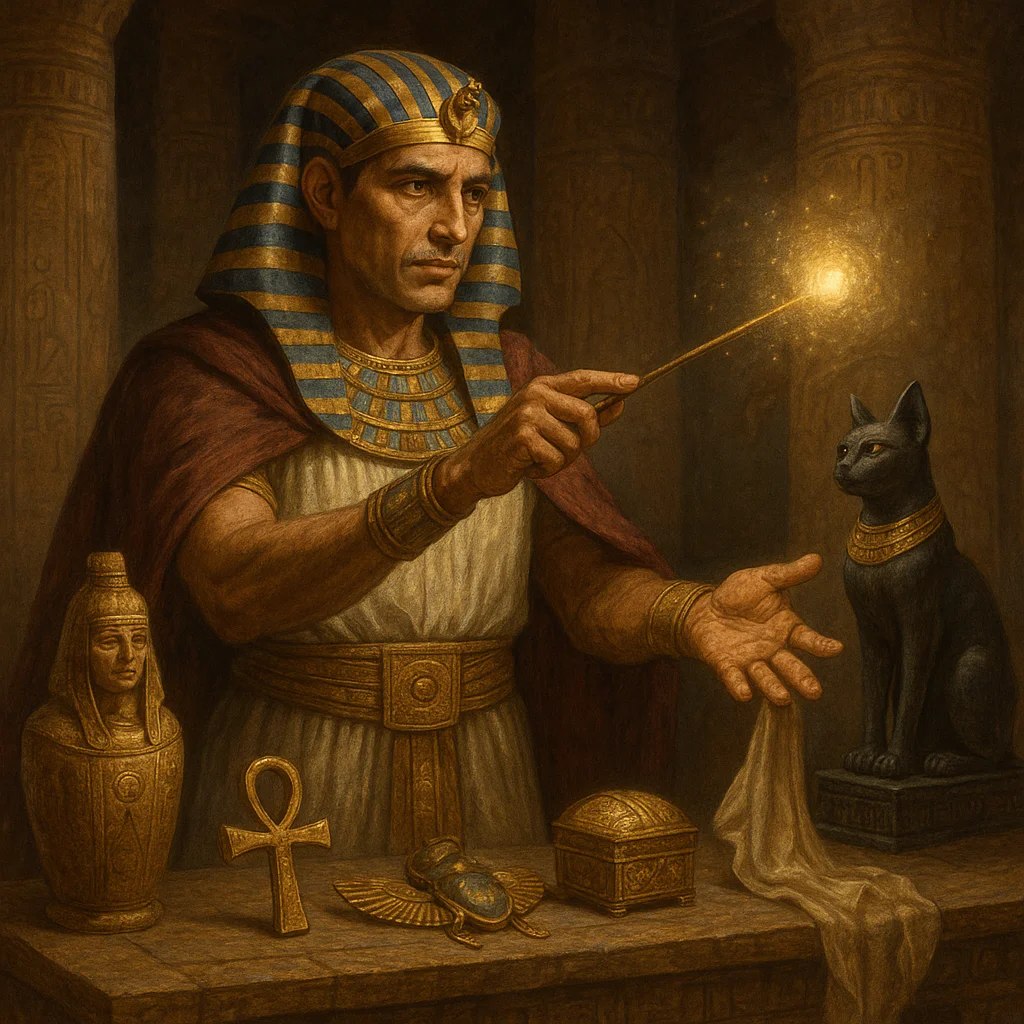
How did ancient civilizations contribute to the development of modern magic tricks? They helped shape magic through ritual traditions, mechanical wonders, object manipulation, and performance techniques that still influence how magicians create a sense of impossibility. The story isn’t a simple handoff from ancient temples today’s stage: it’s a lively mix of inventions, shared ideas, and legends that need a little fact-checking.
Consider ancient Egypt’s Dedi, a magician in a tale preserved on the Westcar Papyrus. His feats sound like spectacular stage magic—but the story is literature, not a surviving performance review. That distinction is part of the fun: the clues are fascinating, and the evidence sometimes keeps its secrets.
Key Takeaways
- Ancient magic included more than entertainment: rituals, divination, engineering, and conjuring all shaped how people experienced the marvelous.
- Ancient Egypt offers intriguing clues, including the story of Dedi and a debated image sometimes linked to the cup-and-balls trick.
- Greek mechanical ingenuity influenced theatrical spectacle: hidden mechanisms and automata showed how concealed causes could create wondrous effects.
- Modern magic preserves enduring principles such as misdirection, timing, storytelling, vanishes, and surprising productions.
- Historical claims deserve careful reading: similar effects don’t prove direct influence, and legends like the Indian rope trick are not the same as verified evidence.
Table of Contents
- ⚡️ Quick Tips and Facts
- 🏺 Ancient Roots of Modern Magic Tricks
- What Counts as Magic, Illusion, and Sleight of Hand?
- How Historians Trace the Origins of Magic
- 🪄 8 Ways Ancient Civilizations Shaped Modern Magic
- 1. Ancient Egypt: Sacred Rituals and the Cup-and-Balls Effect
- 2. Ancient Greece: Mechanical Wonders and Theatrical Illusions
- 3. Ancient Rome: Street Performance and Audience Misdirection
- 4. Ancient China: Acrobatic Feats and the Art of Deception
- 5. Ancient India: Conjuring, Storytelling, and the “Indian Rope Trick”
- 6. Mesopotamia: Divination, Priests, and Hidden Knowledge
- 7. Ancient Jewish and Early Christian Traditions: Wonders and Their Interpretations
- 8. Cross-Cultural Trade: How Tricks and Techniques Traveled
- 🎩 Ancient Effects That Still Apear in Magic Shows
- Cup-and-Balls, Vanishes, and Productions
- Optical Illusions, Automata, and Mechanical Magic
- Mentalism, Prediction, and Apparent Supernatural Powers
- 🧠 The Secrets Behind the Wonder: Misdirection, Props, and Performance
- How Magicians Guide Attention
- From Temple Apparatus to Stage Magic Props
- Why Storytelling Makes an Illusion Convincing
- 📜 Myth, Evidence, and Historical Debate
- What Ancient Texts and Artifacts Can—and Cannot—Prove
- Separating Historical Conjuring from Legend
- 🌍 From Ancient Ritual to Modern Entertainment
- How Magic Changed Across the Middle Ages and Renaissance
- The Rise of the Professional Magician and Stage Illusion
- Ancient Influences in Close-Up, Stage, and Street Magic Today
- 🔍 How to Explore Ancient Magic Responsibly
- Museum Collections, Reliable Books, and Primary Sources
- Respecting Sacred Traditions and Cultural Context
- ✨ Conclusion
- 🔗 Recommended Links
- ❓ FAQ
- Did ancient Egyptians invent the cup-and-balls trick?
- Were ancient priests actually performing magic tricks?
- Did ancient civilizations use trapdoors, mirrors, or hidden mechanisms?
- Is the Indian rope trick historically real?
- Which ancient civilization most influenced modern magic?
- What is the oldest documented magic trick?
- 📚 Reference Links
Quick Tips and Facts
- Ancient magic wasn’t one thing. Depending on the place and period, the word could describe religious ritual, healing, divination, mechanical spectacle, or deliberate deception for entertainment.
- The oldest known magic trick is often said to be the cup-and-balls effect. That claim needs a caveat: ancient Egyptian image is suggestive, but it does not prove that Egyptians performed the exact routine modern magicians use.
- The best-documented ancient account of a magician is the Egyptian tale of Dedi, preserved in the Westcar Papyrus. It is a literary story, not a modern eyewitness report.
- Misdirection, secret preparation, audience management, and theatrical storytelling are ancient in spirit, even though the precise methods and props have changed.
- Greek engineers such as Hero of Alexandria described devices that used pressure, weights, and hidden mechanisms to produce apparently wondrous effects.
- Ancient performers and ritual specialists should not all be labeled “magicians” in the modern stage-entertainer sense. Their social roles varied greatly.
- Our practical takeaway: ancient civilizations contributed more to magic’s performance principles and cultural power than to a provable, unbroken catalog of modern tricks.
| Quick fact | What we can responsibly say |
|---|---|
| Ancient Egyptian evidence | Art and literature offer clues, but interpretations are debated. |
| Greek contribution | Technical writing records ingenious automata and theatrical devices. |
| Roman contribution | Writers describe conjurers and entertainers, though surviving accounts are uneven. |
| Modern legacy | Cups-and-balls routines, vanishes, productions, mechanical effects, and misdirection remain familiar to audiences. |
| Best evidence habit | Separate what a source explicitly says from what later writers infer. |
For broader context, explore our Magic History and Illusions guides. 🏺
🏺 Ancient Roots of Modern Magic Tricks
When we talk about ancient magic, we’re looking at a big, messy, fascinating category. A priest conducting a protective rite, an engineer building a self-moving temple door, and a street performer making a coin vanish might all have seemed “magical” to an audience—but they were not doing the same job.
The enduring connection to modern magic is less “one ancient civilization invented every trick” and more people discovered that controlled attention, clever apparatus, and a compelling story can make the impossible feel close enough touch.
What Counts as Magic, Illusion, and Sleight of Hand?
For clarity, we use a few working definitions:
| Term | Meaning in this guide | Example |
|---|---|---|
| Ritual magic | Practices intended to affect health, fortune, spirits, or divine forces | Protective amulets or healing rites |
| Conjuring | Entertainment built around apparent impossibilities | A ball vanishing from a hand |
| Mechanical wonder | A device that produces a surprising movement or effect | A hidden mechanism opening a door |
| Misdirection | Directing attention away from a secret action or method | A gesture that draws the eye while a prop is secretly managed |
| Sleight of hand | Skilled, concealed manipulation of objects | A coin apparently disappearing |
| Stage illusion | A theatrical effect that creates an impossible visual impression | A person appearing or vanishing onstage |
These categories can overlap. A mechanical device might be part of a religious ceremony, while a conjurer might borrow the language of supernatural power to heighten an entertainment routine.
A useful caution: a source calling someone a “magician” does not automatically mean that person performed a modern stage trick. Ancient labels and social expectations differed. The British Museum’s collection and research resources are a good place to see how objects are interpreted in their archaeological context rather than through a modern entertainment lens.
How Historians Trace the Origins of Magic
We rely on three kinds of evidence, and none is a perfect time machine:
- Texts: stories, technical manuals, religious writings, and descriptions by observers.
- Images and artifacts: wall paintings, figurines, tools, containers, and stage-related objects.
- Later retellings: accounts that may preserve older traditions but can also reshape them.
The Egyptian Westcar Papyrus, for example, includes a story about the magician Dedi at the court of King Khufu. It is valuable evidence for how Egyptians imagined magical expertise, but it is a literary tale—not a verified performance transcript. You can read background on the papyrus through the British Museum and the University of Oxford’s Griffith Institute.
Likewise, an image that looks like cups and balls may be suggestive without proving the exact props, handling, or routine. We treat such evidence as a clue, not a confession. That distinction helps resolve a common disagreement: popular articles often call an effect “the oldest trick,” while historians generally ask what the evidence can actually establish.
🪄 8 Ways Ancient Civilizations Shaped Modern Magic
The following influences are not a claim that every modern trick descends directly from one ancient source. They show the ideas, settings, and performance habits that helped shape magic’s long history.
1. Ancient Egypt: Sacred Rituals and the Cup-and-Balls Effect
Egyptian religion and daily life included practices involving protection, healing, divine power, and ritual knowledge. The Egyptian word often translated as magic, heka, referred to a powerful force within the religious worldview—not simply a performer’s secret method. The Metropolitan Museum of Art’s overview of ancient Egyptian religion provides useful cultural context.
The Westcar Papyrus tells of Dedi, a reputed magician who performs extraordinary feats before the king. The story includes the restoration of a severed animal’s head, a dramatic scene that sounds like a stage effect to modern readers. But the text frames Dedi within a courtly tale and its own worldview. We should not flatten it into “an ancient magic show.”
The cup-and-balls question
A well-known image from the tomb of Baqet III at Beni Hasan is often presented as evidence for ancient cup-and-balls trick. It shows figures handling objects, but scholars and commentators have disagreed about what the scene depicts. It may represent juggling, a game, or another activity.
So what can we say?
- Reasonable: ancient Egyptian images have inspired discussion about early object-manipulation performances.
- Too strong: “This proves modern cup-and-balls was invented in ancient Egypt.”
- Best conclusion: the effect is ancient in its broad family of vanishes and productions, but a direct, continuous line from one Egyptian scene today’s routine is not established.
Modern cup-and-balls performers still rely on the same audience puzzle: where did the object go, and when did it get there? For contemporary practice, see our Close-up Magic and Coin Tricks categories.
2. Ancient Greece: Mechanical Wonders and Theatrical Illusions
Greek writers and engineers explored how hidden mechanisms could create effects that looked astonishing. Hero of Alexandria, writing in the Roman-era Greek-speaking world, described automata, theatrical devices, and mechanisms using air, water, weights, and pressure. His work survives through translations and technical editions, including resources from the Internet Archive and the Science Museum Group.
Hero’s devices were not necessarily “magic tricks” in the modern sense. They are still highly relevant because they demonstrate a core principle of stage illusion: a spectator sees the effect; the operator controls the cause.
Examples of ancient mechanical ingenuity include:
- Doors that appear to open through concealed mechanisms.
- Figures or vessels that move when a hidden system is activated.
- Theatrical devices that exploit pressure, heat, or counterweights.
- Automata designed to surprise viewers with movement.
Modern stage magic uses more sophisticated engineering, but theatrical bargain is familiar: the audience understands that a marvel is being presented, yet wants to experience it as impossible. Explore our Illusions section for modern examples of that principle.
3. Ancient Rome: Street Performance and Audience Misdirection
Roman writers mention performers who entertained crowds with feats of dexterity and apparent impossibility. The surviving references are scattered, and descriptions do not always give enough detail to reconstruct a routine. That makes Roman conjuring harder to document than Hero’s mechanical devices.
Still, Roman public life offers a useful setting for understanding performance:
- Crowds gathered at festivals, markets, and public events.
- Performers competed for attention in busy environments.
- A successful act needed clear visual effects, rhythm, and a strong reveal.
- Audience management mattered: the performer had to keep spectators watching the right place at the right moment.
That last point remains essential in street magic. A close-up performer may use timing, humor, eye contact, and a spectator’s own choices to guide attention without making the audience feel pushed around. The technical secret is only one part of the experience.
4. Ancient China: Acrobatic Feats and the Art of Deception
Ancient Chinese performance traditions included acrobatics, juggling, balancing, and spectacular feats. The evidence spans different periods and regions, so it is more accurate to speak of a long tradition of varied performance arts than to claim that one specific modern trick originated in a single ancient show.
These traditions contributed to the broader performance environment in which skill and illusion could be combined:
- Physical control made feats seem beyond ordinary ability.
- Props could become extensions of a performer’s body.
- Repetition and choreography helped hide the moment of change.
- Visual spectacle worked even when an audience could not hear every word.
Modern magicians still borrow from this performance logic. A production is more convincing when the handling looks natural, the timing has a beat, and the performer’s body directs attention. If you enjoy the hands-on side, our Card Tricks guides cover how choreography and attention work together.
5. Ancient India: Conjuring, Storytelling, and the “Indian Rope Trick”
India has a deep and varied history of ritual practice, performance, storytelling, and conjuring. Travelers’ accounts and later retellings describe Indian performers, but these sources must be read carefully: outsiders sometimes misunderstood what they saw, while later versions embellished stories for dramatic effect.
The famous Indian rope trick is a good example. Its popular form describes a rope rising into the air, with a boy climbing it and disappearing or being cut apart. Reports vary, and skeptics have questioned whether the classic version was ever performed as described. The Smithsonian Magazine discusses the legend and the controversy around it.
What is reliable? India has long-standing traditions of street performance and conjuring. What is not firmly established is that the most spectacular version of the rope trick happened as later stories claim.
This distinction matters because magic history is full of entertaining legends. A good story can reveal what audiences wanted to believe, even when it cannot verify what occurred.
6. Mesopotamia: Divination, Priests, and Hidden Knowledge
In Mesopotamian societies, ritual specialists interpreted omens, dreams, celestial signs, and other events. These roles were connected to religious and scholarly systems, not merely entertainment. The British Museum’s Mesopotamia resources and the University of Pennsylvania Museum offer accessible archaeological context.
Why include this in a history of magic tricks? Because ancient audiences often encountered claims of hidden knowledge—the ability to reveal what was concealed or predict what was coming. Modern mentalism uses a different framework, usually presented as entertainment, but the audience question can feel familiar: “How could the performer know that?”
The important difference is intent and context. Divination was often a serious practice within a belief system; modern mentalism is generally theatrical. Treating both as identical would erase the beliefs and institutions that gave ancient practices their meaning.
7. Ancient Jewish and Early Christian Traditions: Wonders and Their Interpretations
Ancient religious texts describe wonders, healings, signs, and acts attributed to divine power or other spiritual forces. These accounts were written within specific theological traditions. They are not neutral reports of stage performances, and they should not be casually recast as evidence of conjuring.
For historians of magic, such texts show how communities interpreted extraordinary events and debated their sources. The question was often not “What was the secret trick?” but “What power or authority does this event demonstrate?”
That contrast still shapes how people respond to magic. A theater audience may enjoy being fooled because everyone has agreed to play. In a religious context, claims of supernatural power can carry profound consequences. Responsible discussion keeps those settings separate.
8. Cross-Cultural Trade: How Tricks and Techniques Traveled
Trade routes, migration, conquest, and travel moved objects and stories between regions. A technique could travel with a performer; a prop could be adapted locally; a tale could change each time it was retold.
| Route of influence | What could travel | Why it matters |
|---|---|---|
| Trade and travel | Props, materials, performance styles | A local effect could gain new versions elsewhere |
| Military and political contact | Technologies and theatrical customs | Practical devices could inspire spectacle |
| Storytelling | Legends, marvels, accounts of foreign performers | Stories shaped audience expectations |
| Written transmission | Technical descriptions and collections of tricks | Later performers could learn without meeting the original practitioner |
We should be cautious about claiming a direct origin whenever two cultures share a similar effect. Simple methods—hiding an object, changing its location, or revealing it at the right moment—can be invented independently. Similarity is evidence of resemblance, not automatically proof of borrowing.
🎩 Ancient Effects That Still Apear in Magic Shows
Modern routines often share broad structures with older entertainments: an object is introduced, something impossible happens, and the object appears again in an unexpected place. The method may be entirely different. The dramatic shape, however, is wonderfully durable.
Cup-and-Balls, Vanishes, and Productions
The cup-and-balls routine is one of magic’s most recognizable families of effects. A performer apparently moves small objects beneath cups, vanishes them, or makes them reappear—sometimes in impossible locations.
Why it endures:
- The props are simple and visible.
- The audience can follow the apparent rules.
- Repetition builds confidence, then a surprise breaks it.
- The routine can be performed close-up or onstage.
- The ending can escalate into a larger production.
A classic routine also teaches a useful lesson: the audience often watches the cup that seems most important, while the method depends on what happens elsewhere. That is not merely a hand secret; it is a choreography of attention.
Optical Illusions, Automata, and Mechanical Magic
Ancient mechanical wonders and modern stage apparatus share an interest in concealed causes. Today’s methods may involve carefully engineered props, lighting, mirrors, trapdoors, or electronic controls. The audience sees a clean effect; the backstage team handles the complexity.
| Effect family | Ancient parallel | Modern performance form |
|---|---|---|
| Apparent movement | Automata and mechanical figures | Self-moving props or animated stage objects |
| Suden appearance | Theatrical devices and concealed mechanisms | Productions from boxes, tables, or stage scenery |
| Vanishing | Hidden-object principles | Sleight of hand, lighting, screens, or apparatus |
| Impossible transformation | Storytelling and visual surprise | Costume changes, substitutions, or engineered illusions |
Not every modern illusion has ancient ancestor. The useful connection is the design principle: make the visible effect clear, then conceal the causal chain.
Mentalism, Prediction, and Apparent Supernatural Powers
Mentalism presents apparent mind reading, prediction, influence, or extraordinary memory. It is not the same as ancient divination, even if both involve questions about hidden knowledge.
A responsible modern performer should be clear about the entertainment context and avoid exploiting vulnerable spectators. The strongest mentalism is not a claim of genuine supernatural power; it is a carefully constructed experience built from psychology, presentation, method, and audience participation.
🧠 The Secrets Behind the Wonder: Misdirection, Props, and Performance
At Magic Trick™, we often remind learners that a secret method is only the engine. The audience experiences the journey. An ancient or modern effect succeeds when the method, timing, and presentation work as one.
How Magicians Guide Attention
Misdirection does not simply mean “look over there.” It includes every choice that makes one moment feel important and another feel ordinary.
- Establish a clear focus. Show the object or action the audience should follow.
- Create a natural reason for movement. A gesture, question, or change in posture gives the eye somewhere to go.
- Time the secret action. The hidden move should happen when attention is elsewhere—not merely when the hands move quickly.
- Reinforce the apparent story. The audience should remember the effect, not the mechanics.
- Let the revelation breathe. A pause gives spectators time to understand what they think they saw.
A common beginner mistake is rushing. Speed can look suspicious; clarity and timing are more persuasive than frantic fingers. Our Close-up Magic and Coin Tricks sections offer related practice ideas.
From Temple Apparatus to Stage Magic Props
Props are not magic by themselves. Their meaning depends on context and handling.
- A cup can be an ordinary household object or the centerpiece of a routine.
- A hidden mechanism can be a practical device or theatrical apparatus.
- A coin can be currency, a symbol, or a tool for a vanishing effect.
- A box can suggest storage while concealing a secret function.
Ancient temple devices, where documented, belonged to religious or ceremonial environments. Modern stage props belong to performance. The resemblance lies in theatrical principle of controlling what an audience can see, not necessarily in a direct line of invention.
Why Storytelling Makes an Illusion Convincing
A trick becomes memorable when it has a reason to happen. “Watch this coin disappear” is an effect. A story about a coin that keeps returning to its owner gives the same effect a character and a destination.
Storytelling can:
- Make a method feel motivated rather than suspicious.
- Build suspense before the reveal.
- Help spectators remember the effect.
- Give an old principle a fresh presentation.
- Make the audience part of the experience.
A popular evolution-of-magic article describes magic as having come “a long way from its origins in ancient rituals.” That is a useful broad summary, but it should not imply a simple, uninterrupted lineage. Ritual practice, mechanical spectacle, and theatrical conjuring have intersected in different ways across cultures and centuries.
The first YouTube video embedded above presents a sweeping timeline, from ancient rituals through stage and television magic to digital effects. Its broad point—that magic keeps changing while preserving wonder—is compelling. Some individual origin stories, such as precise claims about the oldest trick, deserve more caution than a fast-moving video can provide.
📜 Myth, Evidence, and Historical Debate
Magic history is especially vulnerable to confident claims because a mysterious image or colorful story is irresistible. We love a good origin tale too—but we also want to know what the evidence supports.
What Ancient Texts and Artifacts Can—and Cannot—Prove
| Evidence | What it can help establish | What it usually cannot prove by itself |
|---|---|---|
| A written story | What a culture imagined, valued, or described | That every event happened exactly as narrated |
| A tomb image | What activities or objects were represented | The precise method or modern identity of the activity |
| A technical manual | How a mechanism was intended to work | That it was used as a public magic performance |
| A later travel account | What an observer claimed to see | That the account was complete or unbiased |
| A modern retelling | How a legend has developed | That the oldest version is historically accurate |
A helpful rule: quote the primary evidence, identify the interpretation, and label speculation as speculation. This is why historians may sound less certain than popular summaries. They are not trying to drain the fun; they are keeping the fun attached to what we can actually know.
Separating Historical Conjuring from Legend
Stories about Dedi, the Indian rope trick, and ancient cup-and-balls performances are fascinating for different reasons:
- Dedi appears in an Egyptian literary narrative.
- The rope trick became a famous cross-cultural legend whose details vary.
- The Egyptian image often linked to cup-and-balls has competing interpretations.
These cases are not equal kinds of evidence. A literary story, a disputed image, and a later performance legend require different methods of evaluation. The Magic History category is a good starting point for exploring related historical claims without treating every popular anecdote as settled fact.
🌍 From Ancient Ritual to Modern Entertainment
Magic transformed as societies, technologies, and audiences changed. The broad history is not a straight road from temple to theater; it is a set of overlapping traditions, rediscoveries, and reinventions.
How Magic Changed Across the Middle Ages and Renaissance
In medieval Europe, ideas about magic could be associated with religion, natural philosophy, healing, forbidden practice, or entertainment. Performers might work at fairs and markets, while others faced suspicion because people believed they were invoking dangerous forces.
The Renaissance brought renewed interest in classical learning, mechanical knowledge, and printed books. As secrets circulated more widely, magic could increasingly be discussed as a craft and performed as entertainment. The Folger Shakespeare Library and the Wellcome Collection provide resources for studying changing ideas about performance, science, and belief.
The shift was not universal or immediate. A trick could be entertainment to one audience and suspicious “magic” to another. Context determined how people interpreted the same apparent marvel.
The Rise of the Professional Magician and Stage Illusion
From the early modern period onward, performers increasingly presented magic in dedicated venues and theatrical formats. Larger audiences encouraged bigger effects, stronger visual design, and a recognizable performer persona.
By the 18th and 19th centuries, theatrical conjuring developed into a public art form with elaborate scenery and specialized apparatus. Later performers—including Harry Houdini—made escape artistry and publicity central to their stage identities. The Library of Congress holds historical materials that help document the people and popular culture surrounding modern performance.
Ancient Influences in Close-Up, Stage, and Street Magic Today
The ancient influence is clearest in recurring performance principles:
- Close-up magic: small objects, intimate attention, and moments of impossible change.
- Stage magic: visual clarity, theatrical framing, and concealed apparatus.
- Street magic: quick rapport, flexible presentation, and audience participation.
- Mentalism: the appearance of access to hidden information.
- Digital magic: familiar principles combined with screens, editing, or augmented effects.
The first video’s timeline highlights later milestones such as Houdini, David Copperfield, television, and David Blaine. Those are important chapters in modern magic, but they do not erase the ancient contribution: audiences have long been captivated by the same essential question—what did I just see?
🔍 How to Explore Ancient Magic Responsibly
Curiosity is a wonderful research tool. A little source-checking keeps it from turning a suggestive image into a “proven fact” before breakfast.
Museum Collections, Reliable Books, and Primary Sources
When checking a claim:
- Find the earliest source you can. Is it an artifact, ancient text, later travel report, or modern article?
- Check the institution. Museums, universities, and scholarly projects usually explain evidence and uncertainty.
- Compare interpretations. If experts disagree, learn what each interpretation rests on.
- Watch for invented certainty. Words like “first,” “oldest,” and “invented” often need careful qualification.
- Keep categories distinct. Ritual magic, conjuring, engineering, and religious miracle stories are not interchangeable.
Start with the British Museum, the Metropolitan Museum of Art, the Griffith Institute, and the Science Museum Group.
Respecting Sacred Traditions and Cultural Context
Ancient practices belonged to real communities with their own beliefs, languages, and institutions. We should avoid treating sacred rites as if they were merely primitive stage tricks.
A balanced approach asks:
- How did practitioners understand their own actions?
- How did audiences interpret the event?
- Is the source an insider account, an outsider’s description, or a later retelling?
- Does calling the practice “magic” clarify the evidence—or distort it?
That respect makes the history richer, not less entertaining. It helps us see how people created wonder in many different ways—and why those ways mattered.