Support our educational content for free when you purchase through links on our site. Learn more
What Materials Do You Need for Basic Magic? 🎩


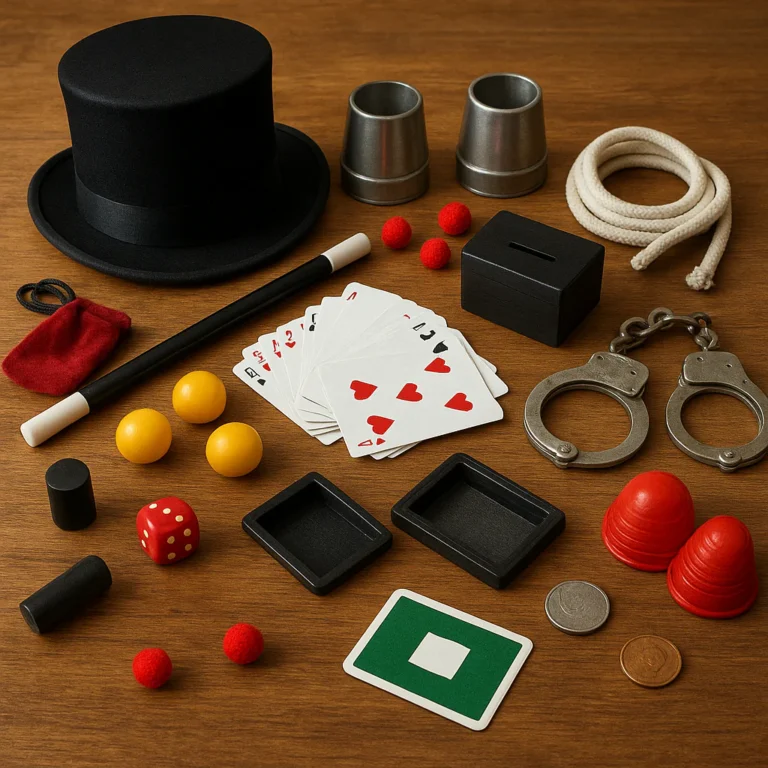
What materials do I need to perform basic magic tricks? Start with a standard deck of playing cards, a coin, rubber bands, soft rope, paper, and an everyday cup. These simple props are affordable, easy to find, and enough to help you learn a surprising range of beginner tricks—no mysterious trunk required.
We’ve seen a plain coin steal the show at a kitchen table while a fancy prop sat untouched in a bag. The secret wasn’t the coin; it was choosing a clear, reliable object and practicing until the handling felt natural.
You can add specialty props later, once a trick calls for them. For now, a small, well-practiced kit beats a drawer full of gadgets every time.
Key Takeaways
- Start with everyday materials: cards, coins, rubber bands, rope, paper, and a cup cover many basic magic tricks.
- Choose props for the effect and audience: larger, contrasting objects are easier to see; durable, unbreakable props are safer for children.
- Practice matters more than buying more: rehearse the handling, angles, timing, and reveal with a mirror or phone camera.
- Keep your beginner kit compact: carry only the props you need for the tricks you can perform confidently.
- Prioritize safety and respect: avoid sharp, breakable, or choking-hazard props, and ask before borrowing someone’s belongings.
Table of Contents
- ⚡️ Quick Tips and Facts
- 🎩 Background: The Materials Behind Basic Magic Tricks
- 🧰 Essential Materials for Beginner Magic Tricks
- 1. Playing Cards
- 2. Coins and Small Objects
- 3. Rope, String, and Shoelaces
- 4. Rubber Bands
- 5. Paper, Envelopes, and Notepads
- 6. Cups, Balls, and Everyday Containers
- 7. Scarves and Handkerchiefs
- 8. Pens, Pencils, and Markers
- 9. Dice and Small Props
- 10. Napkins and Tissues
- 11. Safety Pins and Paper Clips
- 12. Clear Tape and Other Simple Supplies
- 13. A Mirror for Practice
- 14. A Close-Up Mat or Practice Surface
- 15. A Small Case for Organizing Your Props
- 🪄 Choose Materials by Type of Magic Trick
- Card Magic
- Coin and Vanishing Object Tricks
- Rope and Rubber Band Magic
- Impromptu Magic with Everyday Items
- Simple Mentalism and Prediction Effects
- 🛒 What to Buy First: A Beginner Magic Kit Checklist
- 🏠 Household Items You Can Use for Magic
- ✨ How to Pick Props That Suit Your Trick and Audience
- 🎒 Setting Up a Portable Magic Kit
- 🧼 Caring for and Replacing Your Magic Props
- 🛡️ Safety, Practice, and Ethical Performance Tips
- 🎬 Practice Space, Lighting, and Presentation Basics
- ❌ Common Beginner Mistakes When Choosing Magic Materials
- 🔍 Do You Need Special Magician’s Gimmicks?
- 💡 Basic Magic Trick Ideas Using Simple Materials
- Conclusion
- Recommended Links
- FAQ
- Reference Links
Quick Tips and Facts
The best starter kit for basic magic tricks is probably already hiding in your kitchen drawer. A deck of cards, a coin, a rubber band, string, paper, and a cup can support dozens of beginner-friendly effects—no velvet cape or suspiciously large top hat required. Our Magic Trick guide explores how simple props and clear presentation turn ordinary objects into memorable moments.
| Quick fact | What it means for you |
|---|---|
| Everyday items can make effective props | Start with familiar objects before buying specialist gimmicks. |
| Props should fit the trick | A soft rope is easier to handle than stiff cord; a standard deck is more versatile than novelty cards. |
| Practice matters more than prop quantity | Rehearse handling, timing, and angles before performing. |
| Safety comes first | Avoid sharp, breakable, hot, or ingestible props when performing for children. |
| A small kit is enough | A few reliable objects are easier to organize and carry than a suitcase full of gadgets. |
Our quick starter checklist:
- ✅ One standard deck of playing cards
- ✅ A few coins in a consistent size
- ✅ Two or three rubber bands
- ✅ A piece of soft rope or string
- ✅ Paper, envelopes, and a pencil
- ✅ A cup or mug and a small sponge ball
- ✅ A mirror or phone camera for practice
Start with tricks you can perform comfortably at close range. Our close-up magic collection and card tricks collection are natural places to explore once you’ve chosen your props. One question will guide the rest of this list: which materials are worth keeping in your kit, and which can stay in the junk drawer?
🎩 Background: The Materials Behind Basic Magic Tricks
Magic props work because audiences bring assumptions to ordinary objects. A coin is expected to be solid. A playing card is expected to remain unchanged. A rope is expected to have two ends. The magician uses attention, timing, method, and presentation to make those assumptions woble.
That principle has a long history. The Library of Congress preserves historical collections that help researchers explore performance and popular culture, while the Museum of the Moving Image examines how visual storytelling shapes what audiences see. For magic’s own history, the Magic Circle Museum offers a specialist look at the art and its performers.
A useful distinction:
| Prop type | Example | Best for |
|---|---|---|
| Ordinary object | Coin, cup, pencil | Impromptu magic and familiar settings |
| Performance prop | Sponge balls, magician’s rope | Repeated use and clearer handling |
| Special gimmick | Secretly altered object | A particular effect that requires a purpose-built method |
| Practice tool | Mirror, phone camera, close-up mat | Rehearsing angles, rhythm, and control |
Many beginner tutorials emphasize household materials. For example, the video “Five Easy Magic Tricks You Can Do” uses items such as a ball, cup, tie, cards, and string. Another beginner video describes tricks with coins, candy, rope, a bottle, and a matchbox. These examples show that a trick’s impact doesn’t depend on an expensive prop. However, an everyday object may be less durable or less easy to handle than one chosen specifically for performance.
🧰 Essential Materials for Beginner Magic Tricks
Here are the core materials we recommend. Choose items that feel comfortable in your hands, are easy to replace, and suit the tricks you actually plan to learn. You don’t need to buy everything at once.
| Material | Strengths | Limitations | Good first use |
|---|---|---|---|
| Playing cards | Versatile, portable, familiar | Cards wear, bend, and show marks | A simple selection or prediction effect |
| Coins | Small, easy to carry | Can be noisy or difficult to grip | A vanish or transfer |
| Rope or string | Visual and easy to understand | Fraying and stiffness affect handling | A knot or restoration effect |
| Rubber bands | Cheap, lightweight, readily available | Snap, dry out, or vary in stretch | A linking or jump effect |
| Paper and envelopes | Easy to customize | Can tear or reveal creases | A prediction or paper restoration |
| Cup and sponge ball | Clear, visual, repeatable | Requires table space and practice | A vanish-and-reappearance routine |
| Mirror or camera | Helpful for practice | Shows only the angles you check | Rehearsing secret moves and posture |
1. Playing Cards
A standard deck is one of the most useful beginner props. It supports countless effects, fits in a pocket, and looks ordinary to an audience. For learning, choose cards with clear, readable faces and a familiar back design. A standard Bicycle Rider Back deck is a common choice among card handlers because it is widely available and easy to replace. Check Bicycle’s official site for its playing-card range, or search Amazon for Bicycle playing cards.
Benefits
- Suitable for close-up performance and practice.
- Easy to carry and reset.
- Works for tricks that rely on a chosen card, a prediction, or a visual change.
Drawbacks
- Thin or heavily worn cards may be harder to handle.
- Distinctive marks, bent corners, or sticky residue can undermine the appearance of a fair deck.
- Cards designed for games may feel different from specialty handling cards.
For advice and inspiration, see our card tricks collection. Start with a basic effect that requires no difficult sleight of hand; a polished reveal beats a rushed flourish every time.
2. Coins and Small Objects
A coin is a superb practice object because it is familiar, compact, and easy to borrow or carry. Use a coin with a size that suits your hand and is easy for your audience to see. A coin that is too small can disappear visually before you perform any magic at all.
Try this selection checklist:
- Choose a coin with a clear, visible edge.
- Use one denomination consistently while learning.
- Practice with a clean, dry coin.
- Avoid unusually valuable, sharp-edged, or sentimental coins.
Coins are useful for vanishes, transfers, productions, and visual transformations. Our coin tricks collection covers effects built around this classic prop. For a beginner, an ordinary coin is usually preferable to a specialty coin: it looks natural, and you can replace it easily.
3. Rope, String, and Shoelaces
Soft rope is easier to bend, tie, and display than stiff cord. For simple rope magic, look for a clean, light-colored length that contrasts with your clothing and the background. A shoelace can work for casual practice, but its narrow shape may be harder to see from a distance.
Check before using rope:
- Is it flexible enough to form a neat loop?
- Is it bright enough to show against the performance surface?
- Are the ends tidy and free of frays?
- Is the length manageable for your hands and venue?
Do not use rope around anyone’s neck or body. Some online videos demonstrate neck-related visual stunts, but copying a stunt without understanding the method and risks is a bad bargain. For family performances, keep rope effects on a table or in your hands.
4. Rubber Bands
Ruber bands are inexpensive, portable, and surprisingly expressive. Their elasticity makes them useful for visual penetrations, jumps, and linking effects. Use bands that are intact and reasonably fresh; brittle bands can snap at the least theatrical moment.
Practical tips:
- Keep spare bands in a small envelope.
- Avoid bands that feel tacky, cracked, or dry.
- Practice slowly so you can spot unintended slips.
- Don’t stretch a band toward someone’s face.
They’re a strong choice for impromptu magic, but their small size means they work best for a nearby audience. For a larger group, pair the effect with clear framing and a strong spoken presentation.
5. Paper, Envelopes, and Notepads
Paper is a versatile material for predictions, drawings, written choices, and visual restorations. Plain, unlined paper is easy to prepare, while envelopes help keep a written prediction clean and concealed until the reveal.
Good options
- Index cards for short predictions
- Printer paper for drawings and simple visual effects
- Envelopes for sealed reveals
- A small notepad for routines involving written choices
Use a dark marker or pen if your audience needs to read the writing from a distance. Keep spare paper flat, dry, and free of accidental creases. Paper tricks are often less about the paper itself than about when the audience sees it and what they believe it proves.
6. Cups, Balls, and Everyday Containers
A cup is a classic everyday prop: familiar, easy to inspect, and useful for vanishes or appearances. A lightweight, opaque cup is generally easier to handle than glass. A sponge ball compresses easily and is visible in close-up, making it a popular beginner prop.
The classic cups-and-balls plot has a long performance history. The Magic Circle Museum provides context for magic’s performance traditions, and our close-up magic collection features the kind of intimate effects where cups and small balls shine.
Cup choice comparison:
| Cup type | Advantages | Drawbacks |
|---|---|---|
| Plastic cup | Light, durable, easy to replace | Can look flimsy or make noise |
| Ceramic mug | Familiar and stable | Breakable and heavier |
| Paper cup | Disposable and common | Can crumple or reveal handling |
| Opaque reusable cup | Good visibility control | Must be checked for markings or defects |
For children’s performances, avoid glass and fragile ceramic. Keep small balls away from toddlers and anyone who might put them in their mouth.
7. Scarves and Handkerchiefs
A bright scarf is visible, light, and easy to carry. It can help frame a production, conceal an object during a routine, or add color to a performance. Choose fabric that drapes rather than clings; very slippery or stiff material can be awkward to manage.
What to look for:
- A vivid color that contrasts with your outfit
- Fabric that folds without bulky creases
- A size suitable for your hands and audience
- Clean material with no loose threads
A regular handkerchief works for practice, though purpose-made magician’s silks are often lighter and more consistent. Use ordinary fabric when learning basic handling; upgrade only when a specific trick calls for it.
8. Pens, Pencils, and Markers
Writing tools can serve as props, create predictions, or make a reveal more memorable. A pencil is especially useful for casual, impromptu routines because people recognize it and it is easy to borrow. A marker is easier to read on paper from across a room.
Keep in mind:
- Check that the pen works before you perform.
- Use washable, non-toxic markers for children’s activities.
- Don’t borrow a pen without asking.
- Keep the writing visible enough for the audience to understand the ending.
A prop that fails to write isn’t mysterious; it’s just stationery having a difficult day.
9. Dice and Small Props
Dice, bottle caps, buttons, and other small objects can support prediction and transposition effects. They’re useful when you want to make a routine feel personal, but tiny items can be difficult for a group to see.
| Small object | Performance advantage | Watch-out |
|---|---|---|
| Die | Clear faces and familiar use | Small size can limit visibility |
| Bottle cap | Common, lightweight | Sharp edges or dents |
| Button | Easy to carry | May be too small for a larger audience |
| Coin-sized token | Consistent handling | May seem less ordinary than currency |
If you use a borrowed object, inspect it briefly and return it promptly. Avoid objects that could be swallowed, damaged, or mistaken for something valuable.
10. Napkins and Tissues
Napkins and tissues are convenient for simple vanishes, torn-and-restored presentations, and visual comedy. They’re easy to source, but their thiness makes them fragile and their folds can reveal handling.
Choose a clean, unprinted tissue or a plain paper napkin while practicing. Keep extras nearby, and don’t use tissue that has been wet, crumpled, or handled heavily.
11. Safety Pins and Paper Clips
Paper clips can support simple visual effects and are easy to carry. Safety pins are less suitable for casual beginner practice because they have a sharp point and can snag clothing or skin.
Our recommendation: use paper clips for basic handling practice, and leave sharp pins out of children’s kits. If a routine requires a pin, practice over a table, keep it pointed away from people, and store it closed in a secure container.
12. Clear Tape and Other Simple Supplies
Clear tape, scissors, glue, and craft paper can help prepare simple props. They are support materials, not performance necessities. Keep construction neat: lumpy tape, visible adhesive, and raged edges can make a homemade prop look suspicious.
For children, use blunt-tip scissors with supervision. Follow the product label for adhesives, and avoid using tape on skin or delicate surfaces.
13. A Mirror for Practice
A mirror helps you check posture, hand position, and visible angles. It can reveal problems you miss when practicing only by feel. But a mirror is not a substitute for an audience: it shows one view at a time, and you may unconsciously perform differently when watching yourself.
Practice in stages:
- Learn the sequence without looking at your hands.
- Check the move in a mirror from the audience’s position.
- Record yourself on a phone from several angles.
- Rehearse the full presentation, including the final pause.
14. A Close-Up Mat or Practice Surface
A close-up mat gives cards and coins a soft, consistent surface. It can reduce noise and help small objects stand out. You don’t need a specialist mat to begin: a clean, dark cloth or felt pad can work for practice.
A commercial mat is useful if you perform regularly, but a table surface is perfectly adequate for many tricks. The key is contrast: dark coins on a dark mat, for example, are harder to see.
15. A Small Case for Organizing Your Props
A pencil pouch or compact case can keep cards, bands, rope, and paper together. Separate fragile or sharp items, and don’t store rubber bands stretched around objects; they can deform or break.
Simple organization plan
- Pocket section: cards and a few rubber bands
- Paper section: prediction slips and envelopes
- Soft-prop section: rope, scarf, or sponge ball
- Practice section: small mirror or notepad
The ideal case is the one you’ll actually carry. A tidy kit gives you options without making you look as though you’re about to move house.
🪄 Choose Materials by Type of Magic Trick
Different kinds of magic call for different props. Here’s a straightforward guide to matching materials to the effect you want to perform.
| Magic style | Best starting materials | Performance setting |
|---|---|---|
| Card magic | Standard deck, table or close-up mat | Small groups, casual gatherings |
| Coin magic | One or two coins, clear surface | Close-up settings |
| Rope magic | Soft rope, scissors for preparation only | Family or small-group performance |
| Impromptu magic | Borrowed coin, pen, cup, napkin | Everyday situations |
| Prediction magic | Paper, envelope, pen, small object | Table or parlour setting |
Card Magic
A standard deck offers the broadest range of beginner effects. Start with a routine that relies on a simple choice, reveal, or prediction rather than a difficult flourish. See our card tricks collection for more ideas.
Useful materials: a standard deck, a clean table, and optionally a close-up mat.
Coin and Vanishing Object Tricks
Coin tricks rely on visibility, clean handling, and audience attention. A single coin is enough for many beginner routines; adding more coins can complicate practice before it improves the effect. Browse our coin tricks collection for coin-focused ideas.
Useful materials: one clearly visible coin, a contrasting surface, and a quiet place to practice.
Rope and Rubber Band Magic
Rope and rubber-band effects are visual and easy to introduce in casual settings. Use flexible, undamaged materials, and keep your movements deliberate. Rope is more visible to a group; rubber bands are more portable for close-up performance.
Impromptu Magic with Everyday Items
Impromptu magic uses objects people already recognize: cups, pens, napkins, coins, and cards. The 11-trick video by Evan Era emphasizes “No special props needed!” and lists familiar items such as a rubber band, mug, pencil, spoon, balloon, straw, and playing card. Watch “11 Magic Tricks You Can Do Now!” for examples of the everyday-object approach.
The phrase “no special props” doesn’t mean “no preparation.” Some effects still require practice, setup, or careful angles. Ordinary objects make a trick feel spontaneous, but technique makes it convincing.
Simple Mentalism and Prediction Effects
A basic prediction routine can use a notepad, envelope, playing card, or small familiar object. Clear writing and fair-looking handling matter more than fancy stationery.
If your presentation involves a participant’s choices, avoid implying that you can read private thoughts or access personal information. Keep it playful and transparent as entertainment.
🛒 What to Buy First: A Beginner Magic Kit Checklist
Start with props you can use across several effects. The table below ranks materials by versatility, ease of practice, and portability—not by price.
| Starter item | Versatility | Ease for beginners | Portability | Recommendation |
|---|---|---|---|---|
| Standard deck of cards | 10/10 | 8/10 | 10/10 | Buy or borrow first |
| Coin | 8/10 | 6/10 | 10/10 | Choose a comfortable size |
| Rubber bands | 7/10 | 8/10 | 10/10 | Keep a few spares |
| Soft rope | 7/10 | 7/10 | 6/10 | Choose flexible, visible rope |
| Paper and envelopes | 8/10 | 9/10 | 8/10 | Use for predictions and reveals |
| Sponge balls | 7/10 | 7/10 | 8/10 | Helpful for close-up routines |
| Mirror or phone camera | 9/10 | 9/10 | 7/10 | Use for practice, not performance |
Recommended first kit:
- One standard deck, such as Bicycle playing cards
- A few everyday coins
- Fresh rubber bands
- Soft rope or string
- Plain paper and envelopes
- A pencil or pen
- A cup and small sponge ball
- A small pouch to keep everything together
✅ Buy for the trick you’re learning.
❌ Don’t buy a giant collection of gimmicks before you know how to use them.
If you want a ready-made kit, read its contents carefully. Beginner kits vary: some focus on cards, while others include props that require instructions or practice beyond the packaging. A kit is a starting point, not a shortcut around rehearsal.
🏠 Household Items You Can Use for Magic
A household prop works best when the audience already understands what it is. A mug is a mug; a borrowed coin is a coin. That familiarity can make an effect more engaging—but it also means the object should be in good condition and handled respectfully.
| Household item | Possible use | Best practice |
|---|---|---|
| Mug or opaque cup | Vanish or appearance effect | Use an unbreakable cup for children |
| Playing card | Selection or prediction | Use a clean, complete deck |
| Shoelace | Rope-style effect | Check the ends and flexibility |
| Napkin | Visual or comedic routine | Use a clean, unprinted one |
| Pencil | Prediction or visual presentation | Check that it is not sharp or damaged |
| Coin | Vanish or transfer | Ask permission before borrowing |
| Bottle | Prop for a rope routine | Use a stable, unbreakable container |
| Balloon | Visual stunt or party effect | Avoid startling anyone with latex sensitivity |
The video “Five Easy Magic Tricks You Can Do” features a ball and cup, a tie, playing cards, and string. The household-items video “Magic Tricks for Kids” describes effects involving water, coins, candy, rope, a bottle, and a matchbox. These summaries support a useful lesson: ordinary materials make the barrier to trying magic low.
But household objects aren’t automatically safe or suitable. Keep hot drinks, glass, knives, matches, chemicals, and small choking hazards away from child performers. Never use food in a way that could trigger allergies or create a choking risk.
✨ How to Pick Props That Suit Your Trick and Audience
The “best” prop depends on where you’ll perform and who will watch. A coin may be ideal at a kitchen table but too small for a classroom. A card routine can work beautifully for a few people and become difficult to follow from the back of a room.
Ask yourself:
- Can the audience see it? Choose larger, brighter props for more people.
- Can you handle it comfortably? A prop that feels awkward will show in your movements.
- Does it fit the setting? Borrowed items can feel natural in casual performance.
- Is it safe and durable? Avoid fragile or sharp materials, especially around children.
- Does it match the method? Use a prop that suits the actual trick, not just one that looks impressive.
| Audience or setting | Prop priorities |
|---|---|
| One or two friends | Small objects, cards, coins |
| Family gathering | Visible props, simple handling, safe materials |
| Classroom | Durable props, easy-to-see colors, no sharp parts |
| Party or stage | Larger, brighter objects and clear visual framing |
| Walk-around performance | Lightweight, compact, quick-reset materials |
Our magicians often recommend testing a prop under the same lighting and from a similar distance as the performance. A bright red ball that pops on a dark table may disappear against a red sweater. Little details like that are the difference between “How did you do that?” and “I couldn’t see anything.”
🎒 Setting Up a Portable Magic Kit
A compact kit should make it easy to perform, not tempt you to carry every prop you own. Use a small pouch with separate spaces for cards, soft props, and paper.
Pack it in this order:
- Choose three effects you can perform reliably.
- List their shared materials. Carry overlapping props when possible.
- Add one backup for anything disposable, such as a tissue or rubber band.
- Keep props clean and dry.
- Rehearse the reset so you can prepare for the next performance discreetly.
A good pocket kit might contain a deck, a few rubber bands, a coin, a folded prediction, and one small prop. For table magic, add a mat or cloth. For children’s events, leave out small objects that could be swallowed.
🧼 Caring for and Replacing Your Magic Props
Props last longer when you treat them as performance tools rather than pocket clutter.
- Cards: Store them flat and dry. Replace cards that are noticeably bent, sticky, or marked.
- Ruber bands: Keep them away from heat and sunlight; discard cracked or brittle bands.
- Rope: Store it loosely coiled, and trim or replace frayed lengths.
- Paper: Keep prediction slips flat and prepare fresh ones when they crease.
- Sponge balls: Store them clean and dry so they hold their shape.
- Pens and markers: Test them before performing, and cap them after use.
- Cups: Wash reusable props and check for cracks or loose parts.
A worn prop isn’t always unusable, but damage can create distracting clues or make handling unreliable. If you’re unsure, test it in practice before taking it in front of an audience.
🛡️ Safety, Practice, and Ethical Performance Tips
Magic should create surprise, not risk. The American Academy of Pediatrics offers guidance on child safety, while the U.S. Consumer Product Safety Commission publishes broader product-safety information. Use those principles when choosing props for children and family events.
Safety checklist
- ✅ Use unbreakable cups and containers around children.
- ✅ Keep coins, tiny balls, pins, and small parts away from young children.
- ✅ Avoid fire, sharp blades, choking hazards, and unsafe body stunts.
- ✅ Check for latex sensitivities before using balloons or rubber bands.
- ✅ Ask permission before borrowing or handling someone’s property.
- ❌ Never put a small object in someone’s mouth.
- ❌ Never copy a dangerous stunt just because it appears in a video.
Ethically, treat magic as entertainment. Don’t use a trick to pressure people, claim supernatural powers, or embarrass a participant. Ask before involving someone, and give them a graceful role in the effect. The secret is yours; the fun should belong to everyone.
🎬 Practice Space, Lighting, and Presentation Basics
A polished performance depends on more than the prop. Your audience needs to see the object clearly, understand what appears to happen, and have a moment to enjoy the reveal.
A simple practice routine
- Set up the prop under ordinary room lighting.
- Stand or sit where the audience will be.
- Practice the method slowly, focusing on clean handling.
- Check your angles with a mirror or phone recording.
- Add the words and gestures you’ll use during performance.
- Rehearse the ending and reset before repeating the trick.
Keep the background uncluttered. Use a surface that contrasts with your props. If you’re performing cards or coins, avoid placing them beside similar-colored objects.
For inspiration, the Museum of the Moving Image explores how framing and visual presentation shape what audiences notice. Our illusions collection also highlights how perception and presentation contribute to an effect.
❌ Common Beginner Mistakes When Choosing Magic Materials
Even a good trick can stumble if the material is wrong for the job. These are the mistakes we see most often:
- Buying too many props: More equipment means more setup and more things to manage.
- Choosing novelty over reliability: A flashy gimmick is no help if it’s difficult to handle.
- Using damaged materials: Frayed rope and brittle bands can fail during performance.
- Picking props that are too small: The audience may miss the effect.
- Practicing only the secret move: Timing, eye contact, and the reveal matter too.
- Using unsafe objects for children: Small parts, sharp tools, and glass introduce needless risk.
- Copying a video stunt without checking the method: A short demonstration may leave out important safety details.
A useful rule: if a prop makes the trick harder to perform and doesn’t improve the effect, leave it out.
🔍 Do You Need Special Magician’s Gimmicks?
Usually, no—not when you’re learning basic magic. Everyday materials are excellent for practicing fundamentals and presenting impromptu effects. Special gimmicks can make certain methods easier or create results that ordinary props can’t, but they should serve a clear purpose.
| Option | Benefits | Drawbacks | Best for |
|---|---|---|---|
| Everyday objects | Familiar, accessible, easy to replace | May be inconsistent or less visible | Beginners and impromptu magic |
| Purpose-made props | Often durable and designed for handling | Limited to particular effects | Regular performance |
| Gimmicked props | Can enable specific effects | Require learning, care, and suitable presentation | Magicians who know the routine they want |
A video may advertise “no special props,” while a shop sells specialty magic equipment. Those claims are not necessarily contradictory: one describes a particular set of tricks; the other serves performers who want a wider repertoire or more consistent props. Start with ordinary objects, then buy specialized equipment only when a specific routine calls for it.
💡 Basic Magic Trick Ideas Using Simple Materials
Here are practical ways to pair beginner materials with a type of effect. These are starting points for choosing props, not full secret methods.
| Material | Beginner-friendly effect idea | What to practice |
|---|---|---|
| Playing cards | Reveal a selected card | Clear instructions and a strong reveal |
| Coin | Make a coin appear to vanish or travel | Smooth hand movement and timing |
| Rubber band | Create a visual jump or link | Safe stretching and clean positioning |
| Rope | Show a knot appearing or disappearing | Flexible handling and clear display |
| Cup and sponge ball | Vanish and reappear | Audience attention and table management |
| Paper and envelope | Reveal a prediction | Preparation and a fair-looking presentation |
| Pencil | Create a visual illusion | Angles and controlled movement |
For tutorials, start with reputable, beginner-oriented material and practice the full routine before showing anyone. The videos “Five Easy Magic Tricks You Can Do”, “Magic Tricks for Kids”, and “11 Magic Tricks You Can Do Now!” offer examples using household items. Treat videos as demonstrations, not proof that every stunt is safe or suitable for every audience.
Our recommendation is simple: choose one deck, one coin, one rubber band effect, and one everyday-object routine. That gives you variety without a prop avalanche. And the mystery from the beginning—what belongs in your kit?—has a tidy answer: the best materials are the ones that suit your trick, audience, and hands, and that you’ve practiced enough to use confidently.