
Support our educational content for free when you purchase through links on our site. Learn more
🎩 The Ultimate Guide to Structuring a Magic Show (2026)

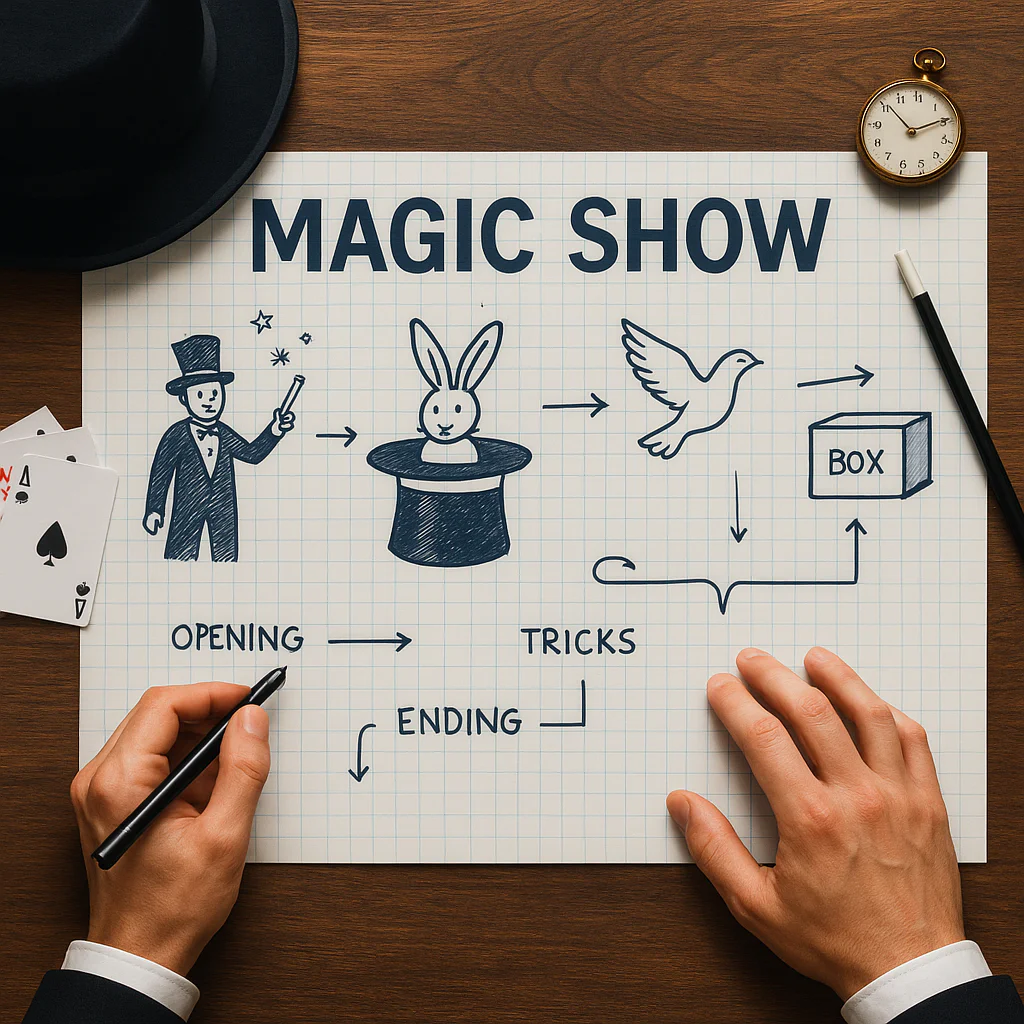
The secret to a standing ovation isn’t just a great trick; it’s Structuring a magic show with a deliberate emotional arc that hooks the audience in the first 30 seconds and leaves them breathless at the end. Most magicians fail not because their sleight of hand is weak, but because their show lacks a narrative spine, turning a potential masterpiece into a disjointed series of “and then” moments.
We once watched a talented young magician perform a flawless card routine that technically amazed everyone, yet the audience walked away feeling nothing. Why? He had no linkage between his effects, and his climax was weaker than his opener. It was a masterclass in technique but a disaster in show construction.
Did you know that audience attention spans for live performances can drop by 40% within the first seven minutes if the pacing doesn’t shift? This is why texture—varying your props, speed, and emotional tone—is just as critical as the trick itself.
Key Takeaways
- The Opener Rule: Your first effect must be visual, fast, and impossible to earn the audience’s trust immediately.
- Narrative Arc: A successful show follows a begining, middle, and end, transforming random tricks into a cohesive story.
- Texture & Pacing: Avoid “visual fatigue” by alternating between comedy, mystery, and high-energy effects.
- The 10% Buffer: Always plan your show to be 10% shorter than your allotted time to account for applause and transitions.
- Linkage is King: Smooth transitions between tricks are what separate a professional act from an amateur hobbyist.
Table of Contents
- ⚡️ Quick Tips and Facts
- 📜 A Brief History of Show Structure: From Court Jesters to Vegas Headliners
- 🧠 The Psychology of Pacing: Why Your Audience Gets Bored (and How to Fix It)
- 🎭 Seven Steps to Constructing a Successful and Commercial Magic Act
- 🚀 What Makes a Good Opening Trick? The Art of the Hook
- ✨ Defining the Feature Trick: Your Show’s Centerpiece
- 🏁 What About a Signature Trick and a Closing Trick?
- 🔗 Linkage and the Length of the Show: Make or Break Matters
- 🎒 Back Ups, Non-Arriving Props, and Oh, My—What to Wear!
- 🎤 Taking a Bow Properly and Managing Your Pockets! Very Important Things…
- 🎬 Set Up, Strike, and Video Taping! Some Final Points
- 🎪 Adapting Your Structure for Different Venues: Wedings, Corporate, and Clubs
- 🎙️ Scripting and Storytelling: Weaving the Narrative Thread
- 🛠️ Troubleshooting Common Structural Flaws in New Acts
- 💡 Conclusion
- 🔗 Recommended Links
- ❓ FAQ
- 📚 Reference Links
⚡️ Quick Tips and Facts
Before we dive into the deep end of show construction, let’s hit the fast-forward button on the essentials. We’ve seen too many talented magicians burn out because they ignored the basics of structure. Here is the Magic Trick™ cheat sheet for a show that doesn’t just work, but wows:
- The Rule of Three: Audiences remember things in threes. Structure your show around three distinct emotional peaks, not just a random list of effects.
- The “No-Repeat” Rule: Never perform two effects using the same prop back-to-back. If you just did a card trick, the next thing better be a coin, a rope, or a mentalism piece.
- The 10% Buffer: Always plan your show to be 10% shorter than the time slot you are given. If you have 20 minutes, perform 18. Leaving them wanting more is infinitely better than being cut off mid-climax.
- The Opener’s Job: Your first trick isn’t about being your best trick; it’s about being your fastest and most visual trick. You have 30 seconds to earn the right to tell a story.
- The Closer’s Job: Your final trick must be the one that leaves the audience with the biggest “How did they do that?” moment. It’s the exclamation point on your sentence.
Did you know? According to a study on audience retention, the average attention span for a live performance drops significantly after the first 7 minutes if the pacing doesn’t shift. This is why linkage is so critical!
If you are looking for the foundational definition of what we are building here, check out our guide on Magic Trick to understand the core philosophy before we break it down.
📜 A Brief History of Show Structure: From Court Jesters to Vegas Headliners
To understand where we are going, we have to look at where we’ve been. The structure of a magic show hasn’t always been the polished, three-act narrative we see in Las Vegas today. In fact, for centuries, magic was less of a “show” and more of a survival tactic.
The Jester’s Gambit
In the medieval courts, the “magician” was often a jester or a fool. Their structure was simple: Amuse, Distract, Survive. They didn’t have a setlist; they had a repertoire of gags and tricks they would pull out based on the King’s mood. If the King was bored, they did a coin vanish. If the King was angry, they told a joke. There was no “climax” because the goal was to keep the ruler from beheading them.
The Victorian Parlor
Fast forward to the 19th century, and magic moved into the parlor. This is where the narrative arc began to take shape. Magicians like Robert-Houdin realized that a show needed a beginning, middle, and end to captivate a seated, paying audience. They introduced the concept of the Feature Trick—a centerpiece that defined the evening.
“A magic show is a story. It has a beginning, a middle, and an end.” — Nick Lewin, Stevens Magic
The Modern Era
Today, we blend these histories. We have the high-energy pacing of the street performer, the narrative depth of the Victorian parlor, and the technical precision of the modern stage. But the core principle remains: Structure is the invisible skeleton that holds the magic together. Without it, you’re just a guy with a deck of cards doing random things. With it, you’re an artist.
For more on how history shaped our current methods, explore our deep dive into Magic History.
🧠 The Psychology of Pacing: Why Your Audience Gets Bored (and How to Fix It)
Let’s be honest: Boredom is the enemy of wonder. If your audience is checking their phones, your structure has failed, no matter how impossible your sleight of hand is.
The Dopamine Loop
Magic works by creating a cycle of Tension (How will they do it?) and Release (Wow, they did it!). If you maintain a constant level of high tension, the audience gets exhausted. If you stay in the “release” phase too long, they get bored. You need to ride the wave.
The “Texture” Problem
One of the biggest structural failures we see is a lack of texture. This term, popularized by experts like Nick Lewin, refers to the variety in your performance.
- Visual vs. Mental: If you do three visual tricks in a row, the audience gets “visual fatigue.” Follow a visual card trick with a mentalism prediction.
- Comedy vs. Serious: A show that is all jokes feels like a comedy club. A show that is all serious feels like a lecture. You need the contrast.
- Fast vs. Slow: A rapid-fire series of small effects followed by a slow, methodical, dramatic routine creates a dynamic rhythm.
The Energy Graph
Imagine your show as a line graph.
- The Opener: Starts high (Visual, fast).
- The Middle: Dips slightly to allow for storytelling and connection, then builds.
- The Climax: Peaks at the highest energy.
- The Closer: Ends on a high note, but allows for a moment of silence before the applause.
If your graph looks like a flat line, you need to inject dynamics. Vary your volume, your speed, and your emotional tone. As the saying goes, “A song with only one note is boring.” Your show is the same.
🎭 Seven Steps to Constructing a Successful and Commercial Magic Act
We’ve all heard of the “Seven Steps” framework mentioned in professional circles. It’s not just a catchy title; it’s a blueprint for turning a hobbyist into a pro. Here is how we at Magic Trick™ break it down:
- Define Your Persona: Who are you? The mysterious stranger? The friendly neighbor? The high-energy comic? Your structure must serve this persona.
- Select Your Effects: Choose tricks that fit your persona and the venue. A close-up coin trick might not work for a 50-person theater.
- Determine the Order: This is where the linkage happens. Arrange the tricks to create a logical flow.
- Write the Patter: The words you say are just as important as the moves. Script your transitions.
- Rehearse the Transitions: Practice moving from Trick A to Trick B without fumbling. The “dead air” between tricks is where the magic dies.
- Test the Timing: Time your show. Does it fit the slot? Is it too long? Too short?
- Refine and Polish: Watch your video. Cut the weak links. Sharpen the strong ones.
Pro Tip: Don’t just practice the tricks. Practice the show. Run through it from start to finish without stopping, even if you mess up. This builds the muscle memory for the entire performance.
🚀 What Makes a Good Opening Trick? The Art of the Hook
Your opening trick is the handshake of your show. It tells the audience, “I am professional, I am in control, and you are in for a treat.”
The Criteria for a Perfect Opener
- Visual Impact: It must be seen from the back of the room. No subtle card palming for the opener unless you have a camera feed.
- Speed: It should be over in under 2 minutes. You don’t want to spend 10 minutes explaining the premise.
- No Complex Setup: If you need to set up a table, hide a prop, or call for an assistant, you’ve already lost the battle.
- The “Impossible” Factor: It should be something that seems physically impossible, not just a clever puzzle.
What to Avoid
- The “Let’s Get to Know You” Opener: Don’t start with a trick that requires the audience to learn your name or backstory. They don’t care yet.
- The “Mystery” Opener: Don’t start with a trick that takes 5 minutes to explain. You need immediate gratification.
Example: A classic opener might be a Card to Pocket effect where a signed card instantly appears in the magician’s pocket. It’s visual, fast, and impossible.
For more on specific opener ideas, check out our collection of Close-up Magic routines.
✨ Defining the Feature Trick: Your Show’s Centerpiece
If the opener is the handshake, the Feature Trick is the main course. This is the trick that defines your act. It’s the one people talk about on the way home.
Characteristics of a Feature Trick
- Duration: It usually takes 3-5 minutes. It allows for a bit more storytelling and buildup.
- Complexity: It can be more complex than the opener because the audience is now invested.
- Emotional Weight: It often carries an emotional story or a deeper theme.
The “Signature” vs. The “Feature”
Sometimes these terms are used interchangeably, but there is a nuance.
- Feature Trick: The main attraction of this specific show.
- Signature Trick: The trick that is uniquely yours, the one you are known for. It might be your feature trick, or it might be a smaller effect you do in every show.
Real World Example: David Copperfield’s “Flying” is a signature trick. It’s his feature. But in a specific show, he might feature a “Levitation of a Statue” as the centerpiece of that act.
🏁 What About a Signature Trick and a Closing Trick?
We touched on the signature trick above, but let’s talk about the Closing Trick. This is the exclamation point.
The Role of the Closer
The closer must be bigger than the feature trick. If your feature trick was a card appearing in a lemon, your closer should be a card appearing in a sealed lemon, or a whole deck of cards vanishing and reappearing in a different location.
The “Signature” in the Closer
Ideally, your closer is your signature trick. It’s the one that leaves the audience with the lingering question: “How is that even possible?”
Common Mistake: Ending with a trick that requires a long explanation or a “gotcha” moment. The closer should be a moment of pure wonder.
🔗 Linkage and the Length of the Show: Make or Break Matters
This is the section where most amateur shows fall apart. Linkage is the art of connecting your tricks so they feel like one continuous story, not a series of disjointed events.
The “And Then” Problem
Amateur magicians often say, “And then I did this trick. And then I did that trick.” This is boring.
Professional Magicians say, “Because of what just happened, I need to do this next trick to prove my point.”
Managing Length
- The 10-Minute Rule: For a standard club set, aim for 10-12 minutes.
- The 45-Minute Rule: For a theater show, you need 45-50 minutes of content, but you must vary the pacing.
- The “Cut” List: Always have a list of tricks you can cut if the show is running long. Never cut the closer!
Insight: As noted in Remarkable Magic, “Linkage and the length of the show. Make or break matters.” If the transitions are clunky, the audience notices. If the show drags, they check their watches.
🎒 Back Ups, Non-Arriving Props, and Oh, My—What to Wear!
Let’s talk about the unglamorous side of magic: Logistics.
The Backup Plan
What happens if your prop breaks? What if the “non-arriving” prop never arrives?
- The “Plan B” Trick: Always have a trick in your back pocket that requires no props (or minimal props) that you can perform if everything else fails.
- The “Double” Prop: If you have a critical prop, have a backup ready to go.
Wardrobe Matters
Your clothes are part of your structure.
- Comfort: You need to move freely.
- Pockets: You need accessible pockets for your gimmicks.
- Color: Avoid patterns that distract from your hands.
Pro Tip: Wear a jacket with deep pockets. It’s the magician’s best friend.
🎤 Taking a Bow Properly and Managing Your Pockets! Very Important Things…
The show isn’t over when the last trick is done. It’s over when you take your bow and leave the stage.
The Art of the Bow
- The Pause: Wait for the applause to peak before you bow.
- The Smile: Smile at the audience. They just gave you a gift; acknowledge it.
- The Exit: Don’t run off. Walk off with confidence.
Pocket Management
This is a technical skill often overlooked.
- The “Clean” Exit: Make sure you don’t leave any gimmicks or trash on the stage.
- The “Pocket” Check: Before you bow, check your pockets. You don’t want a prop falling out during your bow.
🎬 Set Up, Strike, and Video Taping! Some Final Points
Set Up and Strike
- Set Up: Be early. Check your sound, your lights, and your props.
- Strike: Clean up your mess. Leave the stage better than you found it. This is how you get booked again.
Video Taping
- The Promo Rel: Always record your show. You need footage for your website and social media.
- The Self-Critique: Watch the video. You will see things you didn’t notice live. It’s painful but necessary.
🎪 Adapting Your Structure for Different Venues: Wedings, Corporate, and Clubs
One size does not fit all. A show for a wedding is different from a show for a corporate event.
Wedings
- Audience: Mixed ages, emotional.
- Structure: Focus on romance, family, and fun. Avoid anything too dark or controversial.
- Length: Short sets (10-15 mins) during cocktail hour.
Corporate
- Audience: Business professionals, often skeptical.
- Structure: Focus on team building, problem solving, and clean humor.
- Length: Can be longer, but keep it tight.
Clubs
- Audience: Expecting high energy and comedy.
- Structure: Fast-paced, visual, and interactive.
- Length: 45-60 minutes.
For more specific routines, explore our Card Tricks or Illusions categories.
🎙️ Scripting and Storytelling: Weaving the Narrative Thread
A magic show without a story is just a trick. A magic show with a story is an experience.
The Narrative Arc
- Introduction: Introduce theme.
- Rising Action: Build the tension with smaller tricks.
- Climax: The big trick.
- Resolution: The final bow.
Writing Your Patter
- Be Concise: Don’t ramble.
- Be Authentic: Speak in your own voice.
- Be Engaging: Ask questions, make eye contact.
🛠️ Troubleshooting Common Structural Flaws in New Acts
Even the best magicians make mistakes. Here are the most common structural flaws and how to fix them.
The “Slow Start”
- Problem: The first 5 minutes are boring.
- Fix: Cut the first trick. Start with your second best trick.
The “Mid-Show Slump”
- Problem: The audience loses interest in the middle.
- Fix: Add a high-energy trick or a comedy bit in the middle.
The “Weak Finish”
- Problem: The show ends on a whimper.
- Fix: Save your best trick for last. Don’t do a “small” trick as a closer.
💡 Conclusion
Structuring a magic show is an art form that blends psychology, storytelling, and technical skill. It’s not just about the tricks; it’s about the journey you take your audience on. From the opener that grabs their attention to the closer that leaves them in awe, every element must serve the whole.
Remember the Seven Steps: Define your persona, select your effects, determine the order, write the patter, rehearse the transitions, test the timing, and refine. And never forget the importance of linkage and texture. A show with good structure is a show that gets rebooked.
So, the next time you’re in your garage practicing, ask yourself: “Does this trick fit the story? Does it move the show forward? Is it the right time for this effect?” If you can answer “yes” to these questions, you’re well on your way to creating a successful and commercial magic act.
Now, go out there and make some magic!
🔗 Recommended Links
Here are some essential tools and resources to help you build your show:
- Magic Props & Gimmicks:
Bicycle Playing Cards: Amazon | Bicycle Official
TMS Magic Shop: Amazon | TMS Official
Ellusionist: Amazon | Ellusionist Official - Books on Show Structure:
“The Magic of the Mind” by Banachek: Amazon
“Strong Magic” by Darwin Ortiz: Amazon
“The Art of Magic” by David Williamson: Amazon
❓ FAQ
How do you structure a magic show for beginners?
For beginners, the key is simplicity. Start with a clear opener that is visual and fast. Follow with 2-3 medium tricks that vary in prop type (e.g., cards, coins, ropes). End with a closer that is your strongest effect. Avoid complex setups or long explanations. Focus on linkage by using simple transitions like “And now, let’s try something different…”
Read more about “15 Magic Mistakes Beginners Make (And How to Fix Them) 🎩”
What is the best order for magic tricks in a performance?
The best order follows the narrative arc:
- Opener: Fast, visual, high energy.
- Middle: Varied pacing, storytelling, emotional connection.
- Climax: The biggest, most impossible effect.
- Closer: A strong finish that leaves a lasting impression.
Always vary your props and emotional tone to maintain texture.
Read more about “🎩 15 Essential Magic Theory Books to Master Illusion (2026)”
How long should a professional magic show last?
It depends on the venue:
- Cocktail Hour: 10-15 minutes.
- Club Set: 45-60 minutes.
- Theater Show: 60-90 minutes.
Always aim to be 10% shorter than your allotted time to allow for applause and transitions.
What are the key elements of a successful magic show structure?
- Clear Persona: Who are you?
- Strong Opener: Grabs attention immediately.
- Varied Pacing: Mix of fast/slow, funny/serious.
- Effective Linkage: Smooth transitions between tricks.
- Memorable Closer: Leaves the audience in awe.
- Professionalism: Good wardrobe, clean stage, confident bow.
How do you build a climax in a magic show?
Build the climax by escalating the effects. Start small and get bigger. Use storytelling to build tension. Save your most impossible effect for the end. Ensure the pacing accelerates towards the climax.
Read more about “🪄 10 Easy Magic Tricks That Impress Everyone (2026)”
What mistakes to avoid when structuring a magic show?
- Repeating Props: Don’t do three card tricks in a row.
- Long Explanations: Keep the patter concise.
- Weak Closers: Don’t end on a small trick.
- Poor Linkage: Don’t just say “and then.”
- Ignoring the Audience: Adapt to their reaction.
How do you transition between different magic tricks smoothly?
Use verbal bridges and physical movement. Connect the tricks thematically. For example, “If I can make this card vanish, imagine what I can do with this coin…” Practice the transition until it feels natural.
📚 Reference Links
- Remarkable Magic: Two Terrific Techniques To Improve Your Show
- Stevens Magic: Constructing a Strong Magic Show
- Magic Trick™ Categories:
- Coin Tricks
- Magic History
- Illusions
- Close-up Magic
- Card Tricks
- Lewin Enterprises: Nick Lewin’s Resources
- Bicycle Cards: Official Site
- Ellusionist: Official Site


