Support our educational content for free when you purchase through links on our site. Learn more
12 Cognitive Biases in Magic Tricks That Fool Your Brain 🎩 (2026)

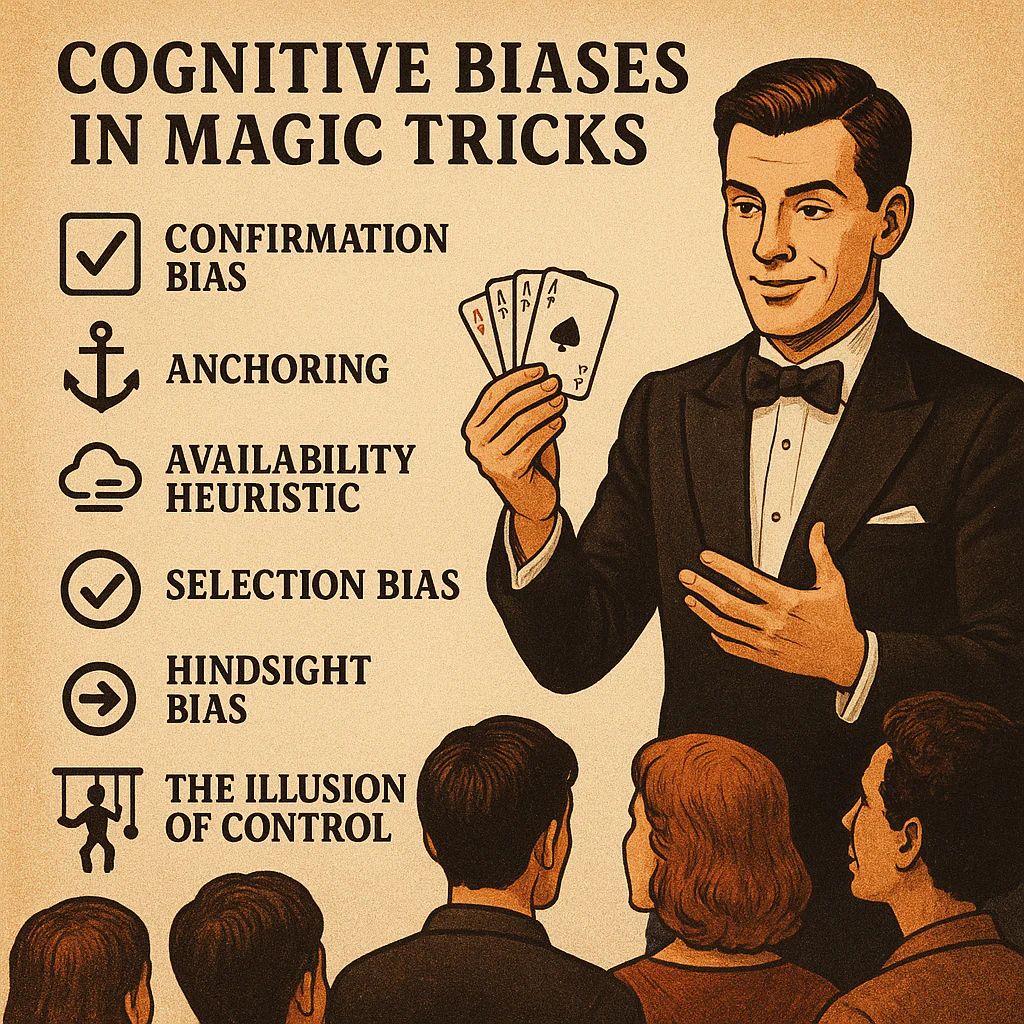
Have you ever wondered why a simple card trick can leave you utterly baffled, convinced that something supernatural just happened? The secret isn’t just in the magician’s sleight of hand—it’s deeply rooted in the quirks of your own brain. At Magic Trick™, we’ve uncovered how 12 powerful cognitive biases work behind the scenes to shape your perception, manipulate your attention, and make the impossible seem real.
In this article, we’ll unravel these fascinating mental shortcuts—from the illusion of control to change blindness—and show you exactly how magicians use them to create mind-blowing illusions. Plus, we’ll share insider tips on how you can harness these biases to elevate your own magic skills or simply become a savvier spectator. Ready to discover the brain science that turns tricks into pure wonder? Let’s dive in!
Key Takeaways
- Cognitive biases are mental shortcuts that magicians exploit to manipulate perception and attention.
- The illusion of control, confirmation bias, and attentional bias are among the most commonly used biases in magic.
- Understanding these biases helps both performers craft more convincing illusions and audiences appreciate the psychology behind the magic.
- Magic is as much about neuroscience as it is about skillful sleight of hand—your brain’s wiring is the ultimate stage.
- Future magic shows will increasingly blend technology with cognitive science, creating even more immersive illusions.
Curious about how these biases play out in classic tricks like the Cups and Balls or the Invisible Deck? Keep reading to unlock the secrets behind the spectacle!
Table of Contents
- ⚡️ Quick Tips and Facts About Cognitive Biases in Magic Tricks
- 🧠 The Magical Mind: How Cognitive Biases Shape Our Perception
- 🎩 History and Evolution of Cognitive Biases in Magic
- 🔍 12 Cognitive Biases Magicians Exploit to Amaze Audiences
- 1. Confirmation Bias: Seeing What You Expect
- 2. Anchoring Effect: The Power of First Impressions
- 3. Availability Heuristic: What’s Most Memorable
- 4. Choice-Supportive Bias: Loving Your Decisions
- 5. Hindsight Bias: “I Knew It All Along” Illusion
- 6. Attentional Bias: Where Your Eyes Go, the Trick Follows
- 7. Change Blindness: Missing the Obvious
- 8. The Illusion of Control: Feeling in Charge When You’re Not
- 9. The Spotlight Effect: Overestimating Attention
- 10. The Gambler’s Fallacy: Expecting Patterns That Don’t Exist
- 11. Framing Effect: How Presentation Changes Perception
- 12. The Baader-Meinhof Phenomenon: Suddenly Seeing Magic Everywhere
- 🧩 How Magicians Use Misdirection and Cognitive Biases Hand-in-Hand
- 🎭 Real-Life Examples: Iconic Magic Tricks Powered by Cognitive Biases
- 🛠️ Practical Tips for Aspiring Magicians: Mastering Cognitive Biases
- 🤔 What Cognitive Biases Teach Us About Everyday Decision-Making
- 🧙 ♂️ All Magicians Know Some Brain Science: The Neuroscience Behind the Magic
- 🔮 The Future of Magic: Cognitive Biases in Digital and Virtual Illusions
- 🎉 Conclusion: Unlocking the Mind’s Secrets to Create Unforgettable Magic
- 🌐 Recommended Links for Deep Diving into Cognitive Biases and Magic
- ❓ FAQ: Your Burning Questions About Cognitive Biases in Magic Answered
- 📚 Reference Links: Trusted Sources and Further Reading
⚡️ Quick Tips and Facts About Cognitive Biases in Magic Tricks
Welcome to the magical world where your brain is the real star! At Magic Trick™, we’ve seen firsthand how cognitive biases are the secret sauce behind jaw-dropping illusions. Before we dive deep, here are some quick facts to get you started:
- Cognitive biases are mental shortcuts or patterns that cause us to perceive reality in a skewed way. Magicians exploit these to misdirect and amaze.
- Your brain prefers speed over accuracy—it jumps to conclusions based on expectations, which magicians cleverly manipulate.
- The illusion of control and confirmation bias make you believe you’re in charge or that you “knew it all along,” even when you don’t.
- Misdirection works hand-in-hand with biases like attentional bias and change blindness to hide the secret moves.
- These biases aren’t flaws—they’re evolutionary adaptations designed to help us survive, but they make us perfect targets for magic!
Curious how these mental quirks turn a simple card trick into mind-boggling sorcery? Keep reading—we’ll unravel the mysteries step-by-step!
For a deeper dive into magic’s brainy side, check out our Magic Trick™ comprehensive guide and explore related categories like Close-up Magic and Illusions.
🧠 The Magical Mind: How Cognitive Biases Shape Our Perception
Before a magician even steps on stage, the real magic happens inside your brain. Your mind is a perception machine wired to filter, simplify, and predict the world around you. This is where cognitive biases come into play—they shape what you think you see.
Why Your Brain Loves Shortcuts
Our ancestors needed to make split-second decisions to survive—spotting a predator or finding food. This led to the brain developing shortcuts called heuristics, which sometimes cause systematic errors or biases.
Magicians exploit these biases by:
- Setting expectations: Your brain anticipates what should happen next.
- Simplifying complex info: It prefers easy-to-digest stories over confusing details.
- Filtering out distractions: Your focus narrows, missing key moves.
The Brain’s “Magic Filter”
Think of your brain as a bouncer at a club, letting in only what fits the expected vibe. This is why you miss the “second assistant” in the classic sawing-in-half trick or fail to notice the sleight of hand in a coin vanish.
This phenomenon is backed by neuroscience research, such as the study highlighted in Psychology Today’s article on magic and the brain, which explains:
“Magic works because your brain oversimplifies the world, seeing what it expects while blinding itself to what it doesn’t expect.”
🎩 History and Evolution of Cognitive Biases in Magic
Magic and cognitive biases have danced together for centuries. Let’s take a quick stroll through history to see how magicians have harnessed these mental quirks over time.
Ancient Roots of Mental Manipulation
- Ancient Egypt and Greece: Early magicians used storytelling and misdirection to create awe, relying on the audience’s expectations and beliefs.
- Renaissance Era: Magicians like Jean Eugène Robert-Houdin began formalizing techniques that exploited attention and perception biases.
- Modern Magic: The 20th century saw the rise of psychological magic, with performers like Derren Brown explicitly using cognitive science principles.
The Science Meets the Stage
In recent decades, cognitive psychology and neuroscience have revealed the mechanisms behind illusions. Magicians started collaborating with scientists to understand biases like change blindness and attentional blink, refining their craft.
For a fascinating read, check our Magic History category.
🔍 12 Cognitive Biases Magicians Exploit to Amaze Audiences
Ready for the magic behind the magic? Here are 12 cognitive biases that magicians at Magic Trick™ use to bend your perception and leave you spellbound.
1. Confirmation Bias: Seeing What You Expect
You tend to notice information that confirms your existing beliefs and ignore contradictory evidence. Magicians use this by planting subtle cues that make you “see” what you want to see.
- Example: When a magician predicts a card, you remember the hits and forget the misses.
- Tip: This bias makes you complicit in the trick without realizing it.
2. Anchoring Effect: The Power of First Impressions
Your brain latches onto the first piece of information it receives and uses it as a reference point for all subsequent judgments.
- Magic use: Setting an initial expectation (like a card’s position) that influences how you interpret the rest.
- Fun fact: This bias explains why a high initial price makes a discount seem better—even if it’s still expensive!
3. Availability Heuristic: What’s Most Memorable
You judge the likelihood of events based on how easily examples come to mind.
- In magic: Familiar scenarios or dramatic moves make the trick feel more plausible.
- Real-world link: Media coverage of rare events can skew perception of risk.
4. Choice-Supportive Bias: Loving Your Decisions
After making a choice, you tend to remember it as better than it was.
- Magician’s trick: Once you pick a card or object, you convince yourself it was the “right” choice, enhancing the illusion.
- Psychology tip: This bias protects your ego and satisfaction.
5. Hindsight Bias: “I Knew It All Along” Illusion
After the trick, you feel like you predicted the outcome, even if you didn’t.
- Effect: Makes magic feel like a puzzle you almost solved.
- Magician’s edge: Encourages you to watch again, trying to “catch” the secret.
6. Attentional Bias: Where Your Eyes Go, the Trick Follows
Your attention is a spotlight, and magicians expertly direct it away from secret moves.
- Classic misdirection: Flashy gestures or eye contact pull your focus.
- Science says: Your brain can only process a limited amount of information at once.
7. Change Blindness: Missing the Obvious
You often fail to notice changes in your visual field if they happen during a distraction.
- Magic use: Quick swaps or hidden moves during a flourish go completely unnoticed.
- Try this: Watch a video where a person changes shirts mid-scene—you’ll be amazed at what you miss!
8. The Illusion of Control: Feeling in Charge When You’re Not
You believe you have more control over events than you actually do.
- In magic: Magicians let you “choose” a card or number, but the outcome is prearranged.
- Why it works: It increases your engagement and belief in the trick.
9. The Spotlight Effect: Overestimating Attention
You think everyone is watching you closely, but in reality, people notice much less.
- Magic angle: Magicians exploit this by making you feel scrutinized while they perform secret moves unnoticed.
- Life hack: This bias can reduce social anxiety!
10. The Gambler’s Fallacy: Expecting Patterns That Don’t Exist
You believe past random events affect future ones.
- Magic twist: Magicians use this to predict “random” choices or outcomes.
- Example: After several red cards, you expect black next—but it’s all chance.
11. Framing Effect: How Presentation Changes Perception
The way information is presented influences your decisions.
- Magic use: A magician’s story or wording sets the frame for how you interpret the trick.
- Marketing parallel: Advertisers use framing to influence buying decisions.
12. The Baader-Meinhof Phenomenon: Suddenly Seeing Magic Everywhere
Once you learn about a concept, you start noticing it everywhere.
- After reading this: You’ll spot cognitive biases in daily life and magic shows alike!
- Fun fact: This is also called frequency illusion.
🧩 How Magicians Use Misdirection and Cognitive Biases Hand-in-Hand
Misdirection is the magician’s Swiss Army knife, and cognitive biases are the blades that cut through your attention and perception.
The Dynamic Duo: Misdirection + Biases
- Misdirection captures your focus with flashy moves, humor, or eye contact.
- Cognitive biases do the heavy lifting by shaping what your brain expects and remembers.
Together, they create a perfect storm of deception.
Step-by-Step Example: The Classic Coin Vanish
- Set the anchor: The magician shows the coin clearly (anchoring effect).
- Direct attention: A wave of the hand draws your eyes away (attentional bias).
- Exploit change blindness: The coin is secretly palmed or dropped unnoticed.
- Confirmation bias kicks in: You recall the coin disappearing “magically,” ignoring any suspicious moments.
Want to master misdirection? Our Coin Tricks category has plenty of tutorials!
🎭 Real-Life Examples: Iconic Magic Tricks Powered by Cognitive Biases
Let’s peek behind the curtain at some legendary tricks and the biases that fuel their magic.
| Trick Name | Cognitive Bias Exploited | How It Works |
|---|---|---|
| Sawing a Woman in Half | Focus on Expected Details | Audience expects one person; two assistants hide the secret. |
| The Invisible Deck | Confirmation Bias | You “choose” a card you think of; magician reveals it, reinforcing belief. |
| The Cups and Balls | Change Blindness & Misdirection | Quick moves hide ball transfers while you focus elsewhere. |
| The Ambitious Card | Anchoring & Choice-Supportive | Repeatedly “rising” card confirms your expectations. |
Personal Story from Magic Trick™ Team
We once performed the Cups and Balls at a birthday party. Despite explaining the trick afterward, guests swore it was “real magic.” Why? Because their brains filled gaps with expectation and bias, not logic.
🛠️ Practical Tips for Aspiring Magicians: Mastering Cognitive Biases
Want to harness these biases like a pro? Here’s how to get started:
Understand Your Audience’s Mind
- Study common biases and how they influence perception.
- Tailor your patter and timing to guide expectations.
Use Misdirection Strategically
- Combine visual, auditory, and verbal distractions.
- Practice smooth, natural gestures to avoid suspicion.
Control the Narrative Frame
- Craft stories that set the right mental anchors.
- Use repetition to reinforce key ideas (availability cascade).
Practice Makes Perfect
- Record your performances to spot where attention drifts.
- Experiment with different biases to see what works best.
Recommended Resources
- Books like “Sleights of Mind” by Stephen L. Macknik and Susana Martinez-Conde.
- Online courses from magicians like Derren Brown.
- Our own Card Tricks tutorials for hands-on practice.
🤔 What Cognitive Biases Teach Us About Everyday Decision-Making
Magic isn’t just entertainment—it’s a mirror reflecting how our minds work daily.
Biases in Real Life
- Confirmation bias affects how we consume news and form opinions.
- Anchoring bias influences negotiations and pricing decisions.
- Availability heuristic skews risk perception (think fear of flying vs. driving).
Becoming a Critical Thinker
Understanding these biases helps you:
- Spot when your judgment is clouded.
- Make more informed decisions.
- Resist manipulation in marketing and politics.
For a practical guide, check out this insightful article on cognitive biases.
🧙 ♂️ All Magicians Know Some Brain Science: The Neuroscience Behind the Magic
Magic is neuroscience in disguise! Let’s peek at the brain’s role in creating illusions.
How the Brain Processes Magic
- Selective attention: The brain filters sensory input, focusing on what seems important.
- Predictive coding: It constantly guesses what will happen next, filling in gaps.
- Neural adaptation: Repetition dulls response, so magicians vary timing to keep you guessing.
Neuroscience Meets Performance
Research shows that watching magic activates brain areas involved in attention, expectation, and surprise. This explains why magic can evoke strong emotional and cognitive reactions.
For a detailed scientific perspective, see the Psychology Today article on neuroscience and magic.
🔮 The Future of Magic: Cognitive Biases in Digital and Virtual Illusions
As technology evolves, so does magic. The digital age offers new playgrounds for cognitive bias exploitation.
Virtual Reality (VR) and Augmented Reality (AR)
- Magicians can manipulate sensory input more precisely.
- Biases like selective perception and change blindness are amplified in immersive environments.
AI and Magic
- Artificial intelligence can predict audience reactions and tailor illusions dynamically.
- Personalized magic shows could exploit individual biases for maximum impact.
Online Magic and Social Media
- Viral magic videos leverage availability heuristic and bandwagon effect to spread illusions rapidly.
- However, digital tricks face challenges like replayability and viewer skepticism.
Want to see how magic is evolving? Our Illusions category covers cutting-edge performances.
Before we wrap up this section, don’t miss the first YouTube video embedded in this article, which brilliantly breaks down cognitive biases like anchoring bias, confirmation bias, and choice supportive bias using everyday examples. It’s a perfect primer to understand why your brain is so easily fooled by magic—and life!
Jump to the video here: Featured Video
Ready to learn more? Stay tuned for the Conclusion where we unlock the secrets to creating unforgettable magic using cognitive biases!
🎉 Conclusion: Unlocking the Mind’s Secrets to Create Unforgettable Magic

After journeying through the fascinating world of cognitive biases and magic tricks, it’s clear that the real magic lies in your brain’s wiring. At Magic Trick™, we’ve seen how understanding biases like confirmation bias, attentional bias, and change blindness transforms a simple sleight of hand into an unforgettable experience that leaves audiences gasping and guessing.
Remember the question we teased earlier—how can magicians make you “choose” a card freely when the outcome is already set? Now you know: it’s all about exploiting the illusion of control and anchoring effects to guide your mind without you realizing it.
The takeaway? Cognitive biases aren’t just quirks; they’re the magician’s toolkit. Whether you’re an aspiring performer or a curious spectator, appreciating these mental shortcuts enriches your understanding and enjoyment of magic.
While this article didn’t review a specific product, we highly recommend exploring resources like “Sleights of Mind” by Stephen L. Macknik and Susana Martinez-Conde for a deep dive into the neuroscience behind magic. And of course, practicing classic tricks that leverage these biases—like coin vanishes or card forces—will sharpen your skills.
So, next time you watch a magic show, remember: the greatest illusion is how your brain plays along. Now, go amaze your friends with your newfound brainy magic knowledge!
🌐 Recommended Links for Deep Diving into Cognitive Biases and Magic
Ready to level up your magic and brain science? Check out these top picks:
-
“Sleights of Mind: What the Neuroscience of Magic Reveals about Our Everyday Deceptions” by Stephen L. Macknik and Susana Martinez-Conde
Shop on Amazon -
“Magic and the Brain” by Derren Brown (DVD & Book)
Shop on Amazon -
Classic Coin Tricks Set by Marvin’s Magic (great for practicing misdirection and attentional bias)
-
Theory and Practice of Magic by Jean Hugard (a timeless resource on classic techniques and psychological principles)
Shop on Amazon
❓ FAQ: Your Burning Questions About Cognitive Biases in Magic Answered

How do cognitive biases enhance the effectiveness of magic tricks?
Cognitive biases shape how your brain processes information, often leading it to fill gaps, ignore contradictions, or jump to conclusions. Magicians exploit these tendencies to create illusions that feel impossible. For example, confirmation bias makes you notice only the “magic” moments that fit the story, while attentional bias directs your focus away from secret moves. This synergy makes tricks more convincing and memorable.
What are the most common cognitive biases exploited in magic performances?
The top biases include:
- Confirmation Bias: Seeing what you expect.
- Anchoring Effect: First impressions set your mental frame.
- Attentional Bias: Focus is directed away from the secret.
- Change Blindness: Missing obvious changes during distractions.
- Illusion of Control: Feeling you influence outcomes when you don’t.
Magicians combine these to manipulate perception seamlessly.
Can understanding cognitive biases improve your own magic trick skills?
Absolutely! Knowing how your audience’s brain works lets you design tricks that exploit natural mental shortcuts. You can craft better misdirection, frame your narrative effectively, and anticipate where spectators’ attention will go. This knowledge elevates your performance from mere sleight of hand to psychological artistry.
How do magicians use attention bias to manipulate audience perception?
Magicians use attentional bias by controlling where the audience looks and what they focus on. Through gestures, eye contact, or verbal cues, they steer attention away from secret actions. Since the brain can only process limited information at once, this selective focus allows magicians to perform hidden moves undetected.
What role does confirmation bias play in the experience of magic shows?
Confirmation bias causes spectators to remember events that support the magical narrative and forget contradictory details. For example, if a magician “predicts” a card, you recall the prediction as accurate because it fits your expectations, ignoring any earlier inconsistencies. This bias deepens the illusion’s impact and encourages repeated viewing.
How can knowledge of cognitive biases help in designing new magic tricks?
Understanding biases allows magicians to innovate by targeting specific mental shortcuts. For instance, designing a trick that exploits the availability heuristic by using familiar objects or scenarios makes the illusion more believable. It also helps avoid pitfalls where the audience might detect the secret, ensuring smoother deception.
Are there psychological principles behind why magic tricks fool our brains?
Yes! Magic tricks tap into fundamental psychological principles like selective attention, expectation, memory distortion, and pattern recognition. These principles evolved to help us navigate complex environments quickly but also make us vulnerable to illusions. Magicians are masters at leveraging these principles to create wonder.
Additional FAQs
How does the illusion of control affect audience participation in magic?
The illusion of control makes spectators feel they are actively influencing the trick’s outcome, increasing engagement and emotional investment. This bias makes the magic feel personal and authentic, even though the magician has orchestrated the result.
Can cognitive biases be used ethically in magic without deceiving audiences unfairly?
Yes! Ethical magicians use biases to entertain and inspire wonder, not to manipulate or harm. Transparency after the show or framing tricks as illusions rather than supernatural feats respects the audience’s intelligence while preserving the magic.
📚 Reference Links: Trusted Sources and Further Reading
- Macknik, S. L., & Martinez-Conde, S. (2010). Sleights of Mind: What the Neuroscience of Magic Reveals about Our Everyday Deceptions. Amazon
- Psychology Today: The Neuroscience of Magic
- Medium: Can You Fool a Mathematician?
- Radix Communications: 5 Cognitive Biases and What They Can Teach Us About B2B Copywriting
- Marvin’s Magic Official Website: https://www.marvinsmagic.com
- Derren Brown Official Website: https://derrenbrown.co.uk
- Magic Trick™ Categories:
We hope this comprehensive guide helps you see magic—and your own mind—in a whole new light! ✨