Support our educational content for free when you purchase through links on our site. Learn more
🪄 How Science Is Changing Magic Tricks and Illusions

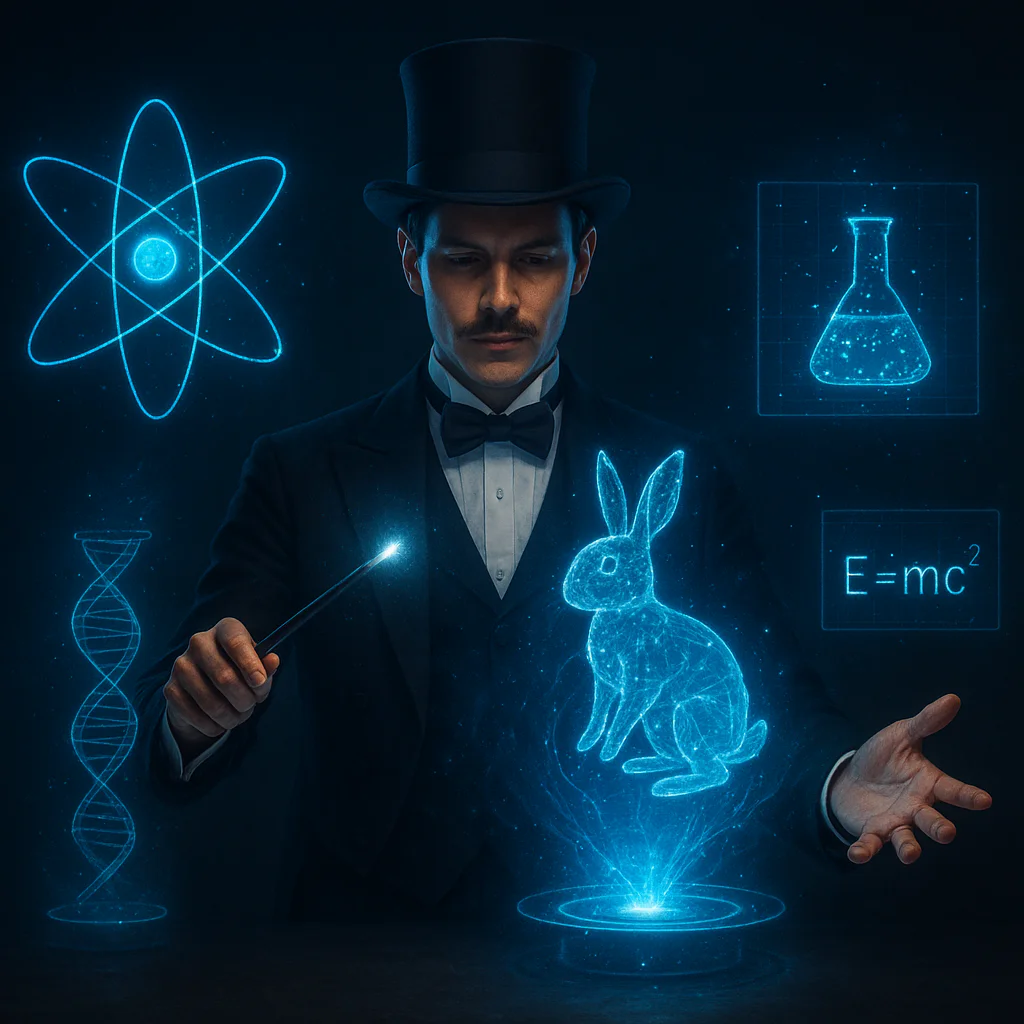
How have advances in technology and science impacted the development of new magic tricks and illusions? They’ve given magicians fresh tools—from robotics and augmented reality to 3D printing and AI—and a deeper understanding of perception. But technology alone doesn’t create wonder: the strongest illusions still depend on timing, storytelling, and the human connection between performer and audience.
A camera, for example, can reveal details that a live audience misses, while editing can create effects that never happened in the room. That difference is a reminder that magic isn’t only about what a device can do; it’s about what people think they saw.
At Magic Trick™, we’ve found the most exciting innovations start with a simple question: What should the audience experience? Once that moment is clear, science and technology can help bring it to life—and careful testing keeps the secret from turning into a technical hicup.
Key Takeaways
- Technology expands the magician’s toolbox: Robotics, AR, VR, projection mapping, sensors, smartphones, and 3D printing can make new effects possible.
- Science helps explain the audience’s experience: Research into attention, perception, expectation, and memory offers useful insights for designing illusions.
- The method must serve the effect: A clever gadget is only worthwhile if it supports a clear, compelling performance.
- Testing is essential: Rehearsal, audience feedback, safety checks, and backup plans help keep technology-assisted tricks reliable.
- Human performance still matters most: Timing, storytelling, and connection turn a technical demonstration into magic.
Table of Contents
- ⚡️ Quick Tips and Facts
- 🕰️ How Magic Tricks Evolved Alongside Science and Technology
- From mechanical automata to modern illusions
- Why magicians borrow ideas from scientists and engineers
- 🔬 The Science Behind a Convincing Illusion
- Perception, attention, and misdirection
- Memory, expectation, and the feeling of impossibility
- How psychology and neuroscience inform performance
- 🤖 10 Ways Technology Is Changing Magic Tricks and Illusions
- 1. Robotics and animatronics
- 2. Artificial intelligence and machine learning
- 3. Augmented reality and mixed reality
- 4. Virtual reality and immersive magic
- 5. Projection mapping and visual effects
- 6. Smartphones, apps, and connected devices
- 7. Sensors, wearables, and hidden electronics
- 8. 3D printing and rapid protyping
- 9. Drones, lasers, and stage automation
- 10. Digital platforms and remote performance
- 🧪 How Magicians Develop and Test New Illusions
- From creative idea to working effect
- Prototyping with software, electronics, and fabrication
- Rehearsal, audience testing, and refining the reveal
- Collaboration between magicians, designers, and scientists
- 🎭 What New Technology Means for Live Magic
- Close-up magic versus large-scale stage illusions
- Making technology invisible to the audience
- Keeping human performance at the center
- 📱 Magic Tricks in Film, Television, and Social Media
- Practical effects, camera tricks, and digital editing
- Short-form video, livestreams, and interactive reveals
- How online exposure changes audience expectations
- ⚖️ Benefits, Risks, and Ethical Questions
- Creative freedom and more ambitious illusions
- Reliability, safety, privacy, and technical failure
- Originality, disclosure, and protecting magical methods
- Balancing digital spectacle with theatrical skill
- 🔮 What the Future of Magic Technology May Hold
- Generative AI and personalized performances
- More immersive and responsive audience experiences
- Why simple, human-centered magic will endure
- ❓ Frequently Asked Questions
- How has technology changed magic tricks?
- Can artificial intelligence perform magic?
- Do modern illusions rely on digital effects?
- How do magicians use science to fool an audience?
- Will technology replace traditional magicians?
- ✅ Conclusion
- 🔗 Recommended Links
- 📚 Reference Links
⚡️ Quick Tips and Facts
Science and technology have expanded the magician’s toolbox, but they haven’t replaced the magician. A clever device can make an effect possible; psychology, timing, and performance make it feel impossible.
Our first lesson in magic history is that new-looking wonders often grow from old ideas: you can trace that story back to what the oldest magic trick might be. Today, magicians combine traditional methods with electronics, robotics, digital media, and research into how people perceive the world.
| Quick fact | What it means for magic |
|---|---|
| The effect is not the method | The effect is what the audience experiences; the method is how the performer creates it. A good method supports a strong effect without stealing attention. |
| Technology adds options, not automatic astonishment | Sensors, projection, apps, and robotics can enable new effects, but a visible technical setup can make an illusion feel like a demonstration instead of magic. |
| Perception is selective | Attention, expectation, and memory influence what spectators notice and later recall. That’s why a secret can sometimes happen in plain sight. |
| Magic innovation is often recombination | A fresh illusion may combine a classic principle, an unusual prop, a new presentation, and a modern tool rather than inventing everything from scratch. |
| Testing matters | A trick that works in a rehearsal room may fail under stage lights, in a camera frame, or when an audience reacts unpredictably. |
| Ethics matter too | Online learning and sharing help magicians develop, but performers should credit creators, avoid copying acts, and handle audience data responsibly. |
✅ Our practical rule: Start with the audience experience you want, then choose the simplest reliable method that can deliver it. Add technology only when it improves the illusion.
For more on the craft, explore our guides to illusions, close-up magic, card tricks, and coin tricks.
🕰️ How Magic Tricks Evolved Alongside Science and Technology
Magic has always borrowed from the tools and ideas of its era. Mechanical devices, stage engineering, lighting, film, electronics, and now digital systems have each widened the range of effects a performer can create. The underlying challenge stays remarkably consistent: make the audience experience something they cannot readily explain.
In a study of professional magicians’ creative work, researchers describe how audiovisual and digital technology offers “new tools to develop tricks, new channels for performance, and new ways of documenting the performances.” The study focuses on professional practice rather than cataloguing inventions, so it’s most useful as a window into how magicians adapt and create, not as a technical product guide. Read the study in Frontiers in Psychology.
From mechanical automata to modern illusions
Long before smartphones and digital projection, performers used engineering to make objects move, vanish, or appear to act on their own. Mechanical automata and clever stage apparatus helped create spectacles that seemed to defy ordinary cause and effect. Later developments in electric lighting, film, sound, and special effects gave performers new ways to control what audiences saw and heard.
The progression isn’t a simple march from “old and crude” to “new and better.” Different methods suit different venues:
| Era or toolset | What it made easier | What it still depends on |
|---|---|---|
| Mechanical props and stage machinery | Repeatable movement, hidden compartments, large-scale transformations | Design, timing, safe operation, and stagecraft |
| Electric lighting and sound | Focused attention, atmosphere, dramatic reveals | Lighting cues, sound design, and a performer’s pacing |
| Film and television production | Camera-specific effects, controlled framing, post-production | Editing choices and a clear distinction between live and recorded performance |
| Digital tools and connected devices | Responsive effects, interactive media, remote performance | Reliable software, connectivity, privacy, and audience trust |
| Robotics and sensors | Motion or reactions triggered by an input | Precise calibration, contingency planning, and convincing presentation |
A new machine may look exciting in a workshop. In performance, though, it has to do more than move: it must fit the story, survive repeated use, and avoid inviting the audience to ask, “What gadget is doing that?”
Why magicians borrow ideas from scientists and engineers
Magicians and scientists often ask different versions of the same question: What did someone observe, and what might explain it? The magician uses that gap to create a controlled mystery. The scientist may use it to study attention, perception, memory, or belief.
That exchange can go both ways. Scientific findings help performers understand how spectators process an event. Meanwhile, magic can provide researchers with carefully designed demonstrations of how a person’s experience can differ from what actually happened. Researcher and magician Matt Tompkins discusses this overlap as the “Science of Magic,” including how illusions can be used to explore perception and people’s responses to emerging technologies. Explore Tompkins’s discussion of seeing through illusions.
The practical lesson for creators is straightforward:
- Enginers can help make an effect stable, repeatable, and safe.
- Psychologists and cognitive scientists can help explain attention, expectation, and memory.
- Designers and artists can turn a technical method into an evocative object, setting, or story.
- Magicians can test whether the result feels magical to real people, not just impressive on a workbench.
We’ve seen an elegant mechanism lose its charm when the performer explained too much about it. We’ve also seen a basic prop become astonishing because the audience had a reason to care. The tool matters, but the framing decides what the tool means.
🔬 The Science Behind a Convincing Illusion
A convincing illusion doesn’t require an audience to be gullible. It takes advantage of ordinary ways the mind makes sense of busy, incomplete information. People combine what they see with what they expect, what they remember, and where their attention is directed.
That’s useful for magicians, but it’s also a reason to treat audience members with respect. Misdirection is a theatrical technique; it should not become an excuse to manipulate people outside the agreed performance.
Perception, attention, and misdirection
We don’t experience every detail in a scene equally. Attention is limited, and perception is influenced by context. If a performer gives you a compelling reason to watch one hand, you may overlook a detail elsewhere, even if it was visible.
Misdirection is not simply “look over there.” It can be built from:
- A meaningful action: A gesture or object provides a natural focus.
- Timing: A secret action occurs during a moment that already has a purpose.
- Expectation: The audience anticipates one kind of event and is less prepared for another.
- Social cues: People often look where a performer looks or where other spectators react.
- Story: A narrative can guide attention more gently than a command.
Tompkins’s account offers a striking example: a shirt change in a live performance went unnoticed by an audience of researchers, while the production had to handle the event differently for a recorded version. The example illustrates an important point: a live illusion and its filmed version may work through different channels. A camera can document a detail that spectators miss in person, but editing can also introduce an effect that was not experienced live.
Memory, expectation, and the feeling of impossibility
Memory is not a perfect recording. We reconstruct past events, and our expectations can shape how we interpret what we remember. A spectator may feel certain that a card was freely chosen, a box was empty, or an object never left sight. The strength of that feeling helps create the “impossible” effect.
That doesn’t mean every trick depends on a memory error. Strong magic can also use openly visible transformations, surprising changes in scale, or impossible-seming coincidences. But when a method relies on what an audience remembers, the performer must be careful about clarity and fairness.
The difference between what happened and what a spectator believes happened is a central theme in research on magic and cognition. A 2021 study on learning magic and divergent thinking discusses the distinction between a trick’s apparent effect and its concealed method, and reviews work on how surprising events can engage flexible thinking. Read the open-access study in Frontiers in Psychology.
How psychology and neuroscience inform performance
Psychology and neuroscience do not hand magicians a universal recipe for fooling people. They offer frameworks and research questions: How do people detect anomalies? How does attention shift? When does an expectation guide perception? How do viewers explain an event afterward?
Tompkins describes a growing research interest in the “Science of Magic,” including studies that use illusions to examine perception and decision-making. He also discusses experimental “fake” devices that can make participants believe a technology has read or influenced their thoughts, allowing researchers to examine reactions to an apparent capability. Such work must include appropriate ethical safeguards and debriefing.
For performers, these ideas are most valuable when used as design prompts, not as claims that every audience member’s brain behaves identically. Test the trick with different people. Watch what they attend to. Ask what they thought happened. A surprising number will tell you a story that differs from the one you thought you presented.
🤖 10 Ways Technology Is Changing Magic Tricks and Illusions
Technology gives magicians more ways to create, rehearse, and deliver an effect. It also introduces fresh failure points: batteries, software updates, lighting conditions, network delays, and a spectator whose phone is on 2% battery.
| Technology | What it can contribute | Main trade-off |
|---|---|---|
| Robotics | Animated objects and responsive movement | Complexity and safety |
| Artificial intelligence | Adaptive scripts, pattern analysis, and creative tools | Accuracy, privacy, and audience trust |
| Augmented reality | Digital objects layered into a live view | Device dependence and camera limitations |
| Virtual reality | Fully controlled immersive environments | Isolation from the live room |
| Projection mapping | Transforming physical surfaces with light | Calibration and sightlines |
| Mobile apps | Interactive reveals and participant input | Device compatibility and distractions |
| Sensors and wearables | Triggered effects and concealed cues | Reliability and privacy |
| 3D printing | Rapid prop protyping and custom shapes | Material suitability and finish |
| Drones and automation | Aerial movement and choreographed spectacle | Regulation, space, and risk management |
| Streaming platforms | Performances for remote audiences | Latency and camera framing |
1. Robotics and animatronics
Robotics can make an object move with controlled, repeatable timing. Animatronic systems can support characters, stage scenery, or props that appear to respond to a performer or audience member. A moving object may seem alive; a small motion can be more unsettling—and more magical—than a noisy machine doing backflips.
Benefits
- Repeatable actions can help synchronize a prop with music or lighting.
- Movement can be programmed to respond to cues.
- A custom mechanism can enable a transformation that is difficult to perform by hand.
Drawbacks
- Motors, noise, heat, and vibration may reveal the mechanism.
- Complex systems need maintenance and a manual backup plan.
- Motion can appear mechanical rather than mysterious if it lacks a clear dramatic purpose.
Our advice: keep the robot’s job simple. If it needs a laptop, three wireless connections, and a tiny crew member praying beside the stage, the effect needs a serious reliability review.
2. Artificial intelligence and machine learning
AI can assist with drafting scripts, generating visual concepts, organizing audience data, or helping a performer build an interactive experience. Machine-learning systems can classify patterns or produce responses based on inputs. But AI does not automatically understand an audience, and a fluent answer is not proof of a reliable effect.
Use AI as a creative assistant, not as an unquestioned authority. Review its output for errors, bias, originality, and privacy implications. If a trick appears to reveal personal information, be transparent about what data is collected and avoid implying that a system knows more than it does.
Good uses
- Brainstorming alternative presentations for an existing effect.
- Generating rough mockups for a stage or prop concept.
- Testing how different audience prompts might affect a scripted interaction.
Poor uses
- Relying on an AI response without rehearsing likely edge cases.
- Uploading audience-identifying information without consent.
- Claiming a system has supernatural or scientifically proven powers when it does not.
AI can help generate possibilities. The magician still has to choose, rehearse, and take responsibility for the performance.
3. Augmented reality and mixed reality
Augmented reality (AR) overlays digital elements on a view of the physical world. Mixed-reality systems can blend virtual content with a more interactive understanding of the surroundings. In a magic performance, these tools might make an object appear to change on a phone screen or add a virtual element to a live environment.
AR can create a dramatic moment, but it changes what the audience is watching: the physical event, the device display, or the connection between them. That choice should be deliberate.
Useful design questions
- Is the illusion meant to happen in the room, on a screen, or across both?
- Can spectators see the same effect from different viewpoints?
- Does the app work without a stable internet connection?
- What does the trick look like if a camera fails or a device is incompatible?
For a broad technical overview of AR, see Google’s ARCore documentation. For a show, test the actual phones and lighting conditions you expect to use; a beautiful prototype is not the same as a dependable performance.
4. Virtual reality and immersive magic
Virtual reality (VR) gives the creator control over a participant’s visual environment. That can support impossible spaces, teleportation effects, or perspective shifts that are difficult to build physically. It can also make the experience feel private and isolated, which may work against the shared excitement of live magic.
A useful VR illusion should give participants enough guidance to feel safe and oriented. Consider accessibility, motion sensitivity, headset fit, cleaning, supervision, and what happens if the device disconnects. The W3C’s XR Accessibility User Requirements discuss accessibility considerations for extended-reality experiences.
VR is not just a digital backdrop. It changes the relationship between performer and spectator. The audience may be looking in different directions at different times, so the magician’s usual tools—eye contact, shared focus, and collective reaction—need fresh choreography.
5. Projection mapping and visual effects
Projection mapping uses light and carefully aligned visual content to make a real surface appear to move, open, dissolve, or transform. A wall can become a window; a box can appear to breathe; a stage can seem to fold into another place.
The result depends on the match between the projection and the physical surface. Setup involves mapping the surface, testing sightlines, controlling ambient light, and checking the projector’s placement. A misaligned image can turn a grand illusion into a slightly haunted PowerPoint.
When it works best
- The projected transformation has a clear relationship to the object.
- The audience knows where to look without being told every second.
- The effect remains legible from the room’s real viewing angles.
- The performer’s timing and story make the visual change feel consequential.
Projection is powerful for spectacle, but it should not be confused with a live physical transformation. Both can be wonderful; they simply create different promises to the audience.
6. Smartphones, apps, and connected devices
Phones can be props, communication tools, cameras, or participant interfaces. A spectator may enter a choice, receive a message, or view an image that becomes part of the trick. The devices are familiar, which can make the effect feel immediate—but also invites scrutiny.
Plan for:
- Different operating systems and screen sizes.
- Notifications, brightness, and accidental app exits.
- Network access and privacy.
- A non-phone alternative for people who do not want to participate.
- Clear consent before a phone is handled or data is entered.
A smartphone trick should not ask for access to private content unless that access is genuinely necessary and explicitly understood. For more on responsible data practices, the UK Information Commissioner’s Office offers guidance on data protection principles.
7. Sensors, wearables, and hidden electronics
Sensors can detect motion, pressure, proximity, orientation, or other inputs. Wearables can provide cues to the performer without putting a visible control panel onstage. These systems may help make an effect responsive, but the audience should not be misled about sensitive data collection.
Advantages
- A cue can be triggered by a natural action.
- A performer can receive feedback without breaking character.
- The prop can respond consistently to a defined input.
Limitations
- Sensors can misread movement or fail under different conditions.
- Calibration may change with temperature, placement, or wear.
- A hidden device still needs a safety check and a fallback.
We recommend building a “failure rehearsal”: run through the trick when the sensor gives no signal, a cue arrives late, or the performer misses it. If the show cannot continue gracefully, the system is not ready.
8. 3D printing and rapid protyping
3D printing makes it easier to test unusual prop shapes, custom fittings, and small mechanical components. The real advantage is iteration: make a prototype, handle it, identify what feels wrong, then revise the design.
A printed piece can look convincingly finished, but its appearance does not establish that the material is suitable for every use. For props that contact skin or food, bear loads, or operate near heat, choose materials and manufacturing methods appropriate to the application. Follow the printer manufacturer’s material guidance and relevant safety data sheets; the National Institute for Occupational Safety and Health (NIOSH) provides information on 3D-printing emissions and safety.
| 3D printing can help with… | It does not guarantee… |
|---|---|
| Custom shapes and fit | A polished surface or realistic finish |
| Rapid design changes | Strength under every load or impact |
| Replacing an awkward prototype | Food-contact or skin-contact suitability |
| Making parts on demand | Perfect dimensional accuracy on the first attempt |
For magic props, the print is often a starting point. Sanding, painting, balancing, and repeated handling may be what make it performance-ready.
9. Drones, lasers, and stage automation
Drones and automated stage systems can create dramatic motion and precise cues, especially in large venues. Lasers can add visual impact, but they require careful attention to audience safety and applicable regulations.
Do not treat safety as a technical footnote. Drones must be operated in compliance with local aviation rules, and stage lasers should be handled by qualified professionals using appropriate controls. In the United States, the Federal Aviation Administration’s drone guidance explains operator responsibilities. The U.S. Food and Drug Administration’s laser products guidance covers laser-product safety.
Automation can create breathtaking spectacle. It can also make a venue’s restrictions, sightlines, and emergency procedures part of the design. Consult the venue and qualified technicians before putting any moving or high-powered equipment near an audience.
10. Digital platforms and remote performance
Online platforms let magicians perform for viewers across cities and time zones, share demonstrations, and learn from other practitioners. They also change the geometry of a trick: a camera crop can hide the very space an in-person audience would see.
A remote effect should be designed for the screen, not merely filmed from a stage. Check the framing, lighting, compression, latency, and whether the audience can see enough to feel involved. For performers learning and sharing work, the Finnish magicians’ study notes that books, videos, the internet, and social media have helped expand professional connections and access to ideas—while also raising concerns about copying and creative ownership. Read the professional-practice study.
🧪 How Magicians Develop and Test New Illusions
A new illusion rarely arrives fully formed. It usually begins as a question: What would the audience find impossible, and what could make that experience believable? The method comes next, but it must eventually fit the performer, venue, audience, and story.
From creative idea to working effect
Here’s a practical development sequence we use:
-
Describe the effect in one sentence.
Say what the audience sees, not how the trick works. “A borrowed ring appears inside a sealed glass bottle” is an effect. “I’ll use a hidden mechanism” is a method. -
Decide what the audience should feel.
Wonder, humor, tension, intimacy, or surprise? A technically difficult trick can feel emotionally flat if the audience has no reason to care. -
List the constraints.
Consider venue, lighting, distance, audience size, handling, accessibility, reset time, safety, and whether the effect must work on camera. -
Sketch several possible methods.
Don’t marry the first solution. Compare a mechanical, psychological, digital, and purely theatrical approach where appropriate. -
Build the simplest prototype.
Cardboard, paper, a basic app mockup, or a low-cost mechanical model can answer important questions before a refined prop exists. -
Test the effect without explaining it.
Show it to people who have not seen the method. Notice where they look, what they believe, and what they suspect. -
Rehearse the full performance.
Include the pater, pauses, music, prop handling, transitions, and recovery plan. The trick is the whole experience, not just the secret moment. -
Revise or discard.
If the effect is hard to follow, unreliable, or too similar to existing work, change it. Abandoning a weak idea is progress, not failure.
The study of Finnish professional magicians found that creating novelty often involves combining or adapting ideas, rather than producing a wholly unprecedented concept. It also describes creators drawing inspiration from film, theatre, music, visual arts, museums, travel, and everyday observations. Originality is often a new connection between familiar things.
Prototyping with software, electronics, and fabrication
Choose tools according to the uncertainty you need to resolve:
| If you’re unsure about… | Start with… | Why |
|---|---|---|
| Size, grip, or handling | Paper, foam, or a rough 3D-printed mockup | You can assess shape before refining the mechanism |
| Timing or sequence | A storyboard or simple video test | It reveals awkward pauses and unclear transitions |
| A sensor response | A basic electronics prototype | You can test reliability before concealing components |
| Screen content | A clickable app mockup | It allows usability testing before software development |
| Projection alignment | A small-scale projection test | It exposes lighting and sightline problems early |
| Audience understanding | A rehearsal with uninformed spectators | It shows whether the effect reads as intended |
We recommend documenting each test: date, venue conditions, audience size, what failed, and what spectators said afterward. It’s unglamorous, but good notes can save a creator from rebuilding the same broken prototype three times.
Rehearsal, audience testing, and refining the reveal
One professional magician interviewed in the Frontiers in Psychology study reportedly filmed a newly developed illusion at least twice a week to evaluate and improve it. That does not mean every performer needs a camera on every rehearsal. It does show how review can make subtle problems visible: a movement that feels natural to the performer may look suspicious from the back row.
Try a test cycle:
- Perform for one trusted observer. Ask them to describe what they saw without asking whether they liked it.
- Record a rehearsal, with consent. Watch for pauses, glances, blocked views, and accidental exposure.
- Change one variable at a time. If you alter the script, prop, and timing all at once, you may not know what helped.
- Test under performance conditions. Stage light, background noise, camera framing, and audience distance all matter.
- Check the reset. A reliable trick needs to work again, not just once.
- Invite honest feedback. “What did you think happened?” is often more useful than “Was that amazing?”
A method can be flawless and still fail because the effect is unclear. Conversely, a small technical imperfection may not matter if the audience understands the premise and the reveal lands. The test is not whether the trick impresses the creator; it is whether the audience experiences the intended moment.
Collaboration between magicians, designers, and scientists
Collaboration can help a project become stronger, provided everyone understands the creative goal. An engineer may see a mechanism problem; a magician may see a timing problem; a designer may see that the prop communicates the wrong story. All three perspectives matter.
When working together:
- Agree on who owns or receives credit for each contribution.
- Decide how any audience data will be collected, stored, and deleted.
- Make the performance goal clear before optimizing the hardware.
- Share safety requirements early, especially for moving equipment, batteries, lasers, or wearables.
- Keep a record of design decisions and prototype changes.
Magic has a long culture of secrecy, but secrecy is not the same as refusing to collaborate. You can protect a method while still giving proper credit, defining boundaries, and building responsibly.
🎭 What New Technology Means for Live Magic
Technology can expand what happens onstage, but live magic has a quality a screen cannot fully reproduce: the audience shares a room, a moment, and a set of expectations. A gasp from one spectator can change the energy for everyone else.
Close-up magic versus large-scale stage illusions
Different forms of magic benefit from different tools. Close-up magic depends on intimacy and visibility; stage illusions must communicate from farther away.
| Performance style | Helpful tools | What audiences tend to value |
|---|---|---|
| Close-up magic | Compact props, phone interfaces, small sensors, discreet lighting | Fair-looking handling, personal interaction, clear sightlines |
| Parlour magic | Projection, amplified sound, larger visual props | A strong shared focal point and readable gestures |
| Stage illusions | Automation, lighting, robotics, projection mapping | Scale, atmosphere, dramatic pacing, safe spectacle |
| Walk-around performance | Portable, robust, low-setup props | Fast resets, adaptability, and direct audience connection |
| Hybrid or streamed shows | Camera-aware staging and remote interaction tools | Clear framing, responsive pacing, and reliable audio |
For close-up work, a high-tech reveal may feel out of place if a simple card trick or coin trick creates a more intimate moment. Onstage, by contrast, projection or automation can help the audience at the back understand what is happening. The right tool depends on the scale of the promise.
Making technology invisible to the audience
“Invisible” doesn’t mean concealing a device at any cost. It means the technology doesn’t distract from the experience. A spectator may know a performer uses a phone, projection system, or robot and still be astonished by what happens.
To keep the focus on the effect:
- Remove unnecessary setup. Don’t show cables, menus, or calibration unless they serve the story.
- Use a natural reason for every device. A prop should belong in the world of the performance.
- Check sound and light leakage. Fans, motor noise, reflections, and screen glow can betray a device.
- Make the timing human. A response that arrives instantly can seem supernatural in one presentation and suspiciously automated in another.
- Plan a graceful failure mode. If a cue fails, continue with a safe alternative rather than blaming the audience’s device.
The best technical work often earns no applause of its own. It quietly lets the performer do something that would otherwise be difficult.
Keeping human performance at the center
A machine can move an object. It cannot automatically create trust, warmth, suspense, or a shared sense of play. Those come from performance choices: where you stand, how you listen, when you pause, and whether the audience feels included.
That’s why traditional forms remain powerful. A well-timed close-up magic routine can feel more astonishing than a huge digital spectacle because spectators sense that the event is happening within arm’s reach. Technology is most effective when it supports the human relationship rather than competing with it.
📱 Magic Tricks in Film, Television, and Social Media
A camera is not a neutral window. It selects a frame, sets a perspective, and may capture details an in-person spectator misses. That makes screen magic its own performance discipline.
Practical effects, camera tricks, and digital editing
A screen illusion may use practical props, camera angles, editing, visual effects, or a mixture of all four. None is automatically more honest or more impressive; the important question is what experience the work claims to provide.
| Approach | Strength | Limitation |
|---|---|---|
| Practical method on camera | Can be performed continuously and reviewed from the recorded frame | Camera framing may expose details or restrict audience perspective |
| Camera-specific illusion | Designed around a particular lens, angle, or shot | May not translate to live performance |
| Editing and visual effects | Can create transformations impossible to stage practically | Viewers may interpret the result as filmmaking rather than live magic |
| Hybrid performance | Combines physical effects with digital enhancement | Needs clarity about what happened in-camera and what was added later |
When a performance is presented as live, viewers reasonably expect the recording to represent what occurred. When it is a film or edited work, visual effects are part of the medium. Honest framing protects trust without giving away a method.
Short-form video, livestreams, and interactive reveals
Short videos reward fast setups and immediate payoffs. Livestreams reward responsiveness and a sense of shared presence. Interactive reveals invite the viewer to make a choice or participate, but they can be vulnerable to delay, platform changes, and inconsistent screen layouts.
Before publishing or performing online:
- Test the effect on more than one device and screen size.
- Check whether captions obscure essential details.
- Rehearse the routine with realistic streaming delay.
- Avoid claiming a trick was filmed in one take unless that is true.
- Give viewers a clear way to opt out of participation.
The Finnish magicians’ study describes the internet and social media as important tools for learning, networking, and reaching broader audiences. The same access that helps creators share work also makes copying easier. Credit and consent still matter when a trick goes viral.
How online exposure changes audience expectations
Viewers can replay, pause, zoom, compare angles, and discuss a performance in comments. That changes how some people watch magic—but not everyone watches as a detective. Many enjoy the story or the surprise without trying to reverse-enginer it.
For creators, the challenge is not to outsmart every possible frame-by-frame analysis. It’s to make an effect that remains worthwhile even when viewers know it is a performance. Strong magic is more than a secret; it is a memorable experience.
The online world can also compress audiences’ patience. One magician in the professional-practice research described changing expectations around repetition, observing that “the audience would be bored” if a routine repeated an action too many times. That is an interviewee’s perspective, not a universal rule. Some formats still use repetition beautifully; the lesson is to test pacing for the audience and setting you actually have.
⚖️ Benefits, Risks, and Ethical Questions
More tools mean more possibility—and more responsibility. Technology can help magicians develop, document, and perform new work, but it also raises questions about safety, privacy, ownership, and how accurately a performance represents itself.
Creative freedom and more ambitious illusions
Digital tools make some ideas easier to test and share. A creator can prototype a prop, mock up a projection, record a rehearsal, or connect with collaborators far beyond their local community. Research on professional magicians reports that online tools have helped knowledge-sharing and career development, while also changing the culture around secrecy and public access.
The upside is real:
- More ways to prototype a method.
- Easier collaboration across disciplines and locations.
- Broader access to performance references and learning resources.
- New formats for remote or interactive shows.
- Better opportunities to review and refine a routine.
But access to information doesn’t equal mastery. A quick tutorial cannot replace safe design, deliberate practice, performance experience, or respect for creative ownership.
Reliability, safety, privacy, and technical failure
Before a technology-assisted trick enters a show, ask four questions:
- Does it work repeatedly? Test it under changing light, temperature, sound, and audience conditions.
- Can it fail safely? A glitch should not put a performer or spectator at risk.
- Does it collect information? If so, minimize collection, explain it clearly, and follow applicable rules.
- Can the show continue if it fails? Build a fallback that preserves the performance.
For connected devices, keep software and hardware updated, but rehearse after updates. For moving machinery, drones, and lasers, use qualified operators and follow relevant safety requirements. For interactive experiences, make participation voluntary. A surprising effect is never worth an unsafe setup or a privacy violation.
Originality, disclosure, and protecting magical methods
The art of magic has a complicated relationship with secrecy. A hidden method is often essential to the experience, yet sharing ideas, teaching, and building on past work are part of how the art develops.
The Finnish magicians’ research describes concerns about copying and the difficulties of protecting methods. It notes that patenting can reveal a secret, while many tricks are not protected by copyright in the same way as a script or recording. Legal protection varies by jurisdiction and by what exactly is being protected, so performers should seek qualified legal advice rather than assume a method is automatically protected—or automatically free to copy.
Good creative practice includes:
- Credit the creator when you know who developed an effect.
- Don’t copy another performer’s routine, script, or presentation wholesale.
- Transform inspiration into work that reflects your own choices.
- Ask permission before filming or sharing another person’s performance.
- Be clear when a filmed effect relies on editing or visual effects.
A useful distinction: protecting a secret does not justify claiming someone else’s idea as your own.
Balancing digital spectacle with theatrical skill
Digital spectacle can be memorable, but more visual complexity does not always produce more wonder. A show filled with constant transformations may leave an audience with little time to process or care about any one of them.
We like a simple balance:
- Use technology for effects that genuinely benefit from it.
- Give each major reveal room to land.
- Let the performer remain emotionally present.
- Mix large visual moments with quieter, more personal magic.
- Make the story clearer than the technical explanation.
The 2021 study on magic and creativity is relevant here, but its scope should be understood accurately: it examined whether learning a trick affected children’s divergent thinking, not whether technology directly invents better illusions. The researchers reported immediate gains in fluency and originality in their magic-learning group, while cautioning that longer-term effects were not established. Read the full study.
🔮 What the Future of Magic Technology May Hold
The next wave may bring more responsive interfaces, more accessible creative tools, and richer hybrid performances. But no prediction can guarantee which inventions will become useful onstage. A technology becomes meaningful to magic only when performers find a compelling way to use it.
Generative AI and personalized performances
Generative AI could help performers draft variations, create visual concepts, or adapt a presentation to a particular theme. A carefully designed system might also let a show respond to audience choices. The risks include inaccurate output, biased assumptions, data misuse, and a personalized effect that feels more invasive than astonishing.
Use personalization with restraint:
- Gather as little personal information as possible.
- Avoid using sensitive details without clear permission.
- Let participants know when a digital system is involved.
- Rehearse unexpected inputs and incorrect outputs.
- Keep the human performer accountable for what the system says or does.
The strongest use may not be an AI that pretends to be all-knowing. It may be a tool that helps the performer create a more thoughtful, responsive moment.
More immersive and responsive audience experiences
AR, VR, spatial audio, and responsive stage systems could give spectators a stronger sense that an illusion reacts to them. That creates opportunities for intimate, branching performances, where different participants experience different details of the same show.
It also creates a design challenge: if each spectator sees something different, how does the group share a reveal? Creators will need to balance individual immersion with collective attention, accessibility, and practical operation.
Why simple, human-centered magic will endure
Even as tools become more sophisticated, some of magic’s most durable ingredients are wonderfully simple: a clear premise, a surprising transformation, a human connection, and a moment when the audience realizes its assumptions may not be enough.
The creativity research offers a useful reminder: learning a trick can encourage people to think about possible methods and alternative explanations. That doesn’t prove that every magic lesson produces lasting creative gains, but it suggests that magic can be more than a finished secret. It can be a prompt to ask better questions.
❓ Frequently Asked Questions
How do modern technologies like augmented reality and projection mapping create new magic tricks?
AR adds digital content to a view of the physical environment, while projection mapping uses aligned light to make a surface appear to transform. They can create effects such as virtual objects appearing beside real props or scenery seeming to open, move, or change texture.
The main difference is where the audience experiences the illusion: through a personal screen, on a shared surface, or in the relationship between the two. Creators should test sightlines, lighting, device compatibility, and what happens if the technology fails. AR and projection can make a trick visually striking, but the story and timing still determine whether it feels magical.
What role does artificial intelligence play in the development of magic illusions?
AI can help brainstorm presentations, mock up visual ideas, analyze test feedback, or support interactive systems. It can also create problems if its output is wrong, if audience data is mishandled, or if a performer overstates what the system can genuinely do.
Treat AI as a tool for generating and testing ideas, not as a substitute for rehearsal or judgment. Review outputs, protect private information, and ensure the performer remains responsible for the experience.
How have advances in materials science made magic props more convincing?
Modern materials and fabrication tools can help creators make props lighter, more durable, more precisely shaped, or easier to customize. 3D printing can support rapid protyping, while coatings and finishing techniques can help a prop look consistent under stage lights and on camera.
But a new material is not automatically suitable for every prop. Strength, flexibility, finish, heat resistance, and intended contact all matter. Check manufacturer guidance and applicable safety information, and test the finished item under real handling conditions.
Can virtual reality be used to create immersive magic tricks and illusions?
Yes. VR can place participants in environments where the viewpoint, scale, or apparent movement of objects can be carefully controlled. It is useful for experiences built around impossible spaces or individual exploration.
The trade-off is that participants may lose contact with the live room and with each other. Designers should plan for orientation, accessibility, headset comfort, motion sensitivity, cleaning, and safe supervision. VR works best when its immersive qualities support the magic rather than merely replacing a stage with a headset.
Does new technology make traditional sleight of hand obsolete?
No. Technology can enable new effects, but traditional skill remains valuable because it is portable, adaptable, and often well suited to close-up performance. A concealed electronic cue and a practiced sleight are different tools; neither is automatically better.
The best choice depends on the desired effect, venue, reliability, and performer. If a direct, human-scale method delivers the moment more clearly, there’s no reason to add a device simply because you can.
How do magicians test whether an illusion works on a real audience?
Perform for people who don’t know the method, then ask what they saw and what they thought happened. Record rehearsals only with appropriate consent, review the timing and sightlines, and test under the lighting and distance expected in the actual venue.
Change one element at a time so you can see what improves the effect. Test resets and failure conditions, too. A trick is ready when it is clear, repeatable, safe, and emotionally effective—not merely when it works once in rehearsal.
Does learning magic improve creativity?
A 2021 study examined 63 children aged 10–11 who learned one magic trick and compared their results with a matched art activity. The researchers found immediate improvements in measures of divergent-thinking fluency and originality for the magic group, but did not find significant between-group differences at the 17-day follow-up. The study is promising, but it does not show that every trick or every learner will experience lasting improvements. See the study and its methods.
What is the first YouTube video about, and how can it help?
The first YouTube video, How magic tricks work: The secrets behind the illusions. With Lloyd Barnes @LloydB (Episode 82), is a 1-hour, 12-minute conversation with professional magician and illusion creator Lloyd Barnes. It can help viewers connect the creative process with practical performance: how a method becomes an effect, why presentation matters, and how illusion design draws on both craft and audience perception. Because the video is a conversation rather than a technical manual, treat it as a useful perspective—not a universal formula for building every trick.